
The best espresso machines for home baristas under $1,000 are the Breville Bambino Plus for convenience, the Gaggia Classic Evo Pro for traditional control, the Breville Barista Express for an all-in-one setup, and the Rancilio Silvia for durable single-boiler performance.
At this price, the most important choice is not the number of bars printed on the box. It is whether you want fast temperature management, manual control, an integrated grinder, or a machine that leaves more of your budget for a separate espresso grinder.
As an Amazon Associate we earn from qualifying purchases at no extra cost to you.


Our Top Picks
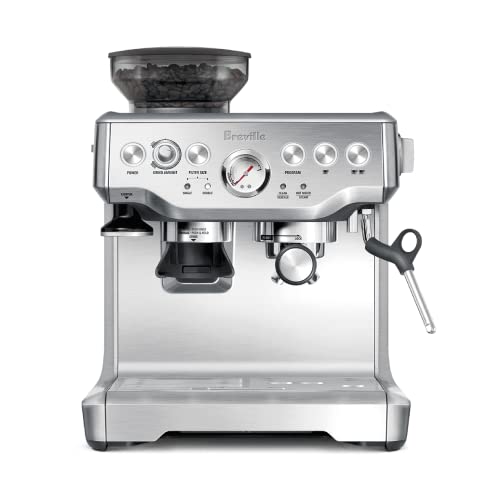 Breville BES870XL Barista Express Espresso MachineLarge13.8 x 12.5 x 15.9 inches22.09 PoundsCheck on Amazon
 Breville BES870BTR Barista Express Espresso Machine213.81 x 12.53 x 15.9 inches22.09 PoundsCheck on Amazon
Best espresso machines for home baristas under $1,000 compared
| Machine | Typical market range | Temperature control | Steam performance | Grinder required? | Approx. footprint | Learning curve |
|---|---|---|---|---|---|---|
| Breville Bambino Plus | $400–$550 | ThermoJet heating, automated dosing options | Fast, assisted automatic steaming | Yes | 7.7 × 12.6 in | Low |
| Gaggia Classic Evo Pro | $450–$650 | Single boiler with manual temperature timing | Strong traditional steam wand, slower recovery | Yes | 8 × 14.2 in | Medium to high |
| Breville Barista Express | $600–$750 | Thermocoil with electronic temperature management | Capable, but less powerful than a dedicated prosumer machine | No, integrated conical burr grinder | 12.5 × 13.8 in | Medium |
| Rancilio Silvia | $800–$1,000 | Single boiler with manual temperature surfing | Powerful steam for the class | Yes | 9.3 × 11.3 in | High |
| Profitec GO | $950–$1,000 | PID-controlled single boiler | Very capable, with a short transition from brewing to steaming | Yes | 8.3 × 14.9 in | Medium |
Breville Bambino Plus: the easiest route to consistent milk drinks
The Bambino Plus is the strongest choice when speed and repeatability matter more than extensive manual adjustment. Its fast-heating system reaches brewing temperature quickly, and the automatic steam wand can stop at a selected milk temperature. That makes it particularly suitable for cappuccinos and flat whites when multiple people want drinks in succession.
Its limitation is that the machine does not solve the grinder problem. Espresso requires fine, repeatable adjustments, so pair it with a proper espresso grinder rather than relying on a basic blade grinder or a general-purpose coffee grinder. The Bambino Plus also gives you less direct control than a traditional machine, which may frustrate users who want to adjust pre-infusion, pressure, or brew temperature manually.
- Choose it if: you want quick warm-up, compact dimensions, and forgiving milk preparation.
- Avoid it if: you want to practice manual steaming or frequently brew many milk drinks back-to-back.
Gaggia Classic Evo Pro: the traditional learning platform
The Gaggia Classic Evo Pro suits someone who wants a conventional espresso workflow: grind, distribute, tamp, start the shot, and steam milk manually. Its 58-mm commercial-style portafilter gives you access to widely available baskets and accessories, while the traditional steam wand provides more control than an automatic system.
Temperature management is the main challenge. The single boiler cannot brew and steam at the same time, and there is no sophisticated temperature display to tell you exactly when the brew water is ready. You learn to use timing, indicator lights, and a consistent warm-up routine. This adds effort, but it also teaches skills that transfer to more advanced machines.
For a double espresso, begin around an 18-g dose and target 36 g of liquid in approximately 25–32 seconds. If the shot reaches 36 g in 18 seconds, make the grind finer. If it takes 45 seconds and tastes harsh or dry, make the grind coarser.
Breville Barista Express: the practical all-in-one compromise
The Barista Express is the most convenient option for buyers who do not want to purchase a separate grinder immediately. Its integrated conical burr grinder, dosing controls, pressure gauge, and steam wand create a complete starter station in one enclosure.
The integrated grinder is useful, but it is also the component most likely to limit future upgrades. A separate grinder generally offers more precise adjustment and avoids moving coffee beans through a machine that may already be crowded on the counter. The Express also has a larger footprint than the Bambino Plus, so measure the available depth, including room to load the hopper and lift the water tank.
Its heating system is convenient for normal home use, but it is not a dual-boiler machine. Brewing and steaming require some sequencing, and the steam wand takes practice to produce silky microfoam. It is a good fit for one or two drinks at a time, not a miniature café workstation.
Rancilio Silvia: best for powerful manual steaming
The Rancilio Silvia is a strong choice for users who care more about steam performance and long-term repairability than beginner convenience. Its commercial-style steam wand can texture milk quickly once you learn the correct positioning, and its metal construction gives it a substantial feel.
The Silvia uses a single boiler and relies on manual temperature management. After steaming, you must refill and cool the boiler before brewing again. That workflow is manageable for occasional drinks, but it becomes noticeable when preparing several lattes. The machine also benefits from a quality grinder, a precise scale, and a willingness to learn temperature surfing.
Choose the Silvia when you already expect to make espresso a regular hobby. For a first machine that must produce easy results immediately, the Bambino Plus is more forgiving.
Profitec GO: the best temperature-control upgrade under the ceiling
The Profitec GO is aimed at the enthusiast who wants a compact single-boiler machine with more direct temperature control. Its PID system lets you set and monitor brew temperature rather than estimating it through boiler timing. The pressure gauge and shot timer also make it easier to connect adjustments with results.
It still cannot brew and steam simultaneously, so it is not a replacement for a dual-boiler machine. However, its controlled brew temperature and strong steam capability make it one of the most technically complete options near the $1,000 limit. Because the machine itself consumes most of the budget, plan carefully for the grinder, tamper, scale, and water treatment.
Decision matrix: which machine fits your setup?
| Your situation | Best match | Why | Main compromise |
|---|---|---|---|
| You mainly make milk drinks before work | Breville Bambino Plus | Fast startup and assisted steaming | Less manual control |
| You want to learn classic espresso technique | Gaggia Classic Evo Pro | Traditional portafilter and manual wand | Temperature timing takes practice |
| You need a grinder and machine in one purchase | Breville Barista Express | Complete integrated setup | Less upgrade flexibility |
| You prioritize strong manual milk steaming | Rancilio Silvia | Powerful wand and robust design | Slow single-boiler workflow |
| You want adjustable temperature without buying a large machine | Profitec GO | PID control and enthusiast-oriented interface | Little budget remains for the grinder |
How much of the $1,000 budget should go to the grinder?
For espresso, the grinder often matters as much as the machine. A useful budget calculation is to reserve approximately 35–45% for the grinder when buying a machine without an integrated one. For a $900 total setup, that means about $315–$405 for grinding and $495–$585 for the machine, before accessories.
A practical example is a $500 machine, a $350 espresso grinder, a $30 scale, a $25 tamper, and $40 for a dosing funnel and cleaning supplies. The total is approximately $945. By contrast, spending the entire amount on a $950 machine and using a poor grinder can produce inconsistent shots because the machine cannot compensate for uneven particle size.
Temperature, steaming, and workflow differences
- For the least waiting: choose the Bambino Plus.
- For the most measurable temperature control: choose the Profitec GO.
- For the strongest traditional steam experience: choose the Silvia or Gaggia Classic Evo Pro.
- For the simplest complete package: choose the Barista Express.
- For several drinks in a row: none of these single-thermoblock or single-boiler machines matches a true dual-boiler workflow; expect to sequence brewing and steaming.
Counter depth matters as much as width. Leave space above machines with tall hoppers, and check whether the water tank can be removed without pulling the machine away from the wall. Also account for grinder width: a compact espresso machine paired with a large grinder can occupy more usable counter space than an all-in-one model.
What to buy
For most new home baristas, the Breville Bambino Plus is the safest choice when paired with a capable espresso grinder. The Gaggia Classic Evo Pro is better for learning traditional technique, while the Barista Express is the most convenient all-in-one option. Choose the Rancilio Silvia for powerful manual steaming and the Profitec GO when PID temperature control is worth allocating more of the budget to the machine.
Frequently asked questions
Do I need a separate grinder with these machines?
Yes, you need a proper espresso grinder with the Bambino Plus, Gaggia Classic Evo Pro, Rancilio Silvia, and Profitec GO. Espresso requires fine, repeatable adjustments, and a basic blade grinder or general-purpose coffee grinder may not provide them. The Barista Express includes an integrated conical burr grinder, but a separate grinder generally offers more precise adjustment and greater upgrade flexibility.
How should I adjust a shot that runs too quickly or slowly?
Adjust the grind finer when a double espresso reaches 36 g in 18 seconds, and adjust it coarser when the shot takes 45 seconds and tastes harsh or dry. The article’s starting point is an 18-g dose and 36 g of liquid in approximately 25–32 seconds. Make one grind change at a time and compare the result.
Can these machines brew espresso and steam milk at the same time?
No, these machines do not provide a true dual-boiler workflow for simultaneous brewing and steaming. The Gaggia Classic Evo Pro, Rancilio Silvia, and Profitec GO use single boilers, while the Barista Express also requires sequencing. Expect to brew and steam in stages, particularly when preparing several lattes or multiple milk drinks in succession.
What accessories are most useful for a separate-machine setup?
A capable espresso grinder, precise scale, tamper, dosing funnel, and cleaning supplies are useful additions to a machine without an integrated grinder. The article gives an example setup that includes a grinder, scale, tamper, dosing funnel, and cleaning supplies. The Profitec GO also benefits from a quality grinder, precise scale, and water treatment.
What should I check before placing an espresso machine on my counter?
Check both the machine’s footprint and the space needed for its water tank, hopper, and grinder. Counter depth matters as much as width, and tall hoppers require clearance above the machine. Also confirm that the water tank can be removed without pulling the machine away from the wall, and measure the complete machine-and-grinder setup rather than the machine alone.


