
Top 3 picks at a glance

Best Belt Drive Garage Door Openers
The best belt drive garage door opener for most homes is a 3/4-horsepower-equivalent model with battery backup, built-in Wi-Fi, rolling-code security, and a rail rated for your door height; the right choice depends more on door weight, noise tolerance, and smart-home requirements than on horsepower alone.
Quick comparison
| Model | Drive and lifting class | Noise profile | Smart-home compatibility | Battery backup | Best suited to |
|---|---|---|---|---|---|
| Chamberlain B6753T | Belt drive, 1-1/4 HP equivalent | Very quiet; DC motor and belt soften vibration | myQ app; selected integrations depend on current compatibility | Yes | Heavy doors, attached garages, integrated lighting |
| Chamberlain B4613T | Belt drive, 3/4 HP equivalent | Quiet | Built-in myQ Wi-Fi | Yes | Typical single or double residential doors |
| LiftMaster 87504-267 | Belt drive, 1-1/4 HP class | Very quiet | myQ; commercial-grade control ecosystem | Yes | Premium installations and heavier doors |
| Genie StealthDrive Connect 7155-TKV | Belt drive, 1-1/4 HP equivalent | Quiet, with some rail vibration depending on mounting | Aladdin Connect; voice-assistant support varies by setup | Yes, when equipped with the compatible battery system | DIY-friendly smart installations |
Specifications can vary by package, retailer bundle, and region, so confirm the included rail, battery, wall console, and keypad before buying. A replacement opener also needs to match the door’s travel height and mounting arrangement.
As an Amazon Associate we earn from qualifying purchases at no extra cost to you.
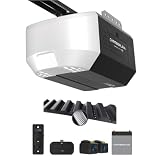


Our top choices by situation
Best overall: Chamberlain B4613T
The B4613T is a strong fit for the average residential garage. Its 3/4-horsepower-equivalent motor is sufficient for most properly balanced sectional doors, while the belt drive avoids the metal-on-metal sound associated with chain drives. Built-in Wi-Fi provides remote monitoring and control through the myQ app, and the battery backup keeps the opener usable during a power outage.
Choose it for a standard seven-foot or eight-foot door, especially when the garage shares a wall with a bedroom or living area. The main limitation is the ecosystem: myQ is excellent for the opener itself, but third-party smart-home control should be checked before purchase rather than assumed.
Best for heavy doors: Chamberlain B6753T
The B6753T adds more lifting capacity and is better suited to heavier insulated doors, oversized doors, and demanding daily use. Its integrated lighting is also useful in garages where the opener’s lamp is the primary illumination. The higher motor class does not mean it can safely lift an unbalanced door; it simply provides more reserve once the door has been correctly adjusted.
This is a sensible upgrade when a standard opener strains, slows near the top of the travel, or operates a wide double door. Have the springs and balance checked first. An opener should not compensate for broken springs, excessive friction, or damaged rollers.
Best premium installation: LiftMaster 87504-267
The LiftMaster 87504-267 targets homeowners who want a robust belt-drive system and are comfortable paying more for a professional-oriented product line. It offers strong lifting capacity, battery backup, myQ connectivity, and a design intended for frequent residential use.
LiftMaster units may be sold through professional dealers and can involve more involved installation or service arrangements than consumer-focused openers. That is an advantage when the garage door itself needs adjustment, but it may be unnecessary for a simple replacement on a well-maintained door.
Best for DIY installers: Genie StealthDrive Connect 7155-TKV
The Genie StealthDrive Connect 7155-TKV is attractive when installation flexibility matters. Genie’s rail and mounting approach can be convenient for homeowners replacing an existing opener, and Aladdin Connect adds remote status and control. It is a quiet, high-capacity choice for many sectional garage doors.
Before ordering, measure the ceiling clearance and verify whether the package includes the battery, wireless keypad, and rail length needed for the door. “DIY-friendly” does not mean risk-free: torsion springs, cables, and bottom brackets remain under dangerous tension and should not be dismantled by an inexperienced installer.
How to choose the correct lifting capacity
Use capacity as a screening criterion, not as a substitute for door maintenance. A balanced garage door should stay near the same position when manually lifted halfway, with only modest resistance. If it drops rapidly or rises on its own, the spring system needs service.
- 1/2 to 3/4 HP equivalent: suitable for most standard single doors and many normal double doors when the door is balanced.
- 3/4 to 1-1/4 HP equivalent: preferable for heavy insulated doors, wide doors, high daily cycles, or garages with more friction.
- Wall-mount jackshaft opener: consider this when ceiling space is limited or overhead storage conflicts with a conventional rail. It requires compatible torsion-spring hardware and is not a direct belt-drive replacement.
As a practical example, suppose a properly balanced door requires about 12 pounds of effective pull at the opener carriage. A 3/4-horsepower-equivalent unit has ample reserve for normal acceleration and friction. If the door develops 25 pounds of resistance because of dry rollers or a misaligned track, buying a 1-1/4-horsepower model may make it move, but it will increase wear and hide the underlying fault. Fix the door first.
Noise: what actually makes one opener quieter
A belt drive usually produces less airborne noise than a chain drive, but the ceiling and door can still vibrate. The largest contributors are often worn rollers, loose hinges, an unbraced opener arm, or a rigid mounting structure that transfers motor vibration into the room above.
For the quietest installation, select a DC belt-drive motor, use the manufacturer’s vibration-isolating brackets, tighten the rail hardware without overtightening it, and replace noisy steel rollers if appropriate. Nylon rollers with sealed bearings can reduce door noise, although they do not fix a bent track or a failing hinge.
Smart-home compatibility and security
Every opener in this class should use rolling-code remote encryption and include a wired or wireless wall control with vacation-lock functionality. Remote access is useful only when the opener reports its actual closed or open state rather than merely sending a command.
Chamberlain and LiftMaster models generally center on myQ. Genie models use Aladdin Connect. These platforms can provide alerts, activity history, guest access, and remote closing, but support for Apple Home, Google Home, Alexa, Matter, or third-party hubs can change. Check the exact model and current hub requirements if voice control or automation is essential.
For security, enable two-factor authentication, use a unique account password, remove old users when a home changes hands, and set an automatic-close rule only after confirming that the door area has reliable safety sensors. Remote closing should never bypass the photo-eye system.
Battery backup: estimate the useful runtime
Battery backup is primarily an outage convenience and an emergency-access feature, not a guarantee of unlimited operation. Runtime depends on battery capacity, motor load, temperature, and how often the door is opened.
Consider a simplified example: a battery provides 24 watt-hours, and one complete open-and-close cycle consumes approximately 4 watt-hours after motor and electronics losses. The theoretical result is:
24 Wh ÷ 4 Wh per cycle = 6 cycles
In real conditions, reserve capacity and cold temperatures may reduce that to roughly four or five useful cycles. If your household needs frequent operation during outages, choose a model with the manufacturer’s specified battery system rather than assuming every belt-drive opener can accept one. Test the backup twice a year by disconnecting mains power and operating the door with the remote.
Installation complexity and fit checks
A conventional ceiling-mounted opener is a moderate DIY project when the existing brackets, header, and electrical outlet are sound. Allow several hours for assembly, rail alignment, wiring, travel-limit setup, Wi-Fi pairing, and safety testing.
- Measure the door: record width, height, headroom, and the distance from the header to the ceiling. A tall door may require an extension rail.
- Inspect the hardware: check springs, cables, rollers, hinges, and tracks. Do not proceed if cables are frayed or springs are damaged.
- Confirm the mounting point: the opener header bracket must attach to structural framing, not just drywall.
- Install and align the rail: a twisted or sloping rail can cause binding, noise, and inaccurate travel limits.
- Set force and travel: use the manufacturer’s automatic setup where available, then verify that the door stops at the correct positions without straining.
- Test safety systems: place a solid object such as a short piece of lumber under the closing door to confirm reversal, and interrupt the photo-eye beam to confirm that closing is prevented.
Hire a garage-door technician if the replacement requires spring work, the door is unusually heavy, the ceiling framing is unclear, or the existing door does not remain balanced manually. The opener installation is usually safer and easier after the door has passed that inspection.
Decision guide
- Quiet attached garage: choose a DC belt drive with vibration-isolating mounts; prioritize roller and track condition as much as motor type.
- Heavy insulated double door: choose the 1-1/4-horsepower-equivalent class, then verify spring balance and rail compatibility.
- Power outages are common: require a documented battery-backup option and test the battery on a schedule.
- Remote control is the priority: choose the ecosystem that works with your existing accounts and automation platform, not simply the opener with the most advertised features.
- Simple replacement on a standard door: a 3/4-horsepower-equivalent belt-drive opener is normally the best value.
- Limited ceiling space: compare a wall-mount jackshaft opener instead of forcing a conventional rail into an unsuitable layout.
For most buyers, the best belt drive garage door openers are a properly matched 3/4-horsepower-equivalent model with Wi-Fi and battery backup. Move to a 1-1/4-horsepower-equivalent unit for genuinely heavy or frequently used doors, and treat door balance, safety reversal, and structural mounting as non-negotiable parts of the purchase.
Frequently asked questions
Can a belt-drive opener lift a door with broken springs?
No. An opener should not compensate for broken springs, excessive friction, damaged rollers, or an unbalanced door. A properly balanced door should remain near the same position when manually lifted halfway, with only modest resistance. If it drops rapidly or rises on its own, have the spring system serviced before selecting or installing an opener.
What should I verify before ordering a replacement opener?
Verify the door’s width, height, headroom, and the distance from the header to the ceiling. Also confirm the included rail, battery, wall console, keypad, and any required extension rail. The opener must match the door’s travel height and mounting arrangement, and compatibility can vary by package, retailer bundle, and region.
Is a higher-capacity opener always the better choice?
No. Capacity is a screening criterion, not a substitute for door maintenance. A 3/4-horsepower-equivalent unit is sufficient for most properly balanced sectional doors, while 3/4 to 1-1/4 horsepower equivalent is preferable for heavier insulated doors, wide doors, high daily cycles, or greater friction. Fix door problems before upgrading capacity.
How many times might the opener work during a power outage?
A simplified example gives about six complete cycles when a 24-watt-hour battery uses approximately 4 watt-hours per cycle. In real conditions, reserve capacity and cold temperatures may reduce that to roughly four or five useful cycles. Runtime also depends on battery capacity, motor load, temperature, and how often the door is opened.
What makes a DIY installation unsafe?
Torsion springs, cables, and bottom brackets remain under dangerous tension and should not be dismantled by an inexperienced installer. Do not proceed if cables are frayed or springs are damaged. A safer DIY project assumes the existing brackets, header, and electrical outlet are sound, followed by correct rail alignment, travel-limit setup, and safety testing.


