
The best insulin cooler travel cases are the 4AllFamily Voyager for longer trips with rechargeable active cooling, the FRIO Duo for lightweight water-activated protection, and an insulated case with replaceable cold packs for travelers who already have reliable freezer access.
The right choice depends less on the brand name than on four practical questions: how long the insulin must stay protected, whether temperatures may fall below freezing, what power is available, and how much insulin and equipment you need to carry. Insulin should be stored according to its manufacturer’s instructions; many unopened products require refrigeration at 2–8°C (36–46°F), while opened products may have different room-temperature limits.
As an Amazon Associate we earn from qualifying purchases at no extra cost to you.


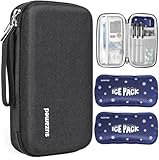

Top 3 picks at a glance
Best insulin cooler travel cases at a glance
| Travel situation | Best case type | Typical protection duration | Main advantage | Main limitation |
|---|---|---|---|---|
| Day trip or airport transfer | Insulated case with a correctly prepared cold pack | Approximately 8–24 hours | Simple and inexpensive | Cold packs can freeze insulin or warm quickly |
| Several days without dependable refrigeration | FRIO Duo or similar evaporative case | Usually 45–72 hours per activation, depending on humidity and airflow | No electricity or freezer required | It cools by evaporation and may not maintain refrigerator temperature |
| Long road trip, cruise, or remote travel | Rechargeable active cooler such as 4AllFamily Voyager | Often multiple days per charge or with power connected | Controlled cooling with a display or temperature monitoring | Higher price, battery dependence, and more security screening questions |
| Large supply, pens, vials, and accessories | Large active or modular insulated case | Depends on the cooling system | More organized capacity | Bulkier and less convenient to carry |
1. Best for long trips: an active refrigerated insulin case
An active case uses a powered cooling system, commonly a thermoelectric module, to remove heat. The 4AllFamily Voyager is an example of this category. These cases are the strongest option when you need several days of temperature control and cannot trust hotel refrigerators, vehicle interiors, or airport facilities.
What to look for
- A settable temperature or a clear operating range.
- An internal temperature display, preferably with a high- or low-temperature alarm.
- Protection against both overheating and freezing.
- USB-C, vehicle, and wall-power compatibility, or adapters for the countries you will visit.
- A battery that can be replaced, recharged during use, or supplemented with a certified power bank.
- Enough internal length for your actual pen or vial packaging, not just the advertised capacity.
Active coolers are not automatically safer. A badly calibrated device or an empty case exposed to direct sun can still develop hot or cold spots. Place insulin in the manufacturer’s intended compartment, keep the sensor unobstructed, and check the temperature before leaving home.
Worked battery calculation
Suppose an active cooler draws 8 watts while operating and its compressor or thermoelectric system runs 40% of the time in moderate conditions. Its average demand is approximately 3.2 watts. A 20,000 mAh power bank rated at 3.7 volts contains about 74 watt-hours before conversion losses. Allowing 20% for conversion and charging losses leaves roughly 59 watt-hours:
59 Wh ÷ 3.2 W = about 18 hours of theoretical runtime.
In hot weather, the duty cycle may rise to 70%, reducing estimated runtime to roughly 10 hours. This is why a claimed battery duration should be treated as a best-case figure. For a 48-hour journey, plan for vehicle or wall power, a second compatible battery, or a backup cooling method rather than relying on one power bank.
2. Best lightweight option: FRIO-style evaporative cooling
The FRIO Duo and similar evaporative insulin wallets use a water-activated inner pouch. The pouch absorbs water, and evaporation lowers the temperature inside the wallet. This makes the system attractive for air travel, walking tours, festivals, and destinations where a freezer is unavailable.
Its main strength is independence from electricity. Its main weakness is that performance depends on humidity, airflow, shade, and the temperature of the surrounding air. In dry, breezy conditions it can work effectively; in hot, humid conditions evaporation is slower. It should not be treated as a precision refrigerator unless the manufacturer specifically states that it maintains the required range.
Evaporative cases are also useful for preventing heat exposure, but they do not solve every temperature problem. Keep the wallet out of a parked car, direct sun, and enclosed luggage. Do not seal a damp evaporative pouch in an airtight plastic bag, because that reduces evaporation. Carry spare insulin separately in a protected backup container.
3. Best for short journeys: insulated case and cold packs
A conventional insulated case is often the most practical choice for a commute, day trip, or airport connection. It is inexpensive, light, and does not require charging. The risk is temperature control: a frozen gel pack can freeze insulin through direct contact, while a small pack may warm before the journey ends.
How to use cold packs more safely
- Use a pack that is chilled rather than rock-solid frozen when the instructions allow it.
- Wrap the pack in a cloth or place it in the case’s separate sleeve.
- Keep insulin from touching the pack directly.
- Use a thermometer or temperature indicator for unfamiliar routes.
- Do not put insulin in checked luggage, where temperatures and delays are harder to control.
Insulin that has frozen, even briefly, may be unusable. Do not judge it only by appearance. If it may have frozen or overheated, follow the medicine’s instructions and ask a pharmacist or diabetes-care professional before using it.
Decision matrix: match the cooler to your trip
| Your constraint | Recommended choice | Why | What to verify |
|---|---|---|---|
| No freezer, 1–3 days, moderate climate | Evaporative FRIO-style wallet | No battery or frozen pack required | Expected temperature range and humidity limitations |
| Several days, hot climate, access to USB or wall power | Active rechargeable cooler | Better control under sustained heat | Runtime at 35°C (95°F), alarm behavior, and charging method |
| Less than 12 hours, freezer available at departure | Insulated case with separated cold pack | Small, cheap, and adequate for a short transfer | Pack temperature and insulation thickness |
| Carry multiple pens, vials, needles, and glucose supplies | Large modular or active case | Prevents crushing and improves organization | Internal dimensions, not external marketing capacity |
| Frequent airport transfers and security checks | Compact case with visible thermometer | Easier to inspect and explain | Medication documentation and power-bank rules |
TSA and airport practicality
Insulin, syringes, pen needles, glucose meters, and medically necessary cooling supplies are generally permitted through U.S. airport security, but procedures can vary. Keep medication in carry-on baggage, ideally in original labeled packaging. Inform the officer that you are carrying medically necessary liquid medication and diabetes supplies before screening begins.
Cooling packs may be allowed even when solid or partially frozen if they are medically necessary, but screening staff may inspect them. An active cooler can attract extra questions because of batteries, cables, or electronics. Keep its temperature instructions, prescription information, and a short doctor’s letter available, especially for international travel.
Do not put a power bank in checked luggage. Confirm the airline’s current rules for lithium batteries, and carry the cooler’s battery and charging cables where they can be removed for inspection.
Protection from heat and freezing
Heat protection is only half the requirement. The safest case has an insulated outer shell, a cooling method that does not contact insulin directly, and a way to detect temperatures outside the intended range.
- Against heat: use shade, insulation, airflow around evaporative pouches, and active cooling when the ambient temperature is high.
- Against freezing: separate insulin from ice packs, avoid freezer compartments, and do not place insulin against the cold wall of a mini-fridge.
- Against impact: choose a rigid or semi-rigid shell if carrying glass vials, and use pen sleeves to prevent movement.
- Against moisture: keep labels, needles, and electronics in a dry compartment; evaporative systems should not soak the medication packaging.
Capacity and organization matter more than advertised volume
Count the supplies for the entire trip, then add an emergency reserve if your clinician recommends one. Measure the length and diameter of the insulin pen or vial, including its cap and protective packaging. A case advertised for “six pens” may hold six bare pens but not six pens in protective sleeves with spare needles.
Keep insulin, backup insulin, prescriptions, glucose-testing equipment, and fast-acting carbohydrates organized in separate sections. This reduces the chance of leaving medication behind during a security check or hotel transfer.
Frequently asked questions
Can I put my insulin in checked luggage when flying?
No. The article states you should not put insulin in checked luggage, where temperatures and delays are harder to control. Keep medication in carry-on baggage, ideally in its original labeled packaging, and inform the security officer that you are carrying medically necessary liquid medication and diabetes supplies before screening begins.
Is insulin that has frozen still safe to use?
Not necessarily. Insulin that has frozen, even briefly, may be unusable, and you should not judge it only by appearance. If it may have frozen or overheated, follow the medicine’s instructions and ask a pharmacist or diabetes-care professional before using it. This is why the article stresses separating insulin from direct contact with ice packs.
How long does a FRIO-style evaporative case keep insulin cool?
Typically 45–72 hours per activation, depending on humidity and airflow. The pouch absorbs water and evaporation lowers the internal temperature, so performance varies: it works effectively in dry, breezy conditions but evaporation slows in hot, humid weather. It should not be treated as a precision refrigerator unless the manufacturer states it maintains the required range.
Do active insulin coolers keep working during a 48-hour journey on one power bank?
Not reliably. The article’s worked example shows a 20,000 mAh bank gives roughly 18 hours theoretically, dropping to about 10 hours in hot weather when the duty cycle rises. For a 48-hour trip, plan for vehicle or wall power, a second compatible battery, or a backup cooling method rather than relying on one power bank.
What temperature does unopened insulin usually need?
Many unopened insulin products require refrigeration at 2–8°C (36–46°F), while opened products may have different room-temperature limits. You should always store insulin according to its manufacturer’s instructions. Whatever cooler you choose should keep insulin within that intended range and include a way to detect temperatures outside it, through a display, alarm, or thermometer.
Bottom line
Choose the 4AllFamily Voyager or another well-specified active cooler when you need controlled cooling for multiple days and can plan reliable power. Choose the FRIO Duo when low weight, no electricity, and simple airport handling matter more than refrigerator-level precision. Choose an insulated cold-pack case for short trips, but prevent direct contact and freezing.
Before buying, confirm the case’s real operating temperature, duration at the ambient temperature you expect, battery runtime, internal dimensions, and protection against both heat and freezing. The best insulin cooler travel cases are the ones that match those details to your route rather than simply offering the largest battery or the most compartments.


