
The best multi tier steamer pot set for most kitchens is a 20–24 cm stainless-steel set with two stackable steaming baskets, a 5–8 litre base pot, a tight lid, and induction compatibility; choose a wider 26–30 cm three-tier set only when you regularly cook for five or more people.
As an Amazon Associate we earn from qualifying purchases at no extra cost to you.


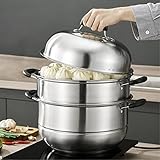
Top 3 picks at a glance
Best multi tier steamer pot set: the short comparison
Multi-tier steamers are most useful when you want to cook several foods at once without mixing them in one basket. The right choice depends less on the number of tiers printed on the box and more on usable diameter, vertical clearance, base-pot volume, and whether the stack remains stable when fully loaded.
| Set type | Typical capacity | Usable diameter | Best for | Main compromise |
|---|---|---|---|---|
| Compact two-tier | 3–5 L base, 2 baskets | 18–20 cm | One or two people, vegetables, dumplings | Small batches and limited height |
| Standard two-tier | 5–8 L base, 2 baskets | 20–24 cm | Everyday family cooking | May not fit very large plates |
| Large three-tier | 8–12 L base, 3 baskets | 26–30 cm | Meal preparation for four to eight people | Needs more storage and a powerful burner |
| Commercial-style tall steamer | 12–24 L base, 3–4 baskets | 30–36 cm | Large batches, catering, frequent steaming | Heavy, tall, and awkward for small cooktops |
What to compare before buying
Tier capacity and usable cooking area
Nominal capacity describes the base pot, not the amount of food each basket can hold. A 10-litre pot with narrow baskets may cook less food per layer than a 7-litre pot with a broad, shallow design.
Measure the interior diameter of each basket and allow space around individual pieces for steam circulation. For example, a 22 cm basket has approximately 380 cm² of circular cooking area, calculated as π × 11². A 28 cm basket has about 616 cm²—roughly 62% more area, not merely 27% more diameter. That difference matters when steaming buns, fish fillets, corn, or several bowls.
Two tiers are usually more practical than three. A two-tier set is easier to load, more stable, and less likely to run dry before the food is finished. Three tiers become worthwhile when you are cooking separate foods with similar cooking times, such as rice in the base, vegetables in the middle, and dumplings on top.
Stainless steel versus aluminium and non-stick surfaces
- Stainless steel: the safest all-purpose choice for durability, dishwasher tolerance, and resistance to scratching. Look for thick rims, reinforced handles, and a fully encapsulated base on the pot.
- Aluminium: heats quickly and keeps the set light, but it can discolor and may be less suitable for acidic foods if the cooking surface is exposed.
- Hard-anodized aluminium: lighter than thick stainless steel and more resistant to wear, although the coating still needs gentler handling than bare steel.
- Non-stick interiors: convenient for the base pot, but unnecessary on steaming baskets and more vulnerable to metal utensils, abrasive cleaners, and high heat.
- Glass lids: let you monitor the water and food without lifting the lid. Stainless lids are tougher and usually retain heat slightly better.
For a set intended to last many years, stainless-steel baskets with a thick, flat-bottomed base are generally the least demanding option.
Diameter and stovetop compatibility
Check the diameter of the cooking zone rather than only the external width of the pot. On induction, a large base may not heat evenly if the magnetic disc is much smaller than the base. A useful rule is to keep the pot base within roughly 2–3 cm of the induction zone diameter when possible.
| Cooktop | What the set needs | Common issue |
|---|---|---|
| Induction | Magnetic stainless-steel base, flat contact surface | Some aluminium sets will not heat unless they have a bonded magnetic disc |
| Gas | Stable base and handles that stay clear of the flame | Oversized pots can heat unevenly or extend beyond the grate |
| Electric coil | Flat base with a diameter close to the coil | Warped or undersized bases take longer to boil |
| Radiant ceramic | Smooth, flat base and careful lifting rather than sliding | Large, heavy sets can scratch the surface if dragged |
Before choosing a 28–30 cm three-tier steamer, measure the distance between neighbouring burners. A wide pot can block controls or prevent another pan from being used safely.
Stack stability and steam control
Stack stability is a more important safety feature than an extra tier. Each basket should sit inside a distinct ledge or rim, rather than balancing on a narrow rolled edge. Handles should align securely and should not force the upper tiers to rotate under load.
Look for baskets that nest without excessive side-to-side movement. A practical check is to assemble the empty set, hold the base handles, and gently move it a few centimetres. If the upper tiers visibly sway, expect more movement once condensation and food weight are added.
The lid should overlap the top basket. A loose lid allows steam to escape, increasing cooking time and water consumption. Steam holes in the baskets should be numerous enough to distribute heat, but not so large that small vegetables, peas, or dumplings fall through.
How much power does a large steamer need?
Steaming performance depends on bringing the water to a boil quickly and then maintaining a steady supply of vapour. A rough energy calculation explains why very large sets can struggle on low-powered burners.
Heating 2 litres of water from 20°C to 100°C requires approximately 670 kilojoules: 2 kg × 4.18 kJ/kg°C × 80°C. At a 2,000-watt burner, assuming about 70% of the energy reaches the pot, the theoretical heating time is about 8 minutes. Real kitchens often take longer because of heat loss, a cold metal pot, lid leakage, and simmering below full power.
For a 10–12 litre, three-tier set, use a burner rated around 1,800–2,500 watts where available. Do not fill the base so high that boiling water can reach the lowest basket. If the water level falls rapidly, reduce heat after boiling and add hot water carefully; never leave a large steamer unattended.
Decision matrix: which set fits your kitchen?
| Your situation | Recommended specification | Why |
|---|---|---|
| Cooking for one or two | 18–20 cm, 3–5 L, two tiers | Uses less water, heats faster, and stores more easily |
| Family of three or four | 20–24 cm, 5–8 L, two tiers | Balances capacity, stability, and everyday storage |
| Frequent dumpling or bun batches | 26–30 cm, three tiers, reinforced rims | Provides more surface area per layer and reduces batch count |
| Induction cooktop | Magnetic stainless base, flat bottom, confirmed zone size | Prevents slow or incomplete heating |
| Limited cupboard space | Nesting baskets, removable handles, one lid that fits all tiers | Reduces the storage footprint |
| Dishwasher household | All-stainless construction or clearly labelled dishwasher-safe parts | Avoids coating damage and hand-washing every basket |
Dishwasher safety and cleaning
Many stainless-steel baskets are dishwasher safe, but the base pot may have a bonded aluminium or copper core that manufacturers recommend washing by hand. Read the care label for the complete set rather than assuming that one dishwasher-safe component makes every part safe.
Hard water can leave white mineral deposits inside the pot. Soak the cooled pot with warm water and a small amount of citric acid or white vinegar, then rinse thoroughly. Avoid chlorine bleach, steel wool, and abrasive powders. Dry baskets fully before stacking them to prevent trapped moisture and stale odours.
Storage requirements people often overlook
Measure the assembled height as well as the diameter. A three-tier set can exceed 45 cm when stacked, which may be too tall for a standard cupboard. The most convenient designs nest the baskets inside the base pot and place the lid upside down on top.
Allow clearance for handles. Fixed side handles can make a 24 cm pot require more than 30 cm of shelf width. Removable or folding handles save space, but they should lock firmly and remain cool enough to handle. If the set cannot nest, plan for a deep lower cupboard rather than a crowded overhead shelf.
Frequently asked questions
Can I cook foods with different cooking times in the same steamer?
Yes, but multi-tier steamers work best when the foods have similar cooking times. The article gives rice in the base, vegetables in the middle, and dumplings on top as an example. If cooking times differ, you may need to remove a tier or food earlier; lifting the lid also lets steam escape and can increase cooking time.
How much water should I put in the base pot?
Add enough water to produce steam, but do not fill the base so high that boiling water can reach the lowest basket. The article does not give a precise fill level because it depends on the pot and food. If the water falls rapidly, reduce the heat after boiling and add hot water carefully.
Can small foods fall through the basket holes?
They can if the steam holes are too large. The article recommends checking that the holes distribute heat without letting small vegetables, peas, or dumplings fall through. Basket diameter and the space around food also matter, because steam needs room to circulate.
Is a glass lid or stainless-steel lid the better choice?
A glass lid is useful if you want to monitor the water and food without lifting the lid. A stainless-steel lid is tougher and usually retains heat slightly better. Either way, the lid should overlap the top basket; a loose fit lets steam escape and can increase cooking time and water consumption.
Can I use steamer baskets from one set with another pot?
The article does not establish that baskets are interchangeable, so do not assume they will fit. For stable stacking, baskets should sit on a distinct ledge or rim, and the lid should overlap the top basket. Check the fit and stability of the complete assembled set before cooking.
Bottom line
Choose a 20–24 cm stainless-steel two-tier steamer with a 5–8 litre base for the best balance of capacity, stability, stovetop compatibility, cleaning, and storage. Move up to a 26–30 cm three-tier model when large batch cooking is the priority, and verify the induction base, burner size, assembled height, and dishwasher instructions before buying. The widest set is not automatically the best: usable basket area, secure stacking, and manageable storage determine whether the steamer remains convenient after the first few uses.


