
The best soccer rebounders for solo practice are adjustable, tightly tensioned models with a stable frame: choose a small, firm rebounder for quick passing, a larger angled net for shooting, and a wide low-return design for goalkeeper drills.
As an Amazon Associate we earn from qualifying purchases at no extra cost to you.


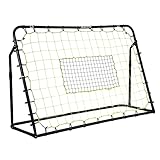
Top 3 picks at a glance
Best soccer rebounders at a glance
| Rebounder type | Typical size | Useful rebound angle | Best for | Portability |
|---|---|---|---|---|
| Compact passing trainer | 3 x 5 to 4 x 6 ft | Nearly flat to 15° upward | First touch, one-touch passing, weak-foot work | Excellent; often under 15 lb |
| Adjustable multi-angle net | 5 x 7 to 7 x 9 ft | 0° to approximately 45° | Passing, volleys, receiving, shooting | Good; typically 15–30 lb |
| Large shooting rebounder | 7 x 7 to 12 x 8 ft | Flat to moderately angled | Power shooting, crosses, aerial balls | Fair; needs more ground space |
| Low goalkeeper rebounder | 6 x 4 to 8 x 5 ft | Low forward return or variable angle | Reaction saves, parries, diving technique | Fair to good, depending on frame |
Best overall: an adjustable multi-angle rebounder
For most players, the best soccer rebounders are in the adjustable 5 x 7 to 7 x 9-foot class. They provide enough surface area for firm passes and driven shots without taking over a small yard. A multi-angle frame also gives you more training variety than a fixed flat net.
Models such as the SKLZ Quickster Soccer Trainer are aimed at this all-purpose role. The important feature is not the brand name but the combination of a flexible training surface, several angle settings, and a frame that can be anchored securely. Look for a setup that lets you change the return from a low, controlled pass to a higher ball for volleys and first-touch practice.
Why angle matters
- 0° to 10°: Produces a relatively predictable return for two-touch passing and receiving across the ground.
- 10° to 25°: Encourages the ball to rise slightly, useful for receiving with the thigh, chest, or instep.
- 25° to 45°: Creates higher, less predictable returns for volleys, clearances, headers, and reaction work.
- Steep downward-facing settings: Can return the ball sharply toward the ground, making them useful for goalkeeper footwork and low saves but less suitable for beginners.
A rebounder with only one angle can still be effective, but you will need to change your distance and passing speed to vary the drill. Adjustable angles change the ball’s flight more efficiently.
Best for passing and first touch
Choose a compact rebounder with a firm net, a narrow frame, and a relatively flat return. A 3 x 5-foot or 4 x 6-foot surface is large enough for accurate passes while still punishing poor technique. The smaller target also helps you practice placing the ball toward a specific foot rather than simply stopping whatever comes back.
For passing drills, excessive net bounce is a disadvantage. A very elastic net can return the ball too quickly and too high, turning a controlled passing exercise into a reaction drill. Look for medium-to-high tension rather than maximum springiness.
Passing setup that scales with skill
- Place the rebounder 8–10 feet away and set it nearly flat.
- Pass at roughly 50% power using the inside of the foot.
- Receive with the foot farthest from the rebounder and take the first touch 1–2 feet sideways.
- Complete 20 right-foot passes and 20 left-foot passes before increasing distance.
- Move back to 15–20 feet only when the ball returns to a comfortable height and direction at least 16 times out of 20.
The distance is a practical control: doubling your distance roughly doubles the time available before the ball returns, but a harder pass adds speed and reduces that advantage. Increase one variable at a time so you know whether the challenge came from distance, power, or angle.
Best for shooting and volleys
Shooting requires a larger, stronger rebounder than passing. A 7 x 7-foot or larger net gives you a useful target for driven shots, while a reinforced perimeter and ground anchors help prevent the frame from folding or sliding.
Large designs such as the Bownet Big Mouth series are built around broad training surfaces and portable frames. They are more suitable for repeated shots than a lightweight mini rebounder, but they still need correct anchoring. Place sandbags, ground stakes, or weighted bases over the frame’s rear supports when shooting at full power.
Net tension for shooting
High tension generally produces a faster, more energetic return. That is useful when you want the rebounder to feed another shot quickly, but it also increases the load on the frame. A loose net absorbs more energy and gives a slower return, which is safer for younger players and better for basic control.
For a shooting session, begin 12–15 feet away and use 60–70% power. If the frame moves after three consecutive shots, do not simply move closer or reduce accuracy: add anchoring or choose a heavier frame. Stability is part of the rebounder’s performance because a shifting target changes the rebound angle from shot to shot.
Best for goalkeeper drills
Goalkeepers should prioritize width, low returns, and angle control. A 6 x 4-foot or 8 x 5-foot rebounder is usually more useful than a tall narrow passing trainer because it can send the ball across the keeper’s body and toward either corner.
Set the rebounder 10–16 feet away and use three types of returns:
- Low and central: Practice setting the feet, getting the body behind the ball, and securing rebounds.
- Low and angled: Aim slightly off-center to create left- and right-sided reaction saves.
- Chest- or head-height: Raise the rebound angle for catches, punches, and controlled parries.
A goalkeeper-specific rebounder should not be so lively that every ball becomes an unpredictable ricochet. For technique work, repeatable returns are more valuable than maximum speed. Add a partner or a second ball only after the basic movement pattern is consistent.
Frame stability, portability, and setup
Frame stability depends on more than total weight. Wide feet, deep rear supports, rigid joints, and effective anchoring all matter. A lightweight rebounder can be stable for passing but unsafe for powerful shooting. Conversely, a heavy commercial frame may be excellent outdoors but inconvenient if you must carry it through a house or store it in a car.
| Use case | Minimum practical features | Preferred frame choice | Anchoring recommendation |
|---|---|---|---|
| Indoor or light passing | Compact footprint, padded edges, medium-tension net | Foldable tubular frame | Non-slip feet or floor-safe weights |
| Outdoor daily practice | Weather-resistant net, reinforced corners, replaceable parts | Wide steel or reinforced composite frame | At least two stakes or rear weights |
| Power shooting | Deep base, tight joints, large target, strong net attachments | Heavy-duty frame with multiple support points | Anchor every available point; add sandbags on hard ground |
| Frequent transport | Carry bag, tool-free assembly, compact folded length | Quick-fold frame, even if slightly less rigid | Use portable weights rather than permanent stakes |
How to choose the right size
Use the smallest net that comfortably supports your main drill. A 3 x 5-foot rebounder improves accuracy because misses are obvious, but it can frustrate beginners and is limited for shooting. A 5 x 7-foot model is the best compromise for one player who wants to pass, receive, shoot, and work on volleys. A 7 x 7-foot or larger model makes sense when power shooting, goalkeeper work, or aerial service is the priority.
Also measure the clearance behind the rebounder. An angled net may project the ball several yards forward, while a high-energy return can travel sideways after a deflection. Leave a safety zone free of windows, vehicles, pets, and other players.
Buying decision matrix
| Your situation | Recommended class | What to prioritize | What to avoid |
|---|---|---|---|
| Apartment or small yard | Compact 3 x 5 to 4 x 6 ft | Quiet medium-tension net and quick folding | Oversized high-tension shooting net |
| One rebounder for every skill | Adjustable 5 x 7 to 7 x 9 ft | Multiple angles and replaceable net | Fixed-angle trainer with no anchoring points |
| Striker practicing alone | 7 x 7 ft or larger | Rigid frame, deep base, strong net attachment | Lightweight frame intended only for passing |
| Goalkeeper training | Wide low-return 6 x 4 to 8 x 5 ft | Low angles, broad target, predictable response | Very small net with extreme rebound speed |
| Frequent travel | Foldable portable model | Carry case, fast setup, manageable packed size | Permanent commercial frame |
Frequently asked questions
How should I anchor a soccer rebounder?
Anchor the rebounder according to its intended use and the surface beneath it. Passing may need non-slip feet or floor-safe weights, while outdoor practice should use at least two stakes or rear weights. For powerful shooting, anchor every available point and add sandbags on hard ground. If the frame moves after shots, improve the anchoring rather than accepting inconsistent returns.
What should I do if the rebounder returns the ball too quickly?
Reduce the rebounder’s tension or choose a less lively setup if the return is too fast. A very elastic net can turn controlled passing into a reaction drill, while a loose net absorbs more energy and returns the ball more slowly. For technique work, repeatable returns are more valuable than maximum speed, especially for younger players and goalkeepers.
How much space should I leave around a rebounder?
Leave a clear safety zone around the rebounder, including space behind it and to the sides. An angled net may project the ball several yards forward, and a high-energy return can travel sideways after a deflection. Keep windows, vehicles, pets, and other players outside this zone. Measure the available clearance before choosing a larger or angled model.
Can one rebounder support both passing and shooting practice?
Yes, an adjustable model in the 5 x 7 to 7 x 9-foot class can support passing, receiving, volleys, and shooting. Use a nearly flat angle and controlled power for passing, then raise the angle or increase power for higher returns and shots. For repeated full-power shooting, prioritize a rigid frame, strong net attachments, and effective anchoring.
How can I make rebounder practice harder without changing equipment?
Increase only one training variable at a time: distance, passing power, or rebound angle. Start with the rebounder 8–10 feet away and use roughly 50% power, then move to 15–20 feet when the returns are consistently manageable. You can also raise the angle to create higher returns for thigh, chest, instep, volley, or reaction work.
Final recommendation
For the widest range of solo sessions, buy an adjustable 5 x 7 to 7 x 9-foot rebounder with medium-to-high net tension, a stable base, and at least three useful angle positions. Choose a compact 3 x 5-foot trainer if passing accuracy is your main goal, or a large 7 x 7-foot-plus heavy-duty model if shooting and goalkeeper drills matter most. The best soccer rebounders are not necessarily the largest or springiest; they are the ones whose size, return angle, and frame stability match the ball speed and technique you intend to practice.


