The Short Answer
Yes, a teleprompter is worth it for most YouTube creators who script their videos — with one condition: you have to be willing to practice with it for a few sessions first. A teleprompter lets you read your script while looking directly into the camera lens, which means natural, confident eye contact with your audience and dramatically fewer retakes. If you improvise, use bullet points, or publish vlog-style content, skip it — a prompter will only slow you down.
The good news is that the price barrier has essentially collapsed. A capable entry-level unit like the LENSGO TCQI 10P — a 10-inch prompter with a magnetic phone mount, mini tripod, and iOS/Android app support — now costs around $78. Step up to the LENSGO TC12P with its 14.5-inch HD wide-angle beam splitter glass and Bluetooth remote, and you’re still under $100. Five years ago, comparable hardware ran $300 to $600.
As an Amazon Associate we earn from qualifying purchases at no extra cost to you. Product prices and availability are accurate as of the date shown and are subject to change.

What You Actually Get
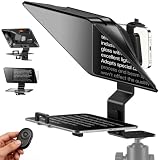
A teleprompter is a simple optical device: a piece of angled beam splitter glass sits in front of your camera lens, and a display (your smartphone or tablet) lying flat inside the housing reflects the script onto that glass. You read the scrolling text while the camera shoots straight through the glass, so on video it looks like you’re gazing straight into the lens.
For $78 to $98, a typical modern package includes:
- Beam splitter glass — the TCQI 10P uses a 10-inch panel; the TC12P steps up to a 14.5-inch HD wide-angle pane, which gives your camera more breathing room and works better with wider focal lengths.
- A foldable housing — most units collapse into a case roughly 11 to 16 inches across and weigh 1.5 to 3 pounds, small enough for a backpack.
- Phone or tablet mount — magnetic or bracket-style cradles that hold your display device inside the hood.
- A companion app — free iOS/Android apps control scroll speed, font size, mirror mode, and text color.
- A Bluetooth remote — on the TC12P, this lets you start, pause, and adjust speed from up to about 30 feet away, so you don’t touch the setup mid-take.
- A mini tripod or mount threads — standard 1/4-inch threads attach the prompter to any tripod, and most housings include a slot so your camera shoots through the glass behind it.
Setup takes about five minutes once you’ve done it twice: mount the prompter, insert your phone face-up, flip the app into mirror mode, load your script, and adjust scroll speed to your speaking pace — most creators land between 100 and 150 words per minute.
Pros
- Fewer retakes. Reading a script through a prompter typically cuts filming time by 30 to 50 percent compared to memorizing lines or reading from notes off-camera.
- Consistent eye contact. Your audience sees you looking at them, not glancing sideways at notes — this measurably improves perceived trust and retention.
- Tighter scripts. Writing for the prompter forces you to edit; rambling tangents disappear when you have to type them out first.
- Low cost of entry. At $78 to $98, the hardware costs less than a decent microphone.
- Portable. Units like the TCQI 10P weigh under two pounds and fold flat, so they travel to shoots easily.
- Dual use. The same prompter works for Zoom calls, TikTok talking-head clips, live streams, and corporate presentations — the app does the heavy lifting either way.
- No subscription required. The controlling app runs on a phone you already own; there’s nothing else to buy.
Cons
- A learning curve is real. Your first two or three sessions will feel robotic. Expect stilted delivery until you calibrate scroll speed and practice glancing rather than reading.
- Light loss and reflections. Beam splitter glass eats roughly one stop of light, and uncontrolled windows or lamps can reflect in the glass. You may need to tweak lighting or add a matte hood in bright rooms.
- Phone capture conflicts. If your prompter display device is also your recording camera, you’ll need a second phone — budget $0 if you have an old one lying around, or borrow one.
- Script quality shows. A prompter amplifies bad writing. Wooden, over-formal scripts sound worse read aloud than improvised speech.
- Small glass limits wide shots. A 10-inch pane constrains framing; if your camera sits far back for a wide, energetic setup, the visible edge of the glass can creep into frame — a reason to prefer the 14.5-inch TC12P for wider rigs.
- Not for run-and-gun. Walking vlogs, unboxing, or fast-paced B-roll scenes don’t benefit from a fixed reading device.
Who Should Buy It
You’re a strong candidate if:
- You publish scripted talking-head videos — tech reviews, tutorials, explainers, commentary, finance, education, or news-style content.
- You shoot at a desk or in a fixed studio setup at least weekly.
- You currently waste time on retakes because you lose your place or fumble phrasing.
- You’re a solo creator who can’t afford a director feeding you lines.
- You also do regular Zoom webinars, virtual trainings, or livestreamed presentations and want a polished delivery there too.
Who Should Skip It
Hold off if:
- You improvise naturally and your delivery is already conversational — the prompter adds friction without benefit.
- Your content is visual-first: vlogs, travel, cooking demos where you’re looking at the food, gym form checks, or anything with heavy movement.
- You shoot fewer than a couple of videos per month; the practice investment won’t pay back quickly.
- You refuse to write full scripts. Bullet points through a prompter produce awkward pauses that read worse than improvisation.
Cheaper Alternatives
| Option | Cost | Trade-off |
|---|---|---|
| Phone notes app held above the lens | $0 | Your eyes visibly drift upward or sideways; fine for casual content, obvious on camera. |
| DIY cardboard prompter with a tablet | $10–$30 | Works in a pinch but wobbles, reflects stray light, and looks fragile on set. |
| Teleprompter apps with picture-in-picture overlay (no glass) | $0–$15 | The script floats over your recording app on the same phone, but your eyes read below the lens — a visible tell. |
| Memorization plus bullet-point cues off-camera | $0 | Free and flexible, but high retake counts and delivery that sounds recited. |
| Entry teleprompter (e.g., LENSGO TCQI 10P) | $78 | The real thing — true through-the-lens reading — with a smaller 10-inch glass footprint. |
If you’re serious enough to be reading this article, the jump from free workarounds to a $78 to $98 purpose-built prompter is the smallest cost-to-quality leap in your whole camera kit. By 2026, there’s little reason to fake it with cardboard and phone stands.
FAQ
Do I need a special camera or expensive setup to use a teleprompter?
No. Prompters like the LENSGO TCQI 10P and TC12P are camera-agnostic. Your camera — a DSLR, mirrorless body, webcam, or even a second smartphone — sits behind the beam splitter glass and shoots through it. If your rig uses a standard 1/4-inch tripod thread, it works.
Will the teleprompter glass show up in my video?
Not if it’s framed correctly. Beam splitter glass is designed to be optically clear from the camera’s side. Keep your focal length reasonable — roughly 35mm equivalent or tighter for a 10-inch pane, wider is fine on a 14.5-inch pane — and light the room so no bright source reflects directly into the glass facing the camera.
Can I use an iPad or tablet instead of a phone as the display?
Yes, on units sized for it. The TC12P’s 14.5-inch housing supports tablets, giving you larger, easier-to-read text at a distance. The smaller TCQI 10P is built around smartphones. Either way, the display device is one you likely already own, which is why the total cost stays under $100.
How long does it take to get good at reading a teleprompter?
Most creators sound natural within three to five filming sessions. The tricks: set scroll speed to about 120 words per minute to start, bump the font size so you can read without leaning in, and write scripts in short, spoken-language sentences. Practice reading aloud with the prompter off-camera once or twice before your first real shoot.