
Top 3 picks at a glance
Best Closet Shelving With Double Hanging Rods: Choose by Load, Wall Type, and Layout
The best adjustable closet shelving systems with double hanging rods for most reach-in closets are wall-mounted track systems: they let you reposition shelves and rods as storage needs change, and their capacity depends on the specific brackets, spans, anchors, and wall—not just the shelf material. Choose a heavy-duty track system for dense storage, a simpler fixed kit for a small closet on a tight budget, or a floor-supported system when the walls cannot reliably carry the load.
Quick comparison
| System type | Typical published capacity | Adjustability | Wall hardware | Assembly time for a 6-foot closet | Best fit |
|---|---|---|---|---|---|
| Heavy-duty, wall-mounted steel track | Often around 50–100 lb per bracket or shelf component; check the exact configuration | High; move brackets, shelves, and rods along standards | Standards should be fastened to studs when possible; masonry needs compatible anchors | About 2–4 hours, including measuring and locating studs | Changing wardrobes, heavier folded items, and long-term flexibility |
| Wire shelf-and-rod kit | Commonly about 20–60 lb per shelf section, varying by span and support | Medium to high; some kits allow shelf and rod repositioning | Usually a mix of wall clips, brackets, and stud screws | About 1.5–3 hours | Budget-conscious reach-in closets with moderate loads |
| Laminate or wood-look modular system | Often roughly 20–50 lb per shelf; verify the maker’s limits | Medium; shelf pin positions may be adjustable, but the frame layout is less flexible | Typically wall anti-tip screws plus floor-supported panels or feet | About 3–6 hours | A finished furniture look and closets with adequate floor space |
| Floor-supported tower with hanging rails | Capacity varies by tower and rail; the floor carries much of the vertical load | Medium; rails and shelves can often be moved within the tower layout | Wall straps or brackets stabilize the unit; they do not replace required anti-tip hardware | About 2–5 hours | Weak, uneven, or hard-to-anchor walls |
These are broad planning ranges, not guarantees or interchangeable ratings. A manufacturer may rate a shelf, bracket, rail, or complete assembly differently. Follow the rating for the exact product and installation method.
As an Amazon Associate we earn from qualifying purchases at no extra cost to you.

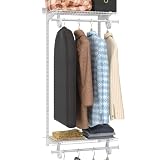

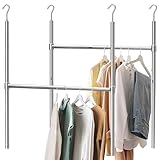
What matters more than the headline weight rating
Load capacity depends on the whole installation
A shelf rated for a certain load can still sag or pull loose if its span is too wide, supports are too far apart, or the wall fasteners miss their intended backing. Heavy stacks of denim, shoes, or storage bins concentrate weight more than lightweight sweaters. Put dense items over brackets or near a tower, and reserve long unsupported spans for lighter goods.
For wall-mounted systems, check whether the stated capacity applies per shelf, per bracket, or to the entire run. Also check whether the number assumes fastening into studs. Drywall anchors are not automatically a substitute for stud attachment; use only the anchor type and configuration permitted by the manufacturer.
Adjustability is useful only if the layout fits your clothes
Two hanging levels make better use of a typical reach-in closet, but the lower rod can conflict with long garments or with the person using it. A practical starting layout is a top rod around 80–84 inches from the floor and a lower rod around 40–42 inches. Treat those as planning dimensions, then check garment lengths and the actual shelf-and-bracket geometry before drilling.
Allow roughly 38–42 inches of vertical space for shirts and folded-over trousers on a hanger. Dresses, coats, and long garments may need 60–70 inches or more. If your wardrobe includes long pieces, keep one section single-hang rather than squeezing in a second rod everywhere.
Match the system to your closet
| Closet situation | Recommended layout | What to prioritize |
|---|---|---|
| 3–4-foot reach-in | Double-hang one side or the full width, with a narrow shelf above | Short spans, simple installation, and a clear path to the door |
| 5–6-foot reach-in | Double-hang across most of the width; add a small single-hang bay if needed | Stud locations, bracket spacing, and keeping the center accessible |
| 7–8-foot reach-in | Double-hang on one or both sides, with a tower or single-hang section for long items | Breaking up long shelf spans and distributing heavy loads near supports |
| Walk-in closet | Use multiple zones: double-hang for everyday clothes, single-hang for long garments, shelves or drawers for folded items | Reach, aisle clearance, and avoiding an overloaded wall run |
Worked example: planning a 6-foot-wide closet
Assume a 72-inch wall, with standards or supports placed at the ends and near the middle. That creates two shelf spans of about 36 inches instead of one unsupported 72-inch span. If the system’s instructions call for additional supports or a shorter maximum span, follow that limit. The shorter sections reduce the chance of visible sag, especially when shelves hold heavy bins.
Next, estimate the hanging space. Two 36-inch rod sections on the upper and lower levels provide 144 inches of total rod length: 2 levels × 2 sections × 36 inches. That does not mean every garment fits without crowding, but it gives a more realistic comparison than counting the closet as just 72 inches of hanging space. Keep a single-hang bay instead if long clothes would hit the lower rod or floor.
Wall mounting: the detail that determines whether it stays put
- Locate studs first: Use a stud finder, then confirm suspected locations with a small pilot hole where appropriate. Mark the center of each stud; a screw near the edge may not have reliable purchase.
- Match hardware to the wall: Use the supplied or specified screws for wood framing. For concrete or brick, use anchors designed for that masonry and the system’s load. For metal studs, use a fastening method approved for the system and framing.
- Do not assume drywall anchors carry the same load: If the design requires stud attachment, an anchor-only installation changes the rated setup. When studs do not align with the proposed layout, add a properly secured mounting board or choose a floor-supported design.
- Check for hidden services: Before drilling, consider wiring, plumbing, and other utilities in the wall. Stop if the location is uncertain.
- Level the top track or standards: A small alignment error can make shelves look crooked and may prevent brackets from seating correctly.
Assembly time and effort
For a 6-foot reach-in, allow about 1.5–3 hours for a straightforward wire kit, 2–4 hours for a track system, and 3–6 hours for a modular tower with multiple panels and drawers. Those estimates assume the closet is empty and the wall is reasonably accessible. Add time for removing old hardware, patching holes, cutting shelves, or working around uneven walls.
Track systems often take longer to lay out carefully but are quicker to reconfigure later. Modular furniture can take longer to assemble, yet offers a more finished appearance and may keep much of its load on the floor. A second person helps hold long rails and shelves level, but do not rely on someone holding a component as a substitute for installing its required fasteners.
Buying checklist
- Measure wall width, closet depth, ceiling height, and door clearance; note baseboards and any obstructions.
- Decide how much space must remain single-hang for coats, dresses, or long garments.
- Check the capacity and support-spacing instructions for each shelf, bracket, rod, and assembled section.
- Confirm the mounting hardware is suitable for your wall and that the proposed layout reaches adequate framing or uses an approved alternative.
- Check whether rods, end caps, shelf liners, and extra brackets are included or sold separately.
- Prefer a layout that leaves a little spare capacity over one that depends on maximum loading across every shelf.
Frequently asked questions
Can I use double hanging rods if I own dresses or coats?
Yes, but you should keep at least one section single-hang for long garments. The article notes that dresses, coats, and other long pieces may need 60–70 inches or more of vertical space, while a lower rod can interfere with them. A double-hang layout works best for shorter garments such as shirts and folded-over trousers on hangers.
Are drywall anchors suitable for every closet shelving system?
No, drywall anchors are not automatically a substitute for fastening into studs. Use only the anchor type and configuration permitted by the manufacturer. If the system requires stud attachment and the studs do not align with the planned layout, add a properly secured mounting board or choose a floor-supported design instead.
How much hanging space does a 6-foot closet provide with double rods?
A 6-foot closet divided into two 36-inch rod sections on both the upper and lower levels provides 144 inches of total rod length. That calculation is 2 levels × 2 sections × 36 inches. It does not guarantee that every garment will fit without crowding, so keep a single-hang bay if long clothing needs the space.
What should I do if the closet wall has metal studs?
Use a fastening method approved for the shelving system and the metal-stud framing. Do not assume that hardware intended for wood framing or ordinary drywall anchors provides the same support. Before drilling, also consider hidden wiring, plumbing, and other utilities, and stop if the location of a service is uncertain.
Do closet shelving kits include all the hardware and accessories I need?
Not necessarily. Check whether rods, end caps, shelf liners, and extra brackets are included or sold separately. You should also confirm that the supplied or specified mounting hardware suits your wall and that the proposed layout reaches adequate framing or uses an approved alternative. Follow the manufacturer’s instructions for the exact product and installation method.
Bottom line
For a closet you expect to reorganize, choose a stud-secured track system with movable brackets and separate hanging sections. For a low-cost, moderate-load closet, a wire shelf-and-rod kit can be sufficient if its supports match the wall and span. Choose a floor-supported tower when wall anchoring is the main constraint, and keep the manufacturer’s anti-tip hardware in place. The best system is the one whose actual support spacing, wall attachment, and hanging heights suit your closet—not simply the one with the largest number on its packaging.


