
The best aquariums for beginners and home displays are complete 10 to 20-gallon kits with an integrated hang-on-back or internal filter, adjustable heater, and LED lid, because this size is stable enough to forgive beginner mistakes but small enough to fit on a dedicated stand in most living rooms or bedrooms without major floor-load concerns.
As an Amazon Associate we earn from qualifying purchases at no extra cost to you.

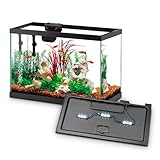


Top 3 picks at a glance
How to Choose the Best Aquariums by Tank Volume and Room Size
Tank volume determines everything else: water stability, fish options, weight, and cleaning time. For beginners, stability matters more than size savings. Smaller water volumes swing faster in temperature, ammonia, and pH.
- 5 to 10 gallons: Best for a single betta, shrimp colony, or 3-4 small nano fish. Ideal for desktops, dorms, and small apartments where floor space is limited. Requires more frequent water testing because parameters shift quickly.
- 15 to 20 gallons: The sweet spot for most beginners. Fits on a 24 to 30-inch stand along a living room wall. Large enough for a small community of tetras, rasboras, or platies with stable nitrogen cycling. Recommended if you want 8-12 small fish.
- 29 to 40 gallons (Breeder style): Best for a true centerpiece display in a living room or home office. Much more stable, but needs a dedicated aquarium stand and 2-4 feet of wall space. Better for cichlids, larger schools, or planted aquascapes.
- 55+ gallons: Only choose if you have a verified level floor, dedicated stand, and plan for 30+ minutes of weekly maintenance. Too large and unforgiving on cost for most first-time owners.
Measure your room before buying. Leave at least 4 inches behind the tank for filter and cord clearance, 12 inches above for lid opening and feeding, and avoid direct sunlight from windows which drives algae growth.
Match Fish Type to Tank Shape and Volume
Not all best aquariums suit all fish. Tall column tanks look elegant but offer less swimming length than long or breeder-style tanks with the same volume.
- Betta and shrimp: A 5-gallon Fluval Spec V style or a 10-gallon standard rectangle with a gentle filter. These species need calm flow and warm, stable water (76-80°F). Long fins tear in strong currents.
- Nano community (neon tetras, chili rasboras, guppies, corydoras): A 15 to 20-gallon long tank like the Aqueon 20-gallon long or Fluval Flex 32.5 format provides horizontal swimming space. Corydoras and other bottom dwellers need footprint, not height.
- Planted aquascape with small schools: A shallow rimless tank such as Waterbox Clear Mini or UNS 60U (approx. 20 gallons) paired with a canister filter and CO2-ready lid. Wide, shallow dimensions give better light penetration for plants.
- Goldfish: Require 20 gallons for the first fancy goldfish plus 10 gallons per additional fish, with heavy filtration. Common single-tail goldfish need 40+ gallons. Do not place goldfish in 5 or 10-gallon kits.
Filtration Explained: What Beginners Actually Need
Filtration turnover is measured in gallons per hour (GPH). For freshwater beginner tanks, aim for 4x to 6x turnover per hour for hang-on-back (HOB) and internal filters, or 5x to 8x for canisters on planted tanks.
HOB Filters (Best for 10-29 gallon kits)
Found on kits like the Tetra ColorFusion and Marineland Portrait series and most Aqueon LED kits. They hang on the back rim, provide mechanical, chemical, and biological filtration, and are easy to service without reaching into the tank. Replace or rinse filter cartridges in old tank water, never tap water, to preserve beneficial bacteria.
Internal Filters (Best for 5-15 gallon all-in-ones)
Common in Fluval Flex and Fluval Spec lines. All filtration is hidden in a rear chamber, which keeps the display clean for home decor. Flow is gentler than HOBs, ideal for bettas and shrimp, but the chamber takes up 10-15% of the tank volume.
Canister Filters (Best for 20+ gallon displays)
Used on rimless display tanks from Waterbox and UNS. Sits in the cabinet below, offers the highest media capacity and quietest operation. Overkill for a first 10-gallon but worth it if you plan a heavily planted or high-bioload tank.
Do not rely on undergravel filters or air-driven sponge filters as sole filtration for a display kit unless you are running a dedicated shrimp breeding setup. They lack chemical filtration and are harder to make visually clean.
Weight, Stand Requirements, and a Worked Calculation
A common failure point is placing a filled aquarium on standard furniture. Particle-board dressers and desks will bow, swell, and eventually collapse. Use a dedicated aquarium stand rated for at least 20% more than your calculated filled weight.
Use this formula to estimate filled weight:
Filled Weight = (Gallons x 8.34 lbs) + Substrate Weight + Empty Tank Weight
Substrate typically weighs 1 to 1.5 lbs per gallon for a 1.5 to 2-inch bed. Empty glass tank weight is roughly 1 to 1.2 lbs per gallon for rimmed tanks, more for rimless low-iron glass.
Example: Standard 20-gallon long on a home office stand
- Water: 20 x 8.34 = 166.8 lbs
- Gravel (1.5-inch layer): ~20 lbs
- Empty 20-gallon long tank: ~25 lbs
- Decor and water displacement: ~5 lbs
- Total estimated filled weight: ~216.8 lbs concentrated on a 30 x 12 inch footprint.
That is over 86 lbs per square foot, far exceeding typical residential floor design of 40 lbs per square foot live load. Place tanks perpendicular to floor joists, along a load-bearing wall, and never on a second floor without checking joist direction. For 29 gallons and above, always use a manufactured steel or solid-wood aquarium stand with leveling feet. Check level with a bubble level front-to-back and side-to-side before filling; an unlevel tank stresses silicone seams.
For heating, budget 3 to 5 watts per gallon of adjustable heater power. A 20-gallon in a 68°F room targeting 78°F needs a 100-watt heater. Go to 150 watts if the room drops below 65°F in winter. Always use an adjustable heater with a thermostat, not a preset pad.
Maintenance Effort by Aquarium Type
Maintenance scales with bioload and filtration, not just tank size. A lightly stocked 20-gallon is less work than an overstocked 10-gallon.
- Low effort (15-20 min/week): 15-20 gallon kit with HOB, lightly stocked nano fish, live plants like anubias and java fern. 25% weekly water change, rinse filter media monthly, trim plants monthly.
- Moderate effort (30 min/week): 10-gallon with betta and 6 tetras, or 20-gallon planted with CO2. Requires weekly 25-30% water change, glass scraping, gravel vacuuming, and filter cleaning every 2-3 weeks.
- Higher effort (45+ min/week): 5-gallon or goldfish tank. Small volumes need twice-weekly testing and water changes; goldfish produce heavy waste that clogs filters faster. All-in-one hidden chambers also need weekly sponge rinsing to prevent bypass.
To reduce effort, choose a kit with a standard rectangular footprint. Bowfronts and tall portraits look good but are harder to scrape and gravel-vac than rectangles, and replacement lids/lights are less standardized.
Comparison Table: Common Beginner and Display Aquarium Classes
| Kit Class / Example Model Type | Volume | Footprint (L x W x H) | Filled Weight | Turnover Needed (GPH) | Best For |
|---|---|---|---|---|---|
| 5-Gallon All-in-One (Fluval Spec V style) | 5 gal | 17.2 x 6.3 x 10.6 in | ~58 lbs | 20 – 30 GPH | Single betta, shrimp, desk display |
| 10-Gallon Standard Kit (Aqueon LED Kit style) | 10 gal | 20 x 10 x 12 in | ~111 lbs | 40 – 60 GPH | First community, bedrooms, low cost |
| 15-Gallon Flex Style (Fluval Flex 15 style) | 15 gal | 16 x 15 x 15 in | ~170 lbs | 60 – 90 GPH | Planted cube, living room corner |
| 20-Gallon Long (Aqueon 20 Long style) | 20 gal | 30 x 12 x 12 in | ~217 lbs | 80 – 120 GPH | Best all-around beginner display |
| 32-Gallon All-in-One (Fluval Flex 32.5 style) | 32 gal | 32 x 15 x 15 in | ~345 lbs | 130 – 195 GPH | Rimless centerpiece, canister-ready |
| 40-Gallon Breeder | 40 gal | 36 x 18 x 16 in | ~455 lbs | 160 – 240 GPH | Aquascape, cichlids, dedicated stand required |
Decision Matrix: Match Your Situation to the Right Aquarium
Use this to map constraints to a choice without overbuying.
| Your Situation | Recommended Best Aquarium | Why |
|---|---|---|
| Small desk, want one pet, minimal maintenance | 5 to 10-gallon all-in-one with internal filter | Low footprint and gentle flow; stable enough for betta/shrimp if you do weekly 25% changes |
| Apartment living room, first community tank | 20-gallon long kit with HOB (100 GPH) + 100W adjustable heater | Best balance of stability, stocking options, and weight that most stands and floors can handle |
| Want a modern rimless display for decor | 15 to 32-gallon rimless (Waterbox / UNS class) with canister filter | Best aesthetics and plant growth; hides equipment in cabinet |
| Kids’ room, want colorful hardy fish | 20-gallon standard with HOB and secure lid | Lid prevents jumping, larger volume forgives overfeeding mistakes, holds platies/guppies well |
| No stand yet, putting on existing furniture | 10-gallon maximum, and only on solid wood furniture rated over 150 lbs | Avoids collapse risk; verify level and add a thin foam mat under rimless tanks |
| Interested in goldfish | 40-gallon breeder with canister filter (200+ GPH) | Only tank in this list that safely handles bioload and adult size of fancy goldfish |
Setup Settings That Prevent Most Beginner Failures
Cycle the tank before adding fish. Dose an ammonia source to 2 ppm and run the filter for 2 to 3 weeks until ammonia and nitrite both read 0 ppm and nitrate appears. This builds the biological filter. Adding fish on day one causes new tank syndrome.
- Temperature: 76-78°F for tropical community, 78-80°F for betta. Set heater and verify with a separate glass thermometer, not just the heater dial.
- Light: 6 to 8 hours per day on a timer. More than 8 hours grows algae, not fish. If algae appears, reduce to 6 hours rather than adding chemicals.
- Feeding: Once daily, only what fish eat in 90 seconds. Overfeeding is the number one cause of cloudy water and ammonia spikes.
- Water changes: 25% weekly with dechlorinated water matched to tank temperature within 2°F. Gravel vacuum half the substrate each week, alternating sides.
- Filter care: Rinse mechanical media in old tank water every 3-4 weeks. Never replace all biological media at once.
If you are choosing between two sizes and have the stand and floor space, choose the larger. In 2026 the price difference between a 10-gallon kit (usually $70-$130) and a 20-gallon kit (usually $130-$220) is small compared to the cost of replacing fish and upgrading later. A 20-gallon long remains the most recommended starting point for the best aquariums that function as both beginner-friendly and attractive home displays.
Frequently asked questions
How much space should I leave around an aquarium?
Leave at least 4 inches behind the tank and 12 inches above it. The rear clearance allows room for the filter and cords, while the upper clearance makes lid opening and feeding easier. Measure the room before buying, and avoid placing the aquarium in direct sunlight because windows can drive algae growth.
Can I place a filled aquarium on a dresser or desk?
No, place a filled aquarium on a dedicated stand rated for at least 20% more than its calculated filled weight. Particle-board dressers and desks can bow, swell, and collapse. Before filling, check the aquarium with a bubble level from front to back and side to side, because an unlevel tank stresses silicone seams.
How often should I change aquarium water?
Most lightly stocked beginner aquariums need a 25% weekly water change. A 10-gallon tank with a betta and 6 tetras or a planted aquarium with CO2 may need a 25-30% weekly change, plus glass scraping and gravel vacuuming. Small-volume or goldfish aquariums can require twice-weekly testing and water changes.
What should I do when cleaning filter media?
Rinse filter media in old tank water rather than tap water. This helps preserve beneficial bacteria involved in filtration. HOB filter media may be rinsed monthly in a lightly stocked setup, while heavily stocked or all-in-one aquariums can require more frequent attention. Internal filter sponges should be rinsed weekly when buildup causes bypass.
What aquarium is suitable for goldfish?
Fancy goldfish require 20 gallons for the first fish plus 10 gallons for each additional fish, with heavy filtration. Common single-tail goldfish need 40+ gallons. They should not be placed in 5 or 10-gallon kits because goldfish produce heavy waste that clogs filters faster and makes maintenance more demanding.


