Choosing inside one brand sounds simple until the Pulsefire names start to blur together. A Haste 2 wired, a Haste 2 wireless, a Surge and a Core can all look alike in a thumbnail, yet they differ in weight, polling rate, button count and whether a cable stays on your desk at all. Picking on headline DPI alone can leave you with a shell that fights your grip or a connection type you never wanted.
This guide serves competitive shooter players chasing the lightest shell, wireless players who move between a gaming PC and a laptop, and everyday players who simply want solid HyperX basics with RGB. Every pick below was chosen from the product names and specifications printed on its Amazon product page, so the differences described here come from the listings themselves.
Top 3 picks at a glance


Quick Picks
As an Amazon Associate we earn from qualifying purchases
| Product | Best for | Key spec from title |
|---|---|---|
| HyperX Pulsefire Haste 2 Wireless | Wireless play without a heavy shell | 61g, 100 Hour Battery Life |
| HyperX Pulsefire Haste 2 Wired | Fastest wired response on a light mouse | 53g, 8000Hz Polling Rate |
| HyperX Pulsefire Surge | RGB fans who still want a strong sensor | Pixart 3389 Sensor up to 16000 DPI |
| HyperX Pulsefire Core | Simple wired basics with an extra button | Pixart 3327 Sensor up to 6,200DPI, 7 Programmable Buttons |
How to Choose
Weight and shell shape
Weight changes how a mouse feels after the first hour, not just during the first flick. The wired Haste 2 is listed at 53g with a solid shell, while its wireless sibling is listed at 61g, and the Core sits at 87g in its title. Lighter shells suit fingertip and claw players who lift and reset often, because each reset costs less effort. Heavier, fuller shells can feel steadier for palm grip and slower, deliberate tracking. All four picks here use symmetrical shapes with side buttons on one side, so left-handed players should check the listing photos carefully before deciding.
Wired, 2.4GHz wireless, or Bluetooth
Connection decides more than tidiness. A wired mouse never needs charging and the wired Haste 2 adds an 8000Hz polling rate, which reports far more often than the standard rate found on the other picks. The Haste 2 Wireless offers three routes in one mouse: 2.4GHz through its dongle for gaming, Bluetooth for compatible laptops and tablets, and the included cable when the battery runs low. Bluetooth is handy for a second machine, but it is a convenience mode rather than the choice for ranked play. If your desk already has crowded USB ports, also confirm you have a free port for a dongle or cable.
Sensor ceiling and polling rate
Listings lead with big DPI numbers, yet few players actually play near a 26,000 DPI ceiling. What matters more day to day is that the sensor tracks cleanly at the modest settings most people use, and the presets on these mice start at familiar low steps. The HyperX 26K sensor in both Haste 2 models is listed up to 26,000 DPI and 650 IPS, the Surge uses a Pixart 3389 up to 16,000 DPI, and the Core uses a Pixart 3327 up to 6,200 DPI. Treat those ceilings as headroom, then weigh polling, weight and buttons more heavily in your final choice.
Buttons, memory and software
Button count separates the lobby chat from the ability kit. Most picks here carry six programmable buttons, while the Core carries seven, giving it one extra bind for a push-to-talk key, a melee command or a building shortcut. Every model in this guide works with HyperX NGENUITY software for DPI stages, macros, button assignments and lighting, and the listings note onboard memory on several models for saving a profile. Decide before buying whether you will actually open that software weekly or set it once and forget it, because lighting and macro plans should follow real habits, not box copy.
The 4 Best Options
HyperX Pulsefire Haste 2 Wireless

For players who want to cut the cord without giving up a light, flick-friendly shell, this is the natural starting point in the Pulsefire range. Its listing pairs a 61g weight with dual wireless connectivity, so it can live on a gaming PC through its dongle and still pair with a laptop over Bluetooth when you travel. The HyperX 26K sensor, long battery rating and wired fallback through the included cable make it the most flexible option here for mixed gaming and everyday use across more than one machine.
Specs
- Connection: 2.4GHz wireless, Bluetooth, and wired via included cable
- Sensor: HyperX 26K Sensor, up to 26,000 DPI
- Tracking speed: up to 650 IPS
- Weight: 61g
- Battery life: up to 100 hours
- Buttons: 6 programmable buttons
- Switches: HyperX switches, rated for up to 100 million clicks
- Model number: 6N0B0AA
- Skates: virgin-grade PTFE skates, with grip tape included
Best for: Wireless players who split time between a gaming PC and a laptop
Watch out for: Confirm Bluetooth is present on your second machine, and keep the charging cable reachable for wired fallback play.
ASIN: B0BX52C4LN
HyperX Pulsefire Haste 2 Wired
Shooter players who reset their aim constantly will feel the appeal of the lightest mouse in this guide. At 53g with a solid shell rather than a honeycomb design, it avoids holes that collect dust while staying easy to lift. Its headline feature is the 8000Hz polling rate, which the listing describes as a signal every .125 milliseconds, paired with the same HyperX 26K sensor as the wireless model. The HyperFlex 2 paracord cable is built to reduce drag, so the wired connection feels less restrictive than older braided cables did.
Specs
- Connection: Wired, HyperFlex 2 cable
- Sensor: HyperX 26K Sensor, up to 26,000 DPI
- Tracking speed: up to 650 IPS
- Polling rate: up to 8000Hz
- Weight: 53g
- Buttons: 6 programmable buttons
- Switches: HyperX switches, rated for up to 100 million clicks
- Model number: 6N0A7AA
- Skates: virgin-grade PTFE skates, with grip tape included
Best for: Competitive wired players who want the lightest shell and the highest polling rate here
Watch out for: There is no wireless or Bluetooth option on this model, so check that a cable suits your desk layout.
ASIN: B0BX52PCJ5
HyperX Pulsefire Surge
The Surge is the pick for players who care how the setup looks as much as how it tracks. Its listing centers on a light ring that provides dynamic 360 degree RGB effects, something none of the other mice here offer in the same way. Behind the lighting sits a Pixart 3389 sensor with native DPI up to 16,000, Omron switches and onboard memory for storing customizations made in NGENUITY. That combination suits players who want one wired mouse for both focused play and a visibly finished desk, rather than the lightest possible shell.
Specs
- Connection: Wired
- Sensor: Pixart 3389, native DPI up to 16,000
- Buttons: 6 programmable buttons
- Switches: Omron switches, rated for 50 million clicks
- Lighting: 360 degree RGB light ring
- Memory: onboard memory to store customizations
- Software: HyperX NGENUITY
- Model number: HX-MC002B
Best for: RGB fans who want a wired mouse with a strong sensor and stored profiles
Watch out for: Check the listed dimensions against your hand and grip, since this is not the lightweight option in the range.
ASIN: B07B9TVQ82
HyperX Pulsefire Core
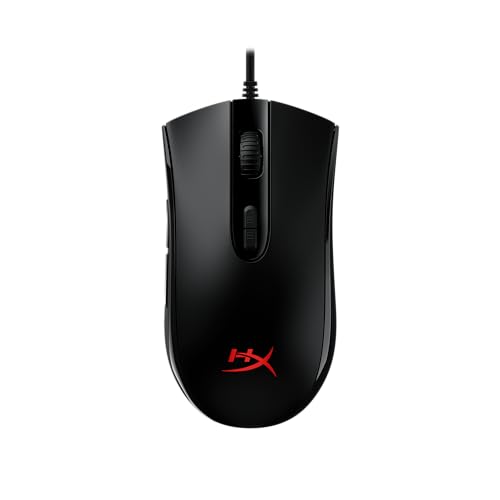
The Core strips the formula back to the essentials and adds one useful extra: a seventh programmable button. Its Pixart 3327 sensor provides precise tracking without hardware acceleration at native DPI settings up to 6,200, which covers the settings most everyday players actually use. The listing describes a comfortable, solid wired mouse with customizable RGB lighting and switches rated for 20 million clicks. For a first HyperX gaming mouse, or a dependable spare for a second PC, that simpler spec sheet is a feature rather than a compromise, provided the lower DPI ceiling fits your games.
Specs
- Connection: Wired
- Sensor: Pixart 3327, native DPI up to 6,200
- Buttons: 7 programmable buttons
- Switches: rated for 20 million clicks
- Weight: 87g
- Lighting: customizable RGB lighting
- Software: HyperX NGENUITY, with onboard memory
- Model number: HX-MC004B
Best for: First-time buyers and second-PC setups that want simple wired basics plus an extra bind
Watch out for: The 6,200 DPI ceiling is the lowest here, so confirm it covers the sensitivity range you plan to use.
ASIN: B07H3GFJJ2
Which One Fits Your Situation
You play ranked shooters every night
Start with the Pulsefire Haste 2 Wired. Its 53g solid shell is the easiest here to lift and reset during fast turns, and its 8000Hz polling rate is the highest listed in this guide. The flexible HyperFlex 2 cable reduces the usual wired drawback, although you should still route it so it cannot catch on a monitor stand or desk edge mid match.
You game on a PC and work on a laptop
Choose the Pulsefire Haste 2 Wireless. Keep the 2.4GHz dongle in your gaming PC for play, switch to Bluetooth for the laptop during the day, and use the included cable when the battery needs charging. That single-mouse routine avoids unplugging anything daily, and the up to 100 hour battery rating means charging becomes an occasional habit rather than a nightly one.
Your desk is part of your stream backdrop
Look at the Pulsefire Surge. Its 360 degree RGB light ring gives the mouse a visible presence that the plainer shells here do not match, while the Pixart 3389 sensor and six programmable buttons keep it credible for actual play. Save your lighting and macro choices to its onboard memory so the look you set is the look that returns when you plug in elsewhere.
You want a spare mouse that just works
Take the Pulsefire Core. It is wired, so there is nothing to charge before a session, and its seven programmable buttons cover the binds most casual players need. The 87g weight feels steadier for slower paced games and desktop use, and the simpler sensor ceiling matters less if your second PC hosts strategy, simulation or older titles rather than ranked shooters.
Common Mistakes
- Buying on maximum DPI alone, when weight, grip fit and connection type will affect every session far more than a ceiling you never reach.
- Choosing the wireless model for Bluetooth gaming, when the listing positions Bluetooth as a mode for compatible devices and the dongle as the gaming connection.
- Ignoring hand size and grip style, because a symmetrical 53g shell and a fuller wired shell reward very different hands and habits.
- Forgetting that DPI stages, macros and lighting changes run through HyperX NGENUITY, so skipping the software leaves several listed features unset.
- Mixing up the wired and wireless Haste 2 listings at checkout, since the names are nearly identical while the weight, polling rate and model numbers differ.
Frequently Asked Questions
Is the Pulsefire Haste 2 Wireless good for competitive play?
Yes, based on its listing. It connects over 2.4GHz wireless for gaming, weighs 61g, and uses the HyperX 26K sensor rated up to 26,000 DPI and 650 IPS. Its battery is rated for up to 100 hours, and the included cable lets you keep playing in wired mode while it charges, which removes the usual wireless worry during a long session.
What does the 8000Hz polling rate on the wired Haste 2 actually change?
The listing says the mouse reports up to eight times per millisecond, or once every .125 milliseconds. In practical terms that means position updates reach the PC more often than with a standard polling rate. Competitive shooter players are the audience most likely to care, while slower paced games will feel much the same either way.
Which HyperX mouse here has the most buttons?
The Pulsefire Core, with seven programmable buttons. The Haste 2 wired, Haste 2 Wireless and Surge each list six. That one extra bind on the Core can hold a push-to-talk key or a frequently used command, although players who need a full MMO style cluster will find every mouse in this guide too lean and should look beyond this range.
Can these mice save settings without the software running?
Several listings say yes, through onboard memory. The Surge listing notes onboard memory to store customizations, and the Core listing says DPI, macros and lighting can be saved to its onboard memory through NGENUITY. Set your profile once in the software, save it, and the mouse carries those choices to another PC without rebuilding them.
Related guides
More from Amazon
Programs that pair well with the guide above. Offers and eligibility are set by Amazon and may change.
Free shipping on eligible items, Prime Video and more. Eligible new members can start with a free trial.
Start a Prime free trialAd-free music streaming. Eligible new subscribers can start with a free trial.
Try Music Unlimited freeA Prime membership for ages 18-24 with a trial period. Eligibility is set by Amazon.
See Prime for Young AdultsAudiobooks and podcasts to listen to on the go. Eligible new members can start with a free trial.
Try Audible freeAs an Amazon Associate we earn from qualifying purchases.