
The best jewelry making kits for beginners are Bead Landing starter kits for broad, reusable supplies, Creativity for Kids Fashion Bracelets for an easy guided project, Klutz friendship-bracelet kits for structured thread work, and a DIY jewelry findings-and-tools kit for creators who want to progress beyond one-time crafts.
As an Amazon Associate we earn from qualifying purchases at no extra cost to you.

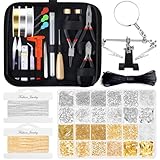


Top 3 picks at a glance
Best jewelry making kits compared
A good kit should do more than fill a box with beads. The useful questions are whether it includes the tools needed to finish a piece, supplies enough projects to justify its price, explains the techniques clearly, and lets you buy compatible refills later.
| Kit type or example | Typical contents | Project variety | Best for | Typical price range |
|---|---|---|---|---|
| Creativity for Kids Fashion Bracelets | Beads, cords or elastic, charms, instructions | Usually several bracelets, with limited variation | Children and first-time makers | $15–$30 |
| Klutz friendship-bracelet kit | Embroidery floss, bracelet-making guide, organizer or loom-style aid | Multiple thread patterns and color combinations | Beginners who prefer fiber crafts | $15–$25 |
| Bead Landing bead assortment or jewelry starter set | Mixed beads, elastic or cord, findings; tools vary by set | Bracelets, necklaces, earrings, and custom combinations | Older children, teens, and casual creators | $15–$40 |
| General jewelry findings-and-tools kit | Round-nose and chain-nose pliers, cutters, jump rings, clasps, wire, beads | Bracelets, earrings, pendants, wire-wrapped designs | Adults and learners building long-term skills | $25–$70 |
1. Creativity for Kids Fashion Bracelets: easiest first project
This type of kit is the strongest choice when the priority is finishing a wearable item quickly. Creativity for Kids Fashion Bracelets sets generally focus on elastic cord, colorful beads, letter beads, charms, or decorative components rather than metalworking.
What is included
- Preselected beads and decorative pieces
- Elastic, cord, or another beginner-friendly stringing material
- Charms or focal pieces in some editions
- Printed instructions with basic stringing and finishing guidance
The main limitation is tools. Many elastic-bracelet kits do not include proper pliers, and some require an adult to help with knot tightening or trimming. Check the package before buying if “ready to use” is important.
Materials, variety, and refills
These kits are good for several related bracelet designs, but they are not usually a complete introduction to earrings, wire wrapping, or metal findings. The beads can often be supplemented with standard 6 mm or 8 mm craft beads, elastic jewelry cord, and basic charms. That makes refilling easy even when the exact kit components are no longer sold.
Choose this option for a child, a classroom activity, or someone who wants a low-frustration introduction. Choose another kit if the maker wants to learn durable clasp connections or make jewelry in several formats.
2. Klutz friendship-bracelet kits: best for learning patterns
Klutz friendship-bracelet kits suit beginners who enjoy repetition, color planning, and visible progress more than loose bead design. Their strength is the instructional material: diagrams and pattern-based lessons usually make forward knots, backward knots, color changes, and finishing easier to understand than a short instruction card.
Tools and materials
The core materials are embroidery floss and a method of holding the work steady, such as a board, guide, or included accessory depending on the edition. These kits generally do not teach metal jewelry skills and may not include scissors, measuring tools, or bead-specific findings.
Project variety comes from changing colors and following different patterns. A single kit can therefore produce many visually different bracelets even though the raw material is similar. It is also easy to refill: embroidery floss is inexpensive and sold in many colors, while beads can be added later for hybrid designs.
Skill level and trade-offs
This is beginner-friendly but not necessarily fast. A first bracelet may take longer than an elastic-bead bracelet because tension and knot direction matter. The kit is a good fit for ages old enough to follow diagrams and maintain even tension. It is less suitable for someone specifically searching for earrings, necklaces, or professional-looking metal closures.
3. Bead Landing sets: best balance of variety and reuse
Bead Landing is a useful choice when the goal is a broader assortment of beads and findings rather than a single prescribed project. Different sets vary substantially, so inspect the contents rather than assuming every box includes the same tools.
Included tools and findings
Some Bead Landing assortments emphasize loose beads, while jewelry-making sets may include elastic, cord, clasps, headpins, jump rings, or earring components. Pliers and cutters are not guaranteed. If the set includes findings but no tools, add a small pair of chain-nose pliers and flush or diagonal cutters.
The assortment format gives more creative freedom than a children’s project kit. Round beads can become bracelets, larger focal beads can become pendants, and compatible earring findings open another project category. The downside is that beginners may receive materials without enough explanation of how to combine them.
Refill and compatibility check
Look for standard component sizes. A kit is easier to refill when it uses ordinary elastic cord, beading wire, 4–8 mm beads, 6–8 mm jump rings, and common lobster clasps. Proprietary plastic parts or unusually small holes can make future supplies harder to match.
Bead Landing sets are best for teens and adults who want freedom to experiment. They are also a practical upgrade from a bracelet-only kit, provided the buyer confirms whether tools and instructions are included.
4. A general findings-and-tools kit: best for serious beginners
For a creator who wants to learn jewelry construction rather than complete one themed craft, a general findings-and-tools kit is the most capable option. Quality varies widely, so evaluate the individual tools rather than judging the kit by the number of pieces.
Minimum useful tool set
- Chain-nose pliers: for gripping, opening jump rings, and flattening crimps
- Round-nose pliers: for making loops and simple wire shapes
- Flush or side cutters: for trimming wire and headpins
- Bead mat or tray: for preventing small components from rolling away
- Crimping pliers: helpful when using beading wire and crimp tubes
Useful findings include jump rings, lobster clasps, crimp beads, eye pins, headpins, earring hooks, and bead caps. A kit that contains hundreds of low-quality findings but no clear instructions is less valuable than a smaller kit with correctly matched components.
Project variety
This category can support stretch bracelets, clasp bracelets, earrings, simple necklaces, charm chains, and beginner wire-wrapped pendants. It has the highest learning curve, but the skills transfer directly to refill supplies from many brands.
How much material do you need for a bracelet?
A simple calculation prevents a common beginner mistake: buying enough beads by weight but not enough for the intended length. For a 7-inch bracelet using 8 mm beads, divide the finished length by bead diameter:
7 inches × 25.4 = 177.8 mm; 177.8 ÷ 8 mm = about 22 beads.
Allow extra length for knots, spacing, and mistakes, so prepare about 24–25 beads. Smaller 6 mm beads require roughly 30 beads for the same length. If a kit includes only 20 large beads, it may make a child-sized bracelet rather than an adult 7-inch bracelet.
Decision matrix: which kit fits your situation?
| Your priority | Best choice | Why | What to add |
|---|---|---|---|
| Finish a project in one sitting | Creativity for Kids Fashion Bracelets | Simple materials and guided designs reduce setup | Scissors or small pliers if absent |
| Learn repeating patterns | Klutz friendship-bracelet kit | Step-by-step diagrams support knot practice | Extra embroidery floss |
| Make several types of jewelry | Bead Landing assortment | More bead and finding combinations | Chain-nose pliers and cutters |
| Develop long-term skills | Findings-and-tools kit | Teaches loops, clasps, crimps, and wire handling | Bead mat and better replacement cutters if needed |
| Refill supplies cheaply | Any kit using standard components | Generic beads, elastic, wire, and findings fit later | Check hole diameter and wire gauge before buying |
What to check before buying
- Tool inclusion: Do not assume pliers or cutters are included because the box says “jewelry making.”
- Finding quality: Look for secure clasps, smooth earring hooks, and jump rings that close fully.
- Instruction depth: Photos are useful, but diagrams showing knot direction, loop formation, or crimp placement are better.
- Project count: Count realistic finished pieces, not every possible color combination.
- Refill compatibility: Standard elastic, embroidery floss, beading wire, jump rings, and bead sizes are easier to replace.
- Age and dexterity: Tiny findings require more control than large beads or thick bracelet cord.
Frequently asked questions
Can I mix beads from different kits?
Yes, if the beads and other components are compatible. The article recommends checking for standard sizes and materials, such as 4–8 mm beads, ordinary elastic cord, and common findings. Proprietary plastic parts or unusually small bead holes may make it harder to match supplies from another kit.
What should I look for in a kit’s instructions?
Look for guidance that matches the techniques you want to learn. Pattern diagrams can help with friendship-bracelet knots, while jewelry construction calls for instructions on loops, clasps, crimps, or wire handling. A kit with many components but unclear instructions may be less useful to a beginner.
Are bracelet kits suitable for making earrings or necklaces?
Some are, but it depends on the kit. Bracelet-focused kits are mainly suited to related bracelet designs, while broader bead assortments and findings-and-tools kits can support earrings, necklaces, pendants, and other projects. Check whether the kit includes suitable findings and tools before choosing it for those projects.
What supplies might I need to add to a kit?
It depends on what the kit includes and what you want to make. Possible additions mentioned in the article include scissors, chain-nose pliers, cutters, embroidery floss, a bead mat, and standard beads or elastic cord. Check the package contents first, since tools and instructions vary between sets.
How can I tell whether a kit has enough beads for an adult bracelet?
Estimate the bead count from the bracelet length and bead size. For a 7-inch bracelet made with 8 mm beads, the article estimates about 22 beads, with 24–25 prepared to allow for knots, spacing, and mistakes. Smaller 6 mm beads require roughly 30 for the same length.
Final recommendation
Pick a Creativity for Kids Fashion Bracelets kit for the easiest first success, a Klutz friendship-bracelet kit for pattern-based thread work, and a Bead Landing assortment for flexible bead projects. If the maker expects to continue beyond a few guided crafts, skip the narrowly themed box and choose a findings-and-tools kit with chain-nose pliers, round-nose pliers, cutters, standard findings, and clear instructions. The best jewelry making kits are the ones whose materials match the intended projects and whose components remain useful after the included designs are finished.


