
The best lapidary saws for clean stone cuts are usually a 6-inch trim saw for small cabochons, a 10-inch slab saw for general-purpose work, or a 14-inch-plus slab saw when you regularly cut large rough; the right choice depends more on blade clearance, water control, vise movement, and replacement costs than on motor horsepower alone.
As an Amazon Associate we earn from qualifying purchases at no extra cost to you.
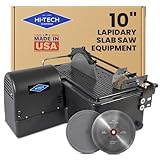
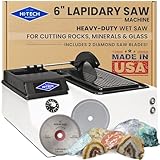


Top 3 picks at a glance
Quick comparison: which lapidary saw fits your work?
| Use case | Blade size | Practical cutting capacity | Useful motor range | Typical 2026 market range |
|---|---|---|---|---|
| Small cabochons, slabs, and trimming | 4–6 inches | About 1–2 inches of material, depending on blade exposure | 1/4–1/2 hp | Usually $250–$600 |
| General rock, agate, jasper, and small geodes | 8–10 inches | About 2–3.5 inches | 1/2–1 hp | Usually $600–$1,500 |
| Large slabs and thick rough | 12–14 inches | About 3.5–5 inches | 1–2 hp | Usually $1,200–$3,000 |
| Frequent production cutting | 14–24 inches | About 5–8 inches or more | 2–5 hp | Often $3,000–$8,000 or higher |
These are planning figures rather than guaranteed specifications. The usable capacity is always smaller than the blade diameter because the arbor, table, blade flange, vise, and guard occupy part of the cutting envelope.
Best lapidary saws by machine type
Best for precision trimming: 4- to 6-inch trim saws
A compact trim saw is the best choice when your rough has already been slabbed and you need controlled cuts around cabochons, faceted-stone preforms, fossils, or small mineral specimens. Models such as the Hi-Tech Diamond 6-inch trim saw and Lortone 6-inch trim saw represent this class.
The main advantage is control. A small blade has less cutting resistance, the table is easier to see, and the machine takes up less space. Many compact saws also use a shallow water reservoir that is simple to drain and clean. The limitation is cutting depth: a 6-inch blade cannot make a deep cut through thick rough in one pass.
Choose a trim saw with a rigid table, a replaceable blade shaft or arbor hardware, and a splash guard that does not obstruct the cut line. A basic fence is useful, but a sliding or pivoting vise is more valuable if you need repeatable angles.
Best all-rounder: 8- to 10-inch slab saws
For most hobbyists, an 8- or 10-inch slab saw is the best balance of capacity, price, and operating cost. The Hi-Tech Diamond 10-inch slab saw, Covington 10-inch slab saws, and Diamond Pacific Titan-class machines are examples of the type to compare.
A 10-inch blade typically gives enough clearance for common agate, jasper, petrified wood, and small geodes. It can also handle rough that would be awkward or unsafe on a trim saw. Look for a vise that travels smoothly and locks firmly; a loose vise can turn a straight cut into a tapered one and can increase blade wear.
Some machines in this category are compact saws with an open table, while others are enclosed slab saws with a carriage. An open design is easier to inspect and clean. An enclosed carriage usually gives better control for long, repeatable slabs and can contain more spray and slurry.
Best for large rough: 12-inch and larger slab saws
A larger saw is justified when you frequently cut thick nodules, sizable petrified wood, or long slabs. The extra blade diameter does not merely increase depth; it also makes long cuts more practical because the material can remain supported farther from the arbor.
The trade-offs are substantial. Larger saws require more floor space, stronger electrical service, more coolant, heavier stands, and costlier blades. A 14-inch machine is often excessive for someone who mostly trims pre-slabbed material. It becomes sensible when buying smaller rough would force you to make multiple passes or when straight slab production matters.
Blade size and cutting capacity
Do not compare blade diameter alone. Check four measurements:
- Maximum depth: the actual vertical clearance from the table or vise to the blade.
- Maximum length: how far the vise or carriage can travel without the rough hitting the guard.
- Arbor diameter: replacement blades must match both the arbor and the included spacers or flanges.
- Blade kerf: a thicker blade removes more stone and usually needs more motor torque.
For example, if a machine advertises a 3-inch theoretical depth but its vise and guard reduce usable clearance by 1/2 inch, plan around 2.5 inches. A rough piece that is 2.75 inches thick may require rotation, a second pass, or a larger saw.
Motor power: calculate the useful margin
Horsepower matters most when the blade is cutting thick, hard material continuously. A simple planning calculation helps prevent buying an underpowered machine. Suppose a 10-inch saw uses a 0.75-hp motor. Mechanical output is approximately:
0.75 hp × 746 watts per hp = about 560 watts of mechanical power.
If the motor and drive system operate at an assumed 70 percent overall efficiency, the electrical input may be roughly 800 watts while cutting hard material. Add a startup allowance of 25 to 50 percent, and a circuit supplying about 1,000–1,200 watts of available capacity is a sensible minimum planning figure. The exact requirement depends on the motor, voltage, and manufacturer instructions.
More power does not automatically create cleaner cuts. A rigid arbor, properly tensioned blade, steady feed rate, and adequate coolant often matter more than an extra fraction of a horsepower. A motor that slows noticeably when you apply light pressure is underpowered for the material or is being fed too aggressively.
Water systems and slurry control
Clean stone cuts require enough coolant to flush diamond debris from the kerf without flooding the work area. Compact trim saws commonly use a reservoir beneath the blade. This is inexpensive and easy to maintain, but the same water circulates repeatedly, so fine grit can build up quickly.
For an open-reservoir saw, begin with clean water filled only to the manufacturer’s level. If the blade is wet but the cut produces a dry, dusty-looking kerf, the water level, pump, or splash path needs attention. If the stone is constantly slipping or the table is covered in thick paste, the water is contaminated or the pump is moving too much slurry.
A practical cleaning routine is:
- Stop the motor before reaching into the tray or adjusting the blade area.
- Drain and wipe the reservoir after each session involving soft or friable stone.
- Remove settled sludge before it reaches the pump intake.
- Rinse the pump and hose separately rather than forcing abrasive slurry through them.
- Use a settling bucket for larger saws so solids can be separated before water is reused.
Do not add random household detergents or oils. They can damage pump components, make the table dangerously slippery, or interfere with the coolant system. Use only additives approved for the machine and local wastewater rules.
Vise adjustability and straight-cut quality
A vise is worth paying for when you need repeatable slabs, parallel cuts, or angled preforms. The most useful features are a long travel range, a quick-release mechanism, adjustable jaws, and a positive lock that does not loosen under vibration.
For a first cut, clamp the rough at its widest stable area and support any overhanging section. Set the feed so the blade removes material continuously without forcing it. If the blade wanders, check the vise alignment and arbor runout before blaming the stone. A misaligned vise can produce a wedge-shaped slab even with a new blade.
A pivoting vise is helpful for angled cuts, but it adds another alignment point. If you primarily make straight slabs, a rigid parallel vise is often preferable to a highly adjustable one.
Replacement-part costs to include in the budget
The purchase price is only part of ownership. Typical replacement costs in 2026 are approximately:
| Part | Typical range | What affects cost |
|---|---|---|
| 6-inch diamond blade | $40–$120 | Rim quality, kerf, and intended material |
| 10-inch diamond blade | $90–$250 | Blade thickness and professional-grade diamond concentration |
| 14-inch diamond blade | $180–$450 | Core construction and segment or rim design |
| Pump, hose, or fittings | $20–$100 | Original equipment compatibility and flow rate |
| Arbor hardware or bearings | $30–$200 | Machine design and whether parts are proprietary |
Before buying, confirm that blades, pumps, belts, bearings, splash guards, and vise components are still available. A less expensive saw with obscure proprietary parts can cost more over several years than a better-supported machine.
Decision matrix
| Your priority | Recommended class | Why |
|---|---|---|
| Small workshop and occasional trimming | 4–6-inch trim saw | Low space, water, and blade costs |
| One machine for varied hobby work | 8–10-inch saw | Useful depth without large-machine overhead |
| Long, repeatable slabs | 10–14-inch carriage or enclosed slab saw | Better support and controlled feed |
| Thick rough every week | 14-inch or larger, 1–2 hp class | Greater clearance and reduced need for multiple passes |
| Lowest maintenance burden | Simple open-reservoir design | Fewer parts and easier access to the slurry tray |
Final buying advice
For most new lapidary users, a well-supported 8- or 10-inch saw with a rigid vise, replaceable pump, accessible slurry tray, and readily available blades is the safest all-purpose recommendation. Choose a 6-inch trim saw if your material is already slabbed and precision shaping is the priority. Move to 14 inches or more only when your regular rough genuinely exceeds smaller machines’ capacity. The cleanest results come from matching blade size and motor capacity to the stone, keeping abrasive slurry out of the pump, and buying a machine whose replacement parts will still be easy to find.

