A lightweight wireless gaming mouse used to mean flagship money. The ultralight category started at the top of each brand’s range, and the mice that defined it — the sub-60 g esports flagships — still sit there. But underneath those halo products, both HyperX and Glorious sell lightweight wireless lines that were never positioned as flagship models, and they deliver the two things that actually matter in this category: a published weight under 70 g and a proper 2.4 GHz gaming connection. If you are hunting for the best lightweight wireless gaming mouse under 100, those non-flagship lines are where the honest value lives.
Every pick in this guide was chosen from its published Amazon listing specifications — the weight, sensor ceiling, connection type, and battery figures below are the numbers the brands themselves publish on the product page, not estimates or figures borrowed from other models in the line. Two mice made the cut. Both publish a weight in the 60 g range, both use 2.4 GHz wireless rather than Bluetooth-only connections, and both come from product lines that sit below their brands’ flagship tiers. Prices on these listings move over time, so check the current listing before you buy — what matters for this guide is that these are the entry and mid-tier lightweight lines, not the pro-flagship ones.
As an Amazon Associate, we earn from qualifying purchases.
Quick answer
Buy the HyperX Pulsefire Haste Wireless if you want the lightest verified option here: its listing publishes a 61 g honeycomb shell, an optical sensor rated up to 16,000 DPI, 2.4 GHz wireless with a 1 ms report rate, up to 100 hours of battery life, and six programmable buttons. Buy the Glorious Model O Wireless in Matte Black if you prefer a slightly larger ambidextrous shape with RGB lighting: its listing publishes a 69 g weight, 2.4 GHz wireless, and a battery-life figure of 71 hours. Both are genuine lightweight wireless gaming mice from non-flagship lines, and both publish their key specifications openly on the listing.
Key takeaways
- Weight is the headline spec, and both picks publish theirs. The Pulsefire Haste Wireless lists 61 g and the Model O Wireless lists 69 g — both comfortably in true lightweight territory, well below the 90–110 g range of ordinary wireless gaming mice.
- 2.4 GHz is the connection that matters for gaming. Both mice use a 2.4 GHz wireless link, the low-latency standard for gaming, rather than relying on Bluetooth alone.
- Battery life differs meaningfully. HyperX publishes up to 100 hours for the Pulsefire Haste Wireless; Glorious publishes a 71-hour battery-life figure for the Model O Wireless.
- These are non-flagship lines on purpose. Neither mouse is its brand’s esports flagship, which is exactly why they fit a value-focused lightweight search — you give up halo features, not the core lightweight-wireless experience.
The picks
1. HyperX Pulsefire Haste Wireless

The Pulsefire Haste Wireless is the lightest mouse in this guide, and its weight is not a vague marketing claim — the listing publishes a 61 g figure for its honeycomb shell. That shell design, with its hexagonal cutouts, is how the mouse reaches that weight, and it also changes the feel in the hand: air moves through the shell, the mouse feels airy rather than dense, and fast swipes take noticeably less effort to start and stop than they do with a heavier wireless mouse. For fingertip and claw grip players who flick constantly, a published 61 g is the single most relevant number on this page.
Under the shell, the listing publishes an optical sensor rated up to 16,000 DPI, which is far beyond the sensitivity range most players actually use — typical gaming settings sit in the hundreds to low thousands, so the ceiling here is headroom, not a limitation. The connection is 2.4 GHz wireless with a 1 ms report rate, the standard low-latency setup for competitive play, and HyperX publishes up to 100 hours of battery life, the longest figure in this guide. Six programmable buttons cover the essentials — the standard clicks, wheel click, and side buttons — without turning the mouse into a button panel. As the lighter, longer-lasting pick from a non-flagship line, it is the default recommendation for most readers.
Specs
- Weight: 61 g (honeycomb shell)
- Sensor: optical, up to 16,000 DPI
- Connection: 2.4 GHz wireless, 1 ms report rate
- Battery life: up to 100 hours
- Buttons: 6 programmable buttons
See the HyperX Pulsefire Haste Wireless on Amazon
2. Glorious Model O Wireless (Matte Black)
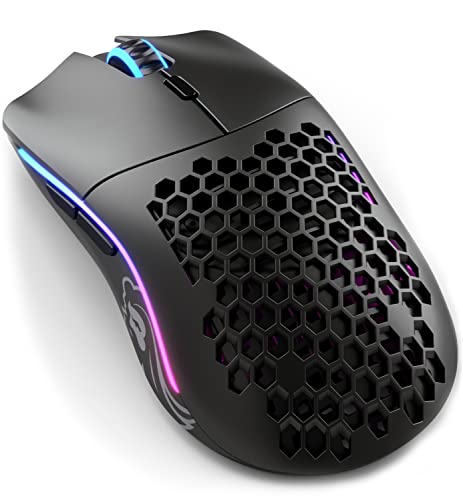
The Glorious Model O Wireless takes a different route to lightweight: instead of chasing the lowest possible number, its listing publishes a 69 g weight in a full-size ambidextrous shape. That extra size matters for palm and relaxed claw grips — there is more shell under your hand, which many players find steadier for tracking-heavy games, while 69 g still qualifies as genuinely light and keeps swipe effort low. The Matte Black finish keeps the look understated, and the mouse includes RGB lighting for players who want their setup to match.
The published connection is 2.4 GHz wireless, the same low-latency standard as the HyperX, so there is no compromise on responsiveness for gaming. Glorious publishes a battery-life figure of 71 hours on the listing, which is shorter than the Pulsefire Haste’s published figure but still covers many days of regular play between charges. One note on research discipline: this listing does not publish a sensor name or DPI figure in the material we verified, so we do not cite one — if sensor specifications are a deciding factor for you, check the current listing for the latest published details. What is verified is the combination that defines this category: 69 g, 2.4 GHz wireless, and multi-day battery life from a mid-tier line.
Specs
- Weight: 69 g
- Connection: 2.4 GHz wireless
- Battery life: 71 hours (published battery-life figure)
- Lighting: RGB
- Color: Matte Black
See the Glorious Model O Wireless on Amazon
How to choose
Start with the weight, and insist on a published number. “Lightweight” has no legal definition, and plenty of mice are marketed with the word while weighing as much as ordinary models. The useful threshold is under about 75 g for a wireless mouse; both picks here publish figures in the 60s. If a listing does not state a weight anywhere, treat that as a warning sign and move on — the brands that build genuinely light mice publish the number prominently, as both of these do.
Check the connection type before anything else. For gaming, you want 2.4 GHz wireless via a USB receiver. It delivers the low-latency, 1 ms-class response that wired mice set as the standard. Bluetooth is fine for office work and travel, but it is not the connection to build a gaming setup around. Both mice in this guide publish 2.4 GHz wireless, which is why they qualify as gaming mice and not just light mice.
Think about how the weight was achieved. The Pulsefire Haste uses a honeycomb shell — visible cutouts that shed grams and let air circulate, at the cost of an open shell that some players dislike the feel of and that can collect dust. The Model O Wireless reaches 69 g in a more conventional shell. Neither approach is wrong; they feel different in the hand, and grip style decides which suits you. Fingertip players tend to prefer the lightest, smallest option; palm players usually prefer more shell contact even at a few grams more.
Compare published battery figures, but read them carefully. Battery numbers are measured under each brand’s own conditions, so they are best used as rough comparisons rather than guarantees. Even so, the gap here is real information: up to 100 hours (HyperX) against a 71-hour published figure (Glorious) tells you the Pulsefire Haste is built to go longer between charges. If you dislike charging cables on your desk, that difference compounds over months of use.
Match the button layout to your games. The Pulsefire Haste publishes six programmable buttons — enough for shooters and general play, where two side buttons handle melee, ping, or push-to-talk duties. If you play games that demand many more binds, neither mouse in this guide is the tool for that job, and you should look at MMO-style mice instead, accepting the extra weight that comes with them.
Remember that “under 100” describes a tier, not a fixed tag. These picks come from lines positioned below each brand’s flagship range, which is the honest way to shop this budget: the specification sheet — weight, connection, battery — is what you are buying, and those published specs do not change when a listing’s price drifts. Check the live listing for the current price before ordering.
Who should skip
Skip both of these mice if you want a flagship esports mouse. The pro-tier ultralights from the major brands add higher-end sensors, higher polling options, and even lower weights, and if you play competitively at a level where those margins matter, the flagship lines exist for you — they simply are not the value tier this guide covers. Also skip these picks if you need a mouse with a large programmable button grid for MMO or MOBA play; six buttons and a standard layout are not a substitute for a dedicated side panel.
You should also look elsewhere if you strongly prefer a solid shell with no cutouts and dislike the feel of honeycomb designs — that rules out the Pulsefire Haste specifically, though the Model O Wireless remains an option. And if your priority is the absolute longest possible battery life at any weight, heavier productivity-leaning wireless mice publish larger battery figures; they give up the lightweight handling that is the entire point of this category.
FAQ
What counts as a lightweight wireless gaming mouse?
There is no official standard, but the working threshold most players use is under about 75 g for a wireless model. Both picks in this guide publish weights in the 60 g range — 61 g for the HyperX Pulsefire Haste Wireless and 69 g for the Glorious Model O Wireless — which puts them firmly in lightweight territory compared with the 90–110 g that ordinary wireless gaming mice typically weigh.
Is 2.4 GHz wireless fast enough for gaming, or do I need a wired mouse?
A 2.4 GHz connection via USB receiver is the established low-latency standard for wireless gaming, and the Pulsefire Haste’s listing publishes a 1 ms report rate — the same response figure associated with wired gaming mice. For the play this tier of mouse is aimed at, a 2.4 GHz link is not a compromise; it is the normal competitive setup. Bluetooth, by contrast, is the connection to avoid for gaming.
How long will the battery actually last between charges?
HyperX publishes up to 100 hours for the Pulsefire Haste Wireless, and Glorious publishes a 71-hour battery-life figure for the Model O Wireless. Real-world life depends on your usage patterns and settings, so treat the published numbers as the brands’ rated figures under their own test conditions — but either mouse should cover many days of regular play before it needs a cable.
Does the honeycomb shell on the Pulsefire Haste cause problems?
The cutouts are how the mouse reaches its published 61 g, and they are a deliberate trade: you get the lightest verified option in this guide, plus airflow across the palm, in exchange for an open shell that can gather dust over time and feels less solid to players who prefer a closed design. It is a preference call, not a defect — if the idea bothers you, the Model O Wireless reaches 69 g in a more conventional shape.
Final verdict
For the best lightweight wireless gaming mouse under 100, the HyperX Pulsefire Haste Wireless is the pick for most players: it publishes the lightest weight here at 61 g, pairs its 2.4 GHz wireless connection with a 1 ms report rate, offers an optical sensor rated up to 16,000 DPI, and publishes the longest battery figure in the guide at up to 100 hours. The Glorious Model O Wireless is the better choice if you want a larger ambidextrous shape and RGB lighting and are happy at a still-light 69 g with a published 71-hour battery figure. Both come from non-flagship lines, both publish their defining specifications openly, and both deliver the core of the ultralight wireless experience — low weight, a real gaming connection, and multi-day battery life — without flagship positioning.
Product and ASIN Reference
| Product | ASIN |
|---|---|
| HyperX Pulsefire Haste Wireless | B09TLCRGMN |
| Glorious Model O Wireless (Matte Black) | B098RDFP3J |
Related guides
More from Amazon
Programs that pair well with the guide above. Offers and eligibility are set by Amazon and may change.
Free shipping on eligible items, Prime Video and more. Eligible new members can start with a free trial.
Start a Prime free trialAd-free music streaming. Eligible new subscribers can start with a free trial.
Try Music Unlimited freeA Prime membership for ages 18-24 with a trial period. Eligibility is set by Amazon.
See Prime for Young AdultsAudiobooks and podcasts to listen to on the go. Eligible new members can start with a free trial.
Try Audible freeAs an Amazon Associate we earn from qualifying purchases.