The phrase solar RV batteries covers two jobs that look similar on a shopping page but behave very differently on the road. One is storing the energy your roof panels collect so you can run lights, a fridge, a water pump, and a laptop after sunset. The other is simply keeping a starter battery topped off in storage. This guide is about the first job: house batteries that pair with solar panels, charge controllers, and inverters in a motorhome, travel trailer, or camper van.
For most RV owners in 2026 that now means lithium iron phosphate, often written LiFePO4, in a 12-volt format. The decision comes down to total capacity in amp-hours or watt-hours, whether to buy one battery or a pair, what built-in protection the battery management system offers, and whether you need a complete solar kit or only a battery. The listings below span single 100Ah batteries, two-battery packs, one very large 300Ah unit, and a starter kit with panels.
Our Top Picks
Top 3 picks at a glance
Quick Picks
As an Amazon Associate we earn from qualifying purchases at no extra cost to you.




| Product | Best for | Key spec from the title |
|---|---|---|
| 12V 100Ah LiFePO4 Group 31 | A first lithium upgrade | 100A smart BMS, 15000+ deep cycles, 1280Wh |
| Dyness 12V 100Ah 2-Pack | Doubling capacity from the start | Two Group 31 batteries, A+ grade cells, low-temp protection |
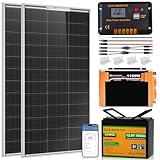
| ECO-WORTHY 200W Solar Kit | Starting solar from scratch | 2x100W panels, 30A charge controller, battery and inverter |
| BUKNUWO 12V 100Ah with Bluetooth | Monitoring from a phone | Bluetooth, 15000+ cycles, RV, marine and solar use |
| 12V 100Ah LiFePO4 2-Pack Group 31 | Larger bank without extra shopping | Two batteries, 100A BMS, low-temp protection |
| Rvpozwer 12V 300Ah | Big loads and long stays off-grid | 3840Wh, 200A BMS, 15000 deep cycles |
How to Choose
Capacity: Amp-Hours and Watt-Hours
Multiply amp-hours by voltage to get watt-hours, so a 12V 100Ah battery stores roughly 1280Wh, matching the figure in the first title. A typical weekend setup with LED lights, a compressor fridge, phone charging, and a fan might use 600 to 1,000Wh per day, so one 100Ah battery gives you about a day of autonomy. Two batteries doubles it, and a 300Ah unit, at 3840Wh, can carry several days of moderate use. Size your bank to your loads, not to the largest number on the box.
Battery Management System and Cold Weather
A built-in battery management system, or BMS, protects against over-charge, over-discharge, short circuits, and overheating. A 100A BMS lets a 100Ah battery deliver one hour at full draw, enough for a microwave through an inverter in short bursts, while a 200A BMS suits bigger loads. Low-temperature protection stops charging below freezing, which prevents damage to the cells. If you winter-camp or park in cold climates, make sure that feature is named in the title.
Cycle Life, Group Size, Fit, and Wiring
Figures like 15000 deep cycles are best read as manufacturer claims in ideal conditions. Even a fraction of that outlasts lead-acid batteries by years. Group 31 is a standard case size, so a Group 31 lithium battery can replace a lead-acid unit in an existing battery box. A 300Ah battery is much larger, so measure the compartment and plan for weight before buying.
A lithium battery is only as safe as the wiring around it. Use a fuse or breaker sized to the BMS limit, cable gauge matched to the current, and a charge source set to a lithium profile, typically around 14.4 volts for 12V packs. Solar is only one input: many RVers also charge from the alternator through a DC-to-DC charger and from shore power. A bank sized with all three in mind recovers faster after cloudy days than one that depends on panels alone.
Complete Kit Versus Battery Only
A kit with panels, controller, and inverter saves time but locks you into the included components, and the inverter size in a starter kit may not match what your appliances need. A battery-only purchase lets you pick panels and a charge controller that suit your roof space. Where budget models cut corners is usually in monitoring, terminals, and documentation, not in the cells themselves, so look for a Bluetooth monitor if you want to track state of charge.
A note on what this list leaves out: small trickle chargers, 20-watt maintainer panels, and rechargeable AA cells for garden lights are useful products, but they do not power an RV, so they are not covered here. Everything below is a deep-cycle battery or a kit built around one.
The 6 Best Options
12V 100Ah LiFePO4 Group 31
This single battery lists a built-in 100A smart BMS, 15000+ deep cycles, 1280Wh of capacity, and low-temperature protection. In Group 31 form it can drop into many existing battery trays. It suits an owner swapping out one lead-acid house battery for a lithium unit.
- Strength: a standard Group 31 size eases the swap.
- Strength: 100A BMS and low-temperature protection are both stated.
- Trade-off: a single 100Ah battery limits how long you can run loads without sun.
For a van or small trailer with LED lighting, a vent fan, a water pump, and device charging, one battery of this size is a clean starting point, and a second identical unit can be added later for more storage. Skip it if you plan to run an air conditioner or a large inverter.
Dyness 12V 100Ah LiFePO4 (2 Pack)
The Dyness pack bundles two 12V 100Ah LiFePO4 batteries in BCI Group 31, with low-temperature protection, A+ grade cells, and a built-in 100A BMS. Two batteries give about 2560Wh when wired in parallel, a sensible starting bank for a travel trailer. It suits owners who want matching batteries from the start.
- Strength: two matched batteries support a bigger bank immediately.
- Strength: A+ grade cells are called out in the title.
- Trade-off: the pack costs more up front than a single battery.
Because both batteries ship together, they begin life at the same age and state, which avoids the mismatched-bank problem that trips up owners who add a battery a year later. Skip it if your needs are small and a single battery will do.
ECO-WORTHY 200 Watt 12V Solar Kit
The ECO-WORTHY kit combines two 100W solar panels, a 30A charge controller, a battery, and an inverter for RV and off-grid use. It is the only complete system on this list and suits a first-time solar buyer who wants all components from one source. The title is truncated, so confirm the battery capacity and inverter size on the full listing.
- Strength: panels, controller, battery, and inverter arrive together.
- Strength: 200 watts of panels is a workable start for light loads.
- Trade-off: the included battery and inverter may be smaller than your loads need.
Many first-time buyers like the single-box approach because it removes guesswork about connectors and wire sizes, though panel mounting hardware and cabling to the RV roof may still need separate shopping. Skip it if you already own panels or want a large bank.
BUKNUWO 12V 100Ah LiFePO4 with Bluetooth
The BUKNUWO lists Bluetooth, 15000+ cycles, a 12.8V 100A rating, and uses that span trolling motors, off-grid power, boats, RVs, marine, and solar. The Bluetooth feature lets you check battery status from a phone, which suits people who like to monitor charge on the road.
- Strength: Bluetooth monitoring shows state of charge without extra gear.
- Strength: broad use list covers RV, marine, and solar.
- Trade-off: the title gives limited detail on low-temperature protection.
Owners who split time between a boat and an RV, or who add a trolling motor, may value that flexibility. Skip it if you camp in freezing weather and need confirmed cold-charge protection.
12V 100Ah LiFePO4 2-Pack Group 31
This 2-pack lists Group 31 batteries with a built-in 100A BMS and low-temperature protection, with up to 15000 deep cycles, aimed at RV and marine use. It is similar to the Dyness pack in format and suits owners who want two batteries from a less-known source at once.
- Strength: two batteries in one purchase double capacity.
- Strength: low-temperature protection and 100A BMS are both listed.
- Trade-off: the brand has less detail in the title than the Dyness pack.
If you go this route, read the full listing for the warranty and for how the batteries should be wired together, since parallel connections need matched cable lengths for even sharing. Skip it if you prefer a named manufacturer or only need one battery.
Rvpozwer 12V 300Ah LiFePO4
The Rvpozwer is a 12V 300Ah battery storing 3840Wh, with a 200A BMS, 15000 deep cycles, and low-temperature protection. It suits a full-time RVer or a camper with an inverter running a microwave or coffee maker. One large unit replaces three 100Ah batteries.
- Strength: 3840Wh of storage supports multi-day stays.
- Strength: a 200A BMS handles heavier loads.
- Trade-off: a single large case is heavy and needs a spacious compartment.
It also simplifies wiring because a single large battery avoids parallel connections between several smaller ones. Skip it if your battery bay is small or you want to spread capacity across units.
Which One Fits Your Situation
You Are Replacing One Lead-Acid House Battery
The 12V 100Ah LiFePO4 Group 31 is the straightforward swap. Its standard case size should drop into an existing tray.
You Are Building Solar From Zero
The ECO-WORTHY 200 Watt Kit provides panels, controller, battery, and inverter in one box. Confirm the missing details on the full listing before buying.
You Boondock for Several Days
Go with the Rvpozwer 12V 300Ah or the Dyness 2-Pack. Both give a large bank, and the Rvpozwer concentrates it in one case.
You Want Phone Monitoring
The BUKNUWO with Bluetooth is the pick. Pair it with a second battery later if capacity falls short.
When two options look equal on paper, confirm the return window and the warranty length, because these batteries are expensive to ship back. If you are splitting hairs, favor the battery with the clearest protection details and the right capacity for your loads. A slightly smaller bank with confirmed cold protection beats a larger one that cannot charge on a freezing morning.
Common Mistakes
- Buying a battery without adding up the daily watt-hours of your appliances.
- Skipping low-temperature charge protection when you camp in cold weather.
- Pairing a large inverter with a battery whose BMS limit is too low.
- Mixing batteries of different capacity or age in the same bank.
- Counting a trickle charger or small solar maintainer as a house power system.
Related guides
- When I Turn On Record Game In Background On Gamebar. Gamebar Crashes, What Do I Do?
- How To Reduce Background Noise On A Streaming Microphone
- Poly Computer Accessories Company Streaming Evaluation
Frequently Asked Questions
How many batteries does an RV need?
It depends on daily use. Light weekend camping can run on one 100Ah battery, while full-time living needs several hundred amp-hours.
Can I use lithium batteries with existing solar panels?
Often yes, but check that your charge controller has a lithium setting. Some older lead-acid controllers do not charge lithium correctly.
Is LiFePO4 safe for RVs?
The chemistry is considered stable, and a built-in BMS adds protections. Still, follow the manufacturer’s wiring and fusing instructions, and keep the battery in a ventilated, protected compartment.
What does Group 31 mean?
It is a standard battery case size used in many RV and marine compartments, which makes swapping easier. Always confirm the exact case dimensions against your battery tray, since small differences between brands can keep a battery from fitting.