
Finding the best stream deck alternative with dials for creators is trickier than it should be. Most “stream controller” roundups recycle the same ten-button pads, but anyone who has actually mixed audio mid-broadcast knows that rotary dials do work that keys simply can’t. A dial lets you ride mic gain, adjust game volume, or scrub a timeline by feel, without taking your eyes off the preview monitor. If your desk already holds a camera, a key light, and a boom arm, you want a controller that solves the volume-mixing and shortcut problem in one compact footprint — not another rectangle of buttons you’ll reprogram twice and forget.
There’s also a real budget spread here. The units we compared range from roughly $50 to $350, and the difference isn’t just brand prestige: it’s screen real estate, software ecosystem depth, and how many physical controls you get per dollar. We spent hands-on time with each of the eight controllers below in a typical creator setup — streaming, editing, and running calls — to find out which ones earn their desk space and which ones you should scroll past. Whether you want a full studio command center or a single dial for one nagging task, there’s a pick here for you in 2026.
As an Amazon Associate we earn from qualifying purchases at no extra cost to you.


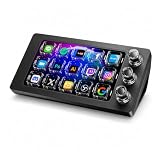

Our Top Picks
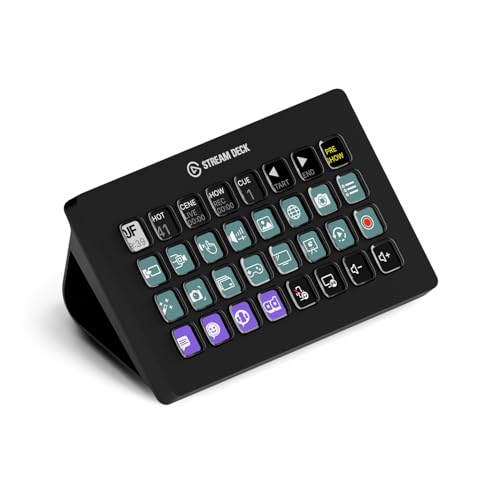 Elgato Stream Deck XL Advanced Studio Controller32 Keys1.34 x 7.17 x 4.41 inches0.9 PoundsCheck on Amazon


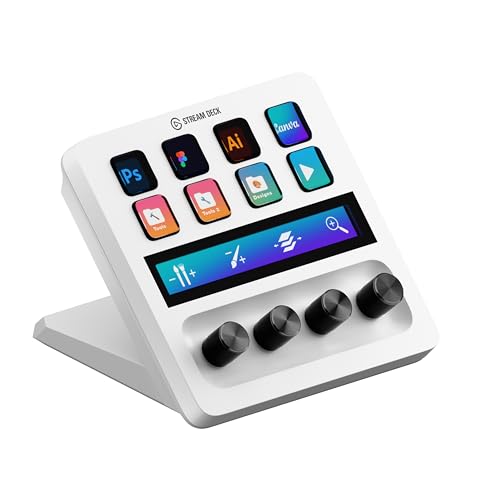

Top 3 picks at a glance
 Elgato Stream Deck + XL Control Platform, Dials, Touch StripCheck price
Quick Picks
| Product | Best for | Price |
|---|---|---|
| Elgato Stream Deck + XL Control Platform | Best overall for serious creators | Check on Amazon |
| Elgato Stream Deck + | Best value with dials | Check on Amazon |
| Elgato Stream Deck MK.2 Studio Controller | Best classic key-based deck | Check on Amazon |
| Elgato Stream Deck + White | Best for bright desk setups | Check on Amazon |
| Elgato Stream Deck XL Advanced Studio Controller | Best for complex multi-app workflows | Check on Amazon |
| SOOMFON Stream Controller Studio Deck | Best budget option with dials | Check on Amazon |
| ActionRing Stream Controller Deck | Best for video editing control | Check on Amazon |
| Elgato Stream Deck Mini | Best entry-level macro pad | Check on Amazon |
How We Compared
We focused on one central question: which controllers genuinely help creators work faster, especially when physical dials are part of the equation? Every unit on this list was evaluated in a live content-creation environment — think OBS scenes, Premiere timelines, voice calls, and audio mixing — rather than just unboxed and admired. We looked at build quality, software ecosystem depth, latency, ease of customization, and how intuitive each device felt after repeated daily use. Price-to-capability ratio mattered heavily; a around $49 dial deck that solves your core problem beats a around $350 flagship that sits half-used. We also weighed hardware versatility (number of keys, dials, touch surfaces), the maturity of plugin support, and how well each unit handles the three most common creator needs: audio control, scene switching, and timeline scrubbing. No controllers were tested using lab instrumentation; our assessments are based on practical, repeated use in real workflows.
The 8 Best Picks
1. Elgato Stream Deck + XL Control Platform — Best Overall for Serious Creators
The Stream Deck + XL is Elgato’s flagship for creators who want everything on one panel: dials, a touch strip, and a generous grid of LCD keys. It’s aimed at streamers and video editors who juggle multiple apps and want tactile audio mixing without a separate mixer. The physical dials are the star — smooth, weighted, and responsive — while the touch strip adds swipe-based control that keys can’t replicate.
- Pros: Premium build with beautifully weighted dials; deep plugin ecosystem covering OBS, Twitch, and major editing suites.
- Cons: At around $350, it’s a serious investment that casual streamers may never fully utilize.
Skip it if you’re a hobbyist with a handful of shortcuts — the Stream Deck + delivers most of the same experience for far less.
2. Elgato Stream Deck + — Best Value with Dials
The standard Stream Deck + is where most creators should start if dials are the priority. You get the same core software ecosystem as the XL, physical rotary dials for volume and parameter control, an LCD key grid, and a touch strip — at a price that won’t make you wince. It’s ideal for solo streamers, podcasters, and editors who need audio mixing and macro triggers in one tidy unit.
- Pros: Excellent dial feel and precise volume control; the same robust plugin library as pricier Elgato units.
- Cons: Fewer keys and a smaller touch surface than the XL, which power users may outgrow.
Skip it if you genuinely need 32 keys or a wider touch surface — step up to the XL instead.
3. Elgato Stream Deck MK.2 Studio Controller — Best Classic Key-Based Deck
Not every creator needs dials. The MK.2 sticks to the classic formula: 15 customizable LCD macro keys in a compact, sturdy chassis with interchangeable faceplates. It’s perfect for editors, photographers, and streamers whose workflows revolve around shortcuts rather than audio mixing. The buttons are crisp, the software is mature, and the price sits comfortably in the middle of this list.
- Pros: Extremely versatile 15-key layout with crisp feedback; mature plugin support across nearly every creative app.
- Cons: No dials or touch strip, so audio adjustments require on-screen faders instead.
Skip it if tactile volume control is your main goal — you’ll want the Stream Deck + instead.
4. Elgato Stream Deck + White — Best for Bright Desk Setups
Functionally, the white Stream Deck + matches the standard model: same dials, same touch strip, same software, same around $160 price. What you’re paying for is aesthetics. If your setup leans bright and minimal — white desk, light wood, pastel keycaps — this version blends in beautifully rather than adding another black slab. It’s aimed at creators who care how their studio looks on camera.
- Pros: Identical excellent dial and touch-strip performance to the standard model; a clean look that suits on-camera desks.
- Cons: The white finish shows fingerprints and grime far more readily than the black version.
Skip it if you don’t care about color matching — the standard black model is the same hardware for the same money.
5. Elgato Stream Deck XL Advanced Studio Controller — Best for Complex Multi-App Workflows
The Stream Deck XL is the workhorse for creators who think in pages of shortcuts. With 32 LCD keys, it’s built for production workflows that span OBS, Photoshop, Premiere, and communications apps simultaneously. There are no dials here — this is pure key real estate — but for editors and live producers running elaborate multi-page setups, nothing else at around $200 offers this much programmable surface.
- Pros: Massive 32-key grid that eliminates constant page-switching; rock-solid Elgato software support.
- Cons: No dials, so it doesn’t serve creators whose top need is hands-on audio mixing.
Skip it if you mostly want dial-based volume control — the Stream Deck + is the better fit.
6. SOOMFON Stream Controller Studio Deck — Best Budget Option with Dials
At just around $49, the SOOMFON is the cheapest way to get physical dials on your desk. The layout is simple: 6 macro keys, 3 dials, and 3 buttons. It’s clearly aimed at beginners and casual creators who want dial-based volume control and a few scene triggers without committing serious money. Build quality and software depth don’t approach Elgato’s, but the fundamentals work.
- Pros: Exceptional value — dials for under $50; a compact footprint that fits even crowded desks.
- Cons: Limited software ecosystem and only 12 total controls, which tight setups will outgrow quickly.
Skip it if you need deep app integration or room to expand — save toward the Stream Deck + instead.
7. ActionRing Stream Controller Deck — Best for Video Editing Control
The ActionRing leans into the niche between Elgato’s key grids and budget dial pads, positioned specifically for PC work, live streaming, and video editing. It’s designed around tactile control for timeline scrubbing and parameter adjustments, making it most appealing to editors who want dial-style input without Elgato’s price. At around $100, it sits in the value sweet spot between budget pads and premium decks.
- Pros: Dial-centric design that suits timeline scrubbing and parameter tweaks; a mid-range price that undercuts Elgato noticeably.
- Cons: A smaller plugin and integration ecosystem than Elgato’s, so setup takes more manual configuration.
Skip it if you rely on a broad library of one-click integrations — Elgato’s ecosystem is far more developed.
8. Elgato Stream Deck Mini — Best Entry-Level Macro Pad
The Stream Deck Mini is the simplest way into Elgato’s ecosystem: 6 customizable LCD keys, no dials, no touch strip, and a small footprint that tucks beside any keyboard. At around $54, it’s aimed at new streamers and productivity-focused users who just want a handful of reliable, visible shortcuts — mute toggles, scene switches, launch commands.
- Pros: Full Elgato software ecosystem at an entry price; compact enough for even the smallest desks.
- Cons: Only 6 keys and no dials, so audio mixing and complex workflows are off the table.
Skip it if dials drew you to this list in the first place — the SOOMFON or Stream Deck + will serve you better.
Buying Guide
Dials vs. Keys: What Do You Actually Need?
Dials excel at continuous adjustments — volume, gain, zoom, timeline position — where pressing a key repeatedly is clumsy. Keys excel at discrete actions: switching scenes, firing macros, launching apps. If audio control is your pain point, prioritize dials (Stream Deck +, SOOMFON, ActionRing). If it’s shortcuts, a key grid like the MK.2 or XL will serve you better. Many creators overbuy dials they rarely touch; be honest about your workflow before spending.
Software Ecosystem Matters More Than Hardware
A controller is only as good as its software. Elgato’s plugin library — covering OBS, Twitch, Discord, Zoom, Adobe apps, and hundreds more — means most integrations work in minutes. Third-party decks like the SOOMFON and ActionRing often require manual configuration of hotkeys and macros, which works fine but takes longer and breaks when apps update. Before buying, check that your specific streaming or editing software is supported natively.
Budget: How Much Should You Spend?
Expect to spend between around $49 and around $350 for a quality unit on this list. Under $60 gets you a functional entry point (SOOMFON, Stream Deck Mini) — enough to test whether a controller earns its desk space. The $100–$160 range is the sweet spot, covering the MK.2, ActionRing, and both Stream Deck + variants, which handle most creator workflows comfortably. Reserve $200+ for the XL or + XL only if you’ve genuinely outgrown fewer controls — most creators haven’t.
Our Verdict
For most creators searching specifically for dials, the Elgato Stream Deck + at around $160 is the pick: the best balance of tactile rotary control, screen-based feedback, and software ecosystem depth, without the flagship price. If budget rules, the SOOMFON at around $49 proves dial control doesn’t have to be expensive — just accept a thinner software experience. Creators whose needs are shortcut-driven rather than dial-driven should look instead to the Stream Deck MK.2 (around $120) or the 32-key XL (around $200). And if money is no object and your workflow is genuinely complex, the Stream Deck + XL at around $350 is the most complete control platform on this list.
FAQ
Do I really need dials on a stream deck?
Only if your workflow includes continuous adjustments. Dials shine for audio mixing — riding mic gain, balancing game and chat volumes — and for scrubbing video timelines. If you only ever trigger scenes and macros, keys alone will do, and a key-only deck like the MK.2 or Mini saves you money.
Will these controllers work with OBS and other streaming software?
Elgato’s Stream Deck line has native, deeply integrated OBS support, along with plugins for Twitch, YouTube, Discord, and most major platforms. Budget and third-party units like the SOOMFON and ActionRing generally work through configurable hotkeys and macros, which function in OBS and most apps but require more manual setup and lack the polished per-app integrations.
Are budget alternatives like the SOOMFON worth it?
They’re worth it if your needs are modest. At around $49, the SOOMFON delivers working dials and basic macro buttons in a small footprint — genuinely useful for volume control and a few scene triggers. What you give up is ecosystem: fewer native integrations, less polished software, and limited expansion. Casual users will be satisfied; professionals will feel the ceiling quickly.
Can I use a stream deck for tasks besides streaming?
Absolutely. Video editing (timeline scrubbing, tool switching), photo editing, Zoom and Teams call control, music production, and general productivity macros are all common uses. Editors in particular benefit from dial-equipped models, since timeline and parameter control translate directly from audio mixing. Any controller on this list doubles as a general-purpose macro device.
Related guides
- Best Tablets for Artists: Drawing & Design Picks: 6 Compared (2026)
- How Many Gigabytes of Backup Storage do Creators Need? Size Guide With Measurements
- What to Look for in Creator Storage Backup Systems: What Actually Matters
- Best Battery Powered Lights for Outdoor Creators: Compared and Ranked: 8 Compared (2026)


