Our Short List of 3

- Best for: Teachers and tutors who want to stream or record lessons without buying a separate camera first.
- Magnification: 40X-2500X (40X, 100X, 250X, 400X, 1000X, 2500X)
- Eyepieces: wide-field 10X and 25X
- Objectives: four DIN achromatic, 4X, 10X, 40X (spring), 100X (spring, oil)
- Head: trinocular Siedentopf, 30-degree inclined, 360-degree rotatable

- Best for: Schools and tutors who already own a microscope camera, or want to pick a higher-resolution camera separately.
- Magnification: 40X-2500X (40X, 100X, 250X, 400X, 1000X, 2500X)
- Eyepieces: wide-field 10X and 25X
- Objectives: four DIN achromatic objectives
- Head: trinocular Siedentopf with a dedicated camera port

- Best for: Classrooms and labs that already use C-mount or DSLR cameras and demonstrate to a room while streaming.
- Magnification: 40X-2000X, eight settings
- Eyepieces: wide-field 10X pair and 20X pair
- Objectives: DIN achromatic 4X, 10X, 40X, 100X
- Head: simul-focal trinocular Siedentopf, 30-degree inclined, 360-degree swiveling
All 3 Picks at a Glance
| Product | Specs | Action |
|---|---|---|
| SWIFT SW350T with 1.3MP Camera |
| Check price on Amazon |
| Swift SW380T |
| Check price on Amazon |
| AmScope T490B |
| Check price on Amazon |
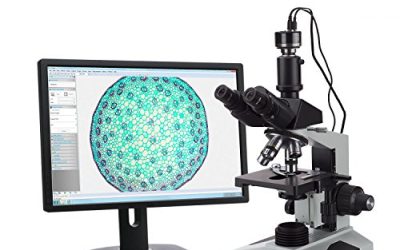
Buying a trinocular microscope for teaching is really a decision about the camera tube, not the headline magnification. The third port decides what your students see on the projector or stream: whether a camera is included, whether the screen image stays in focus with the eyepieces, and whether the software plays nicely with the laptop running your lesson. Two scopes with identical optics can produce completely different streaming experiences.
This guide is for classroom teachers demonstrating slides live, online tutors streaming lab sessions, and homeschool or university lab instructors who record demonstrations for students to rewatch. Every pick below is a true trinocular compound microscope sold on Amazon, chosen from the specifications on its product page, with the camera arrangement called out for each one so you can match it to the setup you already own.
Our Top Picks
Top 3 picks at a glance
Quick Picks
As an Amazon Associate we earn from qualifying purchases.
| Product | Best for | Key spec from title |
|---|---|---|
| SWIFT SW350T with 1.3MP Camera | Streaming lessons out of the box | 40X-2500X trinocular with a 1.3MP USB camera included |
| Swift SW380T | Teachers adding their own camera later | 40X-2500X, camera-compatible trinocular port |
| AmScope T490B | Classrooms with a C-mount or DSLR camera | 40X-2000X simul-focal head with C-mount adapter |
How to Choose
Decide Whether the Camera Is Included or Just Supported
A trinocular head only gives you a place to mount a camera; it does not guarantee one is in the box. Some listings bundle a USB eyepiece camera with viewing software, so the microscope can feed a laptop and a streaming app the day it arrives. Others are camera-compatible, meaning the port is ready but the camera, and sometimes the adapter, is a separate purchase. For a teacher streaming next week, an included camera removes the compatibility guessing. For a department that already owns microscope cameras, a bare port avoids paying twice for the same hardware.
Check the Port Type and Focus Behavior
Eyepiece cameras slide into a 23.2mm tube, while larger sensors usually need a C-mount adapter, sometimes with a reduction lens to frame the full field. The other detail worth checking is whether the head is simul-focal. On a simul-focal trinocular, the camera image and the eyepiece image come to focus together, so what you sharpen for yourself is also sharp on the stream. With a basic port, focus can sit slightly off between the two views, and you end up refocusing every time you switch attention from the eyepieces to the screen during a live demonstration.
Match Eyepieces and Magnification to Your Slides
Most teaching scopes in this class pair two eyepiece sets with four objectives. A 10X and 25X pairing produces six settings up to 2500X, while a 10X and 20X pairing produces eight settings up to 2000X. For classroom work the practical ceiling is the 100X oil-immersion objective at 1000X with the 10X eyepieces; the higher settings mostly enlarge the same image for the camera. What matters more for streaming is the spread of low and mid settings, because pond water, onion skin, and cheek cells are demonstrated far more often than bacteria at maximum power.
Weigh Illumination and Stage Control for Live Demos
Your audience watches the camera feed, so illumination quality shows up on screen before optical quality does. LED systems run cool and hold a steady color during long streamed sessions, while halogen systems are bright and traditional but warm up and can shift as they age. A two-layer mechanical stage matters just as much on camera: it lets you track a moving specimen with the coaxial knobs instead of nudging the slide by hand, which keeps the subject centered in the frame instead of lurching it out of view mid-sentence.
The 3 Best Options
SWIFT SW350T with 1.3MP Camera
- Best for: Teachers and tutors who want to stream or record lessons without buying a separate camera first.
- Magnification: 40X-2500X (40X, 100X, 250X, 400X, 1000X, 2500X)
- Eyepieces: wide-field 10X and 25X
- Objectives: four DIN achromatic, 4X, 10X, 40X (spring), 100X (spring, oil)
- Head: trinocular Siedentopf, 30-degree inclined, 360-degree rotatable
Teachers and tutors who want to stream or record lessons without buying a separate camera first.
The camera software ships on a CD-ROM, so a laptop without a disc drive needs the downloadable version from Swift before the first session.
This is the shortest path from unboxing to a streamed lesson. The SW350T bundles a 1.3MP USB eyepiece camera that slides into the trinocular tube, connects over USB 2.0, and works with software for Windows and Mac, so the feed can go straight into your recording or streaming app. The scope itself covers six magnification levels from 40X to 2500X through wide-field 10X and 25X eyepieces, and the box includes 100 blank slides and 100 cover slips, which suits a teacher preparing demonstration material for a whole term of classes.
Swift SW380T
- Best for: Schools and tutors who already own a microscope camera, or want to pick a higher-resolution camera separately.
- Magnification: 40X-2500X (40X, 100X, 250X, 400X, 1000X, 2500X)
- Eyepieces: wide-field 10X and 25X
- Objectives: four DIN achromatic objectives
- Head: trinocular Siedentopf with a dedicated camera port
Schools and tutors who already own a microscope camera, or want to pick a higher-resolution camera separately.
No camera is included, so the port is only useful once you add an eyepiece or C-mount camera of your own.
The SW380T is the camera-ready counterpart to the bundle above: the same 40X to 2500X range and wide-field 10X and 25X eyepieces, but the trinocular port ships empty so you choose the camera yourself. That suits instructors who already own an eyepiece camera or plan to buy a higher-resolution one later, because nothing in the box duplicates what is on the shelf. Listing attributes give it an LED light source and a metal build at 9.46 pounds, and its precise coarse and fine focusing is the kind of detail that pays off when a specimen has to stay sharp on screen for a full lesson.
AmScope T490B
- Best for: Classrooms and labs that already use C-mount or DSLR cameras and demonstrate to a room while streaming.
- Magnification: 40X-2000X, eight settings
- Eyepieces: wide-field 10X pair and 20X pair
- Objectives: DIN achromatic 4X, 10X, 40X, 100X
- Head: simul-focal trinocular Siedentopf, 30-degree inclined, 360-degree swiveling
Classrooms and labs that already use C-mount or DSLR cameras and demonstrate to a room while streaming.
The halogen lamp is a consumable, and a spare 6V/20W bulb is included for a reason; keep it somewhere you can find it mid-term.
The T490B is built around the problem of keeping two views in focus at once. Its simul-focal trinocular head keeps the camera image focused while you focus through the eyepieces, and the 23mm photo port arrives with a C-mount adapter in the box, opening it up to a wide range of microscope cameras and adapted DSLR bodies. Eight magnification settings run from 40X to 2000X using the included 10X and 20X wide-field eyepiece pairs, and variable-intensity halogen illumination runs through an Abbe condenser. At 17.75 pounds it is a bench fixture rather than something you carry between rooms.
Which One Fits Your Situation
You Stream Lessons From a Laptop and Own No Camera Gear
Start with the SWIFT SW350T bundle. The included 1.3MP eyepiece camera and Windows and Mac software mean the microscope feeds your streaming or recording app without a separate camera order, an adapter hunt, or a compatibility gamble. The included slides and cover slips cover your first round of demonstration prep as well.
Your Department Already Has Cameras on the Shelf
The AmScope T490B puts your existing hardware to work. Its C-mount adapter is included, the simul-focal head keeps the projected image in step with your eyepieces, and the eight magnification settings give demonstrators finer steps for walking a class through a specimen. It is the natural fit for a shared teaching lab with an established camera kit.
You Are Buying the Scope Now and the Camera Next Budget Cycle
The Swift SW380T keeps the same magnification range and eyepieces as the streaming bundle while leaving the camera decision open. Teach through the eyepieces this term, then add the eyepiece or C-mount camera your budget allows later, knowing the trinocular port and focusing system were chosen with that upgrade in mind.
You Record Demonstrations Students Rewatch Later
Either camera path works, but pick based on who controls focus. If you record alone and narrate over the feed, the SW350T bundle is the simpler rig. If a second person presents while you operate the scope, the T490B’s simul-focal head keeps the recorded image sharp without the presenter stopping to correct focus between the eyepieces and the screen.
Common Mistakes
- Assuming “trinocular” means a camera is included, when many models only provide the empty port.
- Buying a camera before checking the port, then discovering the scope needs a C-mount adapter or a 23.2mm eyepiece camera.
- Judging by maximum magnification alone, when streamed lessons live at 40X to 400X and the 2500X settings add size, not new detail.
- Ignoring the software platform, then finding the bundled camera software does not support the laptop you teach from.
- Forgetting that halogen models need spare bulbs, while LED models trade that chore for a fixed light source.
Frequently Asked Questions
Can a trinocular microscope stream straight into Zoom or OBS?
Yes, once a camera is fitted. A USB eyepiece camera presents itself to the computer like a standard video source, so it can be selected inside Zoom, OBS, or recording software. The SW350T bundle includes that camera, while the SW380T and T490B need one added to the port before they can send any picture to a streaming app.
What camera fits the trinocular port on these scopes?
Two formats cover most cases. Eyepiece cameras slide into a standard 23.2mm tube, which is how the SW350T’s bundled 1.3MP camera mounts. Larger microscope cameras and adapted DSLR bodies use a C-mount thread instead; the AmScope T490B includes that adapter, while other scopes may need the adapter bought separately to match the camera you own.
Is 2500X actually better than 2000X for teaching?
Rarely in practice. Both ranges share the same objective set, and the difference comes from the second eyepiece pair, 25X instead of 20X, which enlarges the image without adding resolved detail. For streamed lessons the useful range is roughly 40X to 1000X. Choose between these scopes on the camera arrangement and port type rather than the larger number on the box.
Can students still look through the eyepieces while the class watches the stream?
Yes, that is the point of the trinocular design. Both eyepieces stay in use while the third tube feeds the camera, so the person at the bench keeps a normal binocular view. On a simul-focal head like the T490B’s, the two views also share a focus point, so the projected image stays sharp as the operator adjusts.
Related guides
More from Amazon
Programs that pair well with the guide above. Offers and eligibility are set by Amazon and may change.
Free shipping on eligible items, Prime Video and more. Eligible new members can start with a free trial.
Start a Prime free trialAd-free music streaming. Eligible new subscribers can start with a free trial.
Try Music Unlimited freeA Prime membership for ages 18-24 with a trial period. Eligibility is set by Amazon.
See Prime for Young AdultsAudiobooks and podcasts to listen to on the go. Eligible new members can start with a free trial.
Try Audible freeAs an Amazon Associate we earn from qualifying purchases.