
If you have ever stood in an empty room and clapped your hands, you know the annoying, metallic ring of flutter echo. Whether you are setting up a home recording studio, treating a dedicated home theater, trying to tame the echoes in a high-ceilinged living room, or simply wanting to make your Zoom calls sound professional, you need sound treatment. But as you begin shopping, you will quickly find yourself at a major crossroads: acoustic foam vs fiberglass panels for sound treatment.
The decision is not just about aesthetics; it is a choice between two entirely different materials with contrasting densities, installation methods, and price points. Many buyers make the mistake of choosing the cheapest option without realizing that different materials target different sound frequencies. If you choose the wrong one, you could end up with a room that still sounds boomy, muddy, or cluttered despite being covered in wall treatments. Let us break down the real science, costs, and practical realities of these two popular solutions so you can make the right investment for your home.
As an Amazon Associate we earn from qualifying purchases at no extra cost to you.


Top 3 picks at a glance
Quick Verdict
For budget-conscious creators, temporary renters, and those dealing strictly with high-frequency flutter echo (like vocal recording or keyboard clicking), acoustic foam is the most practical choice. However, if you require professional-grade audio performance, balanced frequency absorption (including low-end bass and low-mids), or a premium, furniture-grade aesthetic that blends seamlessly into your home decor, fiberglass panels are superior in every metric. While fiberglass requires a larger upfront investment, its durability and acoustic efficiency make it the preferred long-term solution for serious spaces.
Side by Side
To help you weigh your options at a glance, here is a direct comparison of how these two sound treatment materials perform across key household and performance categories.
| Feature | Acoustic Foam | Fiberglass Panels |
|---|---|---|
| Material Composition | Open-cell polyurethane foam | Compressed glass wool/mineral fiber with fabric wrap |
| Density & Weight | Very low density (approx. 1–1.5 lbs/cu. ft.); extremely light | High density (approx. 3–6 lbs/cu. ft.); moderately heavy |
| Acoustic Range | High frequencies (above 1000 Hz); poor bass absorption | Broadband (down to 125 Hz or lower depending on thickness) |
| Price Range | Budget-friendly ($1 to $3 per square foot) | Premium ($10 to $25+ per square foot) |
| Installation Effort | Very easy; mounts with double-sided tape or spray adhesive | Moderate; requires drywall anchors, Z-clips, or impaling clips |
| Durability & Lifespan | Low; prone to crumbling, dust collection, and UV yellowing | High; rigid frames and durable fabric coverings last decades |
| Maintenance | Hard to clean; collects dust easily; cannot be washed | Easy to vacuum or wipe down with a lint roller |
| Aesthetic Appeal | Industrial, utilitarian, or studio-like look | Polished, clean, resembles high-end wall art |
| Resale Value | Virtually zero (often destroyed during removal) | High; can be packed up, sold, or moved to a new home |
| Best For | Quick vocal booths, podcasting corners, and temporary setups | Home theaters, listening rooms, living spaces, and studios |
Where Acoustic Foam Wins
Acoustic foam has earned its place as a staple in the home recording community primarily because of its accessibility. For those operating on a tight budget, foam offers an incredibly low barrier to entry. If you are setting up a basic podcasting desk in a spare bedroom, you do not necessarily need heavy-duty bass traps. You simply need to stop your voice from bouncing off the wall directly in front of you. Lightweight solutions like the Focusound 52 Pack Acoustic Foam Panels 1″ x 12″ x 12″ Sound Proof Foam Panles Soundproofing Noise Cancelling Wedge Panels for Home Office Recoding Studio with 300PCS Double-Side Adhesive (priced at $36.99) allow you to spot-treat an entire workspace for less than the cost of a single restaurant meal.
Another major advantage of acoustic foam is the ease of installation and customization. Because it is made of open-cell polyurethane, it weighs mere ounces. You do not need to hunt for studs, drill holes, or worry about panels falling and injuring children or pets. Using simple adhesive solutions, you can mount panels in minutes. If you need to fit foam around an electrical outlet, a window frame, or an awkward corner, you can easily slice through the material with a standard utility knife or electric carving knife. Products like the 24 Pack 2” Thick Pyramid Acoustic Foam, Sound Proof Foam Panels for Walls (priced at $34.99) provide enough thickness to tame high-frequency reflections while remaining remarkably simple to shape and mount around existing room fixtures.
Where Fiberglass Panels for Sound Treatment Wins
When comparing acoustic foam vs fiberglass panels for sound treatment, fiberglass is the undisputed champion of acoustic physics. Sound waves are energy, and to stop them, that energy must be converted into heat through friction. Because compressed fiberglass is significantly denser than open-cell polyurethane foam, it offers far greater resistance to passing sound waves. While a standard 2-inch foam panel will only absorb high-pitched sounds, a 2-inch fiberglass panel can absorb mid-range and low-mid frequencies where muddy resonances and vocal “boominess” reside.
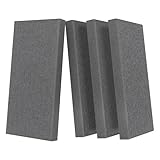
This superior density translates directly to a flatter, more natural-sounding room. If you only use foam, your room will end up “dead” in the high frequencies but still suffer from muddy bass buildup in the corners. Investing in a high-quality product like the 2 Pack Acoustic Panel 47.2″x23.6″ Soundproof Fiberglass Panel,Charcoal Grey (priced at $159.99) ensures balanced, broadband absorption. These large panels cover significant surface area, providing professional-grade performance that makes music, movies, and spoken word sound incredibly clear.
Aesthetics are another area where fiberglass panels completely outshine foam. Acoustic foam looks like a recording studio—which is fine for a dedicated backroom, but less than ideal for a shared living room or home office. Fabric-wrapped fiberglass panels look like high-end, minimalist wall art. The 4 Pack Acoustic Panel 23.6″x11.8″ Soundproof Fiberglass Panel,Charcoal Grey (priced at $92.99) offers a clean, architectural finish with bevelled edges and a textured fabric wrap that complements modern interior design. Furthermore, because the fiberglass core is rigid and framed, these panels do not sag, warp, or crumble over time, maintaining their pristine appearance for years.
Cost Over 5 Years
When evaluating the cost of acoustic foam vs fiberglass panels for sound treatment, it is crucial to look past the initial purchase price and consider the five-year total cost of ownership. Polyurethane foam is highly susceptible to environmental degradation. Exposure to oxygen and ultraviolet (UV) light causes the foam to oxidize, which leads to yellowing, loss of elasticity, and eventual crumbling. By the time 2026 rolls around, cheap foam installed today may already require replacement due to physical degradation or loss of adhesive grip.
Furthermore, foam is rarely reusable. Because it is typically glued directly to drywall using spray adhesives or strong double-sided tape, attempting to remove the foam usually tears the material to shreds and rips off the top layer of your drywall. The cost of repairing, patching, and repainting a damaged room can easily run between $150 and $300 in paint and supplies, completely wiping out any initial savings.
In contrast, fiberglass panels are a long-term asset. They are hung using picture wire, Z-clips, or simple drywall anchors, leaving minimal wall damage that can be patched in seconds with a dab of spackle. Because they are wrapped in durable, heavy-duty fabrics, they do not degrade from UV exposure or collect dust in a way that damages the internal structure. If you move houses, you can pack your fiberglass panels into boxes and reinstall them in your new home, or sell them on the secondary market where high-quality acoustic panels retain excellent resale value.
Which One for Your Home
Small Apartment
If you live in a tight space where floor and wall real estate is at a premium, lightweight acoustic foam is often the most practical choice. You can mount it using non-damaging adhesive strips, and its slim profile ensures it won’t crowd your living area. It is perfect for treating a small desk alcove to improve your daily work-from-home audio quality without requiring heavy mounting hardware.
Family with Kids and Pets
In a busy household, acoustic foam is a magnet for trouble. Curious toddlers love to pick at and tear soft foam, and cats view the textured surface as a vertical scratching post. For family rooms and play areas, fabric-wrapped fiberglass panels are the only logical choice. Their tough outer fabric resists punctures, and they can be easily vacuumed or lint-rolled to remove pet hair and dust.
Rental Property
Renters must always keep their security deposits in mind. Because gluing foam to walls causes extensive drywall damage, renters should opt for smaller, easily mountable fiberglass panels that hang like standard picture frames. A set of lightweight, fabric-wrapped panels can be hung using small nails or push-pin hangers, leaving virtually invisible holes when it is time to move out.
Long-Term Home
If you own your home and are designing a dedicated home theater, listening room, or high-end home office, invest in fiberglass panels. They offer superior acoustic performance across all frequencies, elevate the architectural aesthetic of your rooms, and provide a permanent solution that will perform beautifully for decades without needing to be replaced.
FAQ
Does acoustic foam block sound from neighbors?
No. This is the most common misconception in home acoustics. Acoustic foam is designed for sound treatment (absorbing reflections within a room to improve sound quality), not sound proofing (blocking sound from entering or leaving a room). Blocking sound requires dense mass and structural isolation, which lightweight foam cannot provide.
Are fiberglass panels safe to have in my home?
Yes. While raw fiberglass fibers can cause skin and respiratory irritation, commercial acoustic panels wrap the fiberglass core in tightly woven acoustic fabrics. This completely encapsulates the fibers, preventing them from escaping into the air. As long as the fabric cover remains undamaged, they are completely safe for bedrooms, living rooms, and offices.
How much wall coverage do I need for effective treatment?
For standard residential rooms, you do not need to cover every wall. For general speech clarity, home offices, and living rooms, 15% to 20% wall coverage is usually sufficient. For dedicated listening rooms, home theaters, or recording spaces, you may want to aim for 30% to 40% coverage, focusing primarily on the first reflection points.
Can I mix acoustic foam and fiberglass panels in the same room?
Absolutely. In fact, mixing the two can be a highly cost-effective strategy. You can place heavy fiberglass panels in the corners of your room to act as bass traps and at the primary reflection points on your side walls, while using cheaper acoustic foam tiles on secondary wall surfaces to catch remaining high-frequency flutter echoes.


