
Music streams are unforgiving in a way gaming streams are not. When you talk over a shooter, a slightly harsh or noisy microphone blends into the chaos. When you sing into it, every sibilant “s”, every room reflection, and every bit of self-noise sits naked in the mix. Choosing a microphone for singing and live music streaming means thinking about frequency response, self-noise, and how the capsule handles loud transients, not just whether it “sounds warm on voice”.
Top 3 picks at a glance
Condenser or dynamic for singing on stream?
The classic studio answer is a large-diaphragm condenser, and it is still the right call if your room is even mildly treated. Condensers capture the airy 8–12 kHz detail that makes vocals feel expensive, and their fast transient response flatters acoustic guitar and piano. The catch is sensitivity: a condenser will also capture your fridge, your mechanical keyboard, and the reflections off a bare wall.
As an Amazon Associate we earn from qualifying purchases at no extra cost to you.


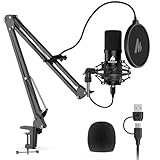

If you sing in an untreated bedroom, a broadcast dynamic (the kind everyone knows from podcasting) is the safer bet. It rejects room noise, tolerates loud belting without clipping, and forgives a boxy space. You lose a little top-end sparkle, but a clean, controlled vocal beats a detailed vocal drowning in echo.
Key specs that actually matter
| Spec | Target for singing | Why it matters |
|---|---|---|
| Self-noise (condenser) | Under 12 dBA | Quiet passages stay clean |
| Max SPL | 130 dB+ | Belting won’t distort the capsule |
| Polar pattern | Cardioid | Rejects sound from behind the mic |
| Frequency range | 20 Hz–18 kHz | Captures low body and air |
| Connection | XLR | Pairs with interface + phantom power |
Budget tiers and what you get
You do not need a $700 microphone to sound good on a music stream. Here is how the money maps to results.
| Budget | Type | What you get |
|---|---|---|
| $50–100 | USB dynamic/condenser | Plug-and-play, decent for singing covers |
| $100–180 | XLR dynamic | Broadcast clarity, great noise rejection |
| $180–350 | Large-diaphragm condenser | Studio-grade detail in a treated room |
| $350–600+ | Premium condenser | Diminishing returns unless mixing pro tracks |
Instruments change the answer
Singer-songwriters running vocals and an acoustic guitar into the same stream often do best with two microphones or a dynamic plus a DI box, so each source can be balanced independently. A pure keyboard or synth performer can skip the vocal-first logic entirely and route the instrument via line-in, using the microphone only for talkbreaks. Match the tool to the loudest and most important source.
Placement makes or breaks it
Even a great microphone sounds amateur 12 inches too far away. For singing, aim for 6–10 inches with a pop filter, angled slightly off-axis so plosives blow past rather than into the capsule. Back off another few inches when you belt to avoid overloading. A boom arm keeps the mic out of frame and lets you lean in for intimate passages, which is a real performance tool, not just tidiness.
Accessories that change the sound
A microphone never works alone on a music stream. A pop filter tames plosives on sustained notes, a shock mount isolates the capsule from desk thumps and foot taps that a sensitive condenser would otherwise capture, and a boom arm lets you close the distance for intimate passages and pull back when you belt. For quiet dynamic microphones, an inline preamp gain booster adds 20–25 dB of clean gain so your interface is not straining at maximum, which reduces hiss on soft singing.
Monitoring matters just as much as capture. Closed-back headphones let you hear yourself and any backing track without bleed into the microphone, and low-latency direct monitoring on your interface means you sing in time with what you hear. Budget roughly 20–30% of your microphone spend for these extras; a $180 dynamic with a proper stand, filter, and monitoring beats a $300 microphone flopping on a desk stand with earbuds.
FAQ
Can I use a gaming headset mic for singing streams?
You can, but you shouldn’t for anything music-focused. Headset mics are tuned for speech intelligibility around 1–4 kHz and roll off the lows and airy highs that give vocals body. They also sit inconsistently as your head moves. For casual talking that is fine; for singing it sounds thin and boxy.
Do I need phantom power for a singing microphone?
Only condensers need it. Every condenser requires 48V phantom power delivered by your audio interface or mixer. Dynamic microphones do not need it and are unaffected if it is switched on, so if you run both, leaving phantom power engaged is harmless for the dynamic.
Bottom line
For an untreated room, start with a broadcast XLR dynamic in the $120–180 range and a solid interface. Treat the room, then graduate to a large-diaphragm condenser once reflections are under control. Chasing an expensive capsule before fixing your space is the most common and most expensive mistake singers make on stream.


