
If you have swapped a webcam for a mirrorless or DSLR camera on your stream, the lens does more for your image than the camera body. The two focal lengths creators argue about most are 35mm and 50mm, and the choice changes how much of your room the viewer sees, how flattering you look, and how creamy that background blur gets. This guide breaks down the real trade-offs so you pick once and stop second-guessing.
As an Amazon Associate we earn from qualifying purchases at no extra cost to you.


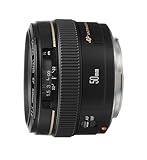

Top 3 picks at a glance
How focal length changes your on-camera framing
On an APS-C sensor (the most common size in creator cameras), a 35mm lens gives roughly a 52mm full-frame equivalent, while a 50mm lands near 75mm. That difference decides how far you must sit from the camera to fit your head and shoulders in frame.
Sitting distance matters more than you think
A 35mm lens on APS-C lets you frame a comfortable head-and-shoulders shot from about 60–90cm away, which fits most desks. A 50mm needs closer to 1.2–1.8m, which many streaming desks simply cannot provide without pushing the camera onto a tripod behind your monitor. If your camera lives on a desk mount, 35mm is usually the practical winner.
Background blur (bokeh): the 50mm advantage
Longer focal lengths compress the scene and throw the background further out of focus at the same aperture. Shoot both lenses at f/1.8 and the 50mm will render noticeably softer, larger bokeh circles behind you. If a clean, dreamy backdrop is your goal, 50mm has the edge, especially in a small room where you cannot move junk far from the wall.
| Factor | 35mm (APS-C) | 50mm (APS-C) |
|---|---|---|
| Full-frame equivalent | ~52mm | ~75mm |
| Ideal sitting distance | 60–90 cm | 1.2–1.8 m |
| Background blur at f/1.8 | Good | Stronger |
| Room shown behind you | More | Less |
| Face distortion up close | Slight | Minimal |
| Typical prime price | $180–350 | $150–300 |
Which flatters your face?
Wider lenses used up close exaggerate whatever is nearest the camera, usually your nose. At normal streaming distance a 35mm is fine, but if you lean in toward the mic often, the 50mm’s longer working distance keeps your features more natural. Portrait shooters have preferred the 75–85mm equivalent range for decades for exactly this reason.
Light and autofocus considerations
Both lenses are commonly sold as bright f/1.8 primes, so low-light performance is similar. The bigger practical issue is autofocus at wide apertures: at f/1.8 your depth of field can be just a few centimeters, so if you sway in your chair your eyes drift out of focus. Many streamers stop down to f/2.8–f/4 for a more forgiving focus zone and still get pleasant separation, especially on 50mm.
What about a 35mm on full frame?
On a full-frame body a 35mm becomes a true wide-normal lens, great for showing your setup, while a 50mm is the classic “normal” portrait-ish look. Full-frame sensors also blur backgrounds more at any focal length, so a 50mm f/1.8 on full frame is arguably the strongest single-person streaming look for under $250.
Aperture matters as much as focal length
Focal length sets your framing and compression, but aperture controls how much light and blur you get. A lens at f/1.8 gathers about four times more light than one at f/3.5, which lets you use lower ISO and get a cleaner image in a dim room. It also thins depth of field, so background separation is really a partnership between focal length and aperture, not focal length alone. A 35mm at f/1.8 can out-blur a 50mm stopped down to f/4.
Match the lens to your room, then buy lighting
Whichever focal length you pick, resist the urge to solve a dark room by shooting wide open at f/1.4. That razor-thin focus makes you drift out of sharpness every time you shift in your chair. A smarter path is a modest f/1.8 prime plus one good key light around 30W to 60W, which lets you shoot at f/2.8 to f/4 with a comfortable focus zone and still enjoy pleasant, natural background falloff.
FAQ
Can I just use a zoom lens instead?
You can, and a 24–70mm covers both ends. The catch is that most affordable zooms open only to f/3.5–5.6, which kills the background blur that makes camera streaming worth the hassle. A cheap f/1.8 prime usually beats a mid-range zoom for on-camera work.
Do I need image stabilization for a static stream?
No. Stabilization matters for handheld or IRL streaming. For a camera locked on a desk mount or tripod, save your money and put it toward a brighter aperture or better lighting instead.
Bottom line
Pick 35mm if your camera sits on the desk, your room is tight, and you want your setup visible behind you. Pick 50mm if you have 1.2m-plus of clearance and want the softest, most professional background blur. On a cramped streaming desk, most creators are happier long-term with a 35mm; if you have the space, a 50mm delivers the flattering, blurred look that made you consider a real camera in the first place.


