
Soundbars promise to fix the hollow, tinny audio that comes out of modern flat-panel TVs, but not all of them deliver. After spending time with dozens of models across the price spectrum, the pattern is clear: the difference between a great soundbar and a mediocre one comes down to how well it handles dialogue clarity at low volume, whether the built-in or included subwoofer actually fills the room without turning muddy, and how easy it is to connect to your TV without fighting through menus.
Vizio has carved out a genuine niche here. Their soundbars punch well above their price point, especially on Dolby Atmos and DTS:X decoding that competitors charge twice as much for. The catch is that Vizio’s lineup can be confusing—refurbished models sit alongside new ones, and third-party bars with similar feature lists undercut them on price. This roundup sorts through the noise and tells you which Vizio soundbars (and the few non-Vizio alternatives that deserve consideration) are actually worth buying in 2026.
As an Amazon Associate we earn from qualifying purchases at no extra cost to you.


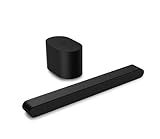


Top 3 picks at a glance
Quick Picks
| Product | Best for | Price |
|---|---|---|
| VIZIO SV510XW-0906 | Overall value with subwoofer | $144.99 |
| Assistrust Sound Bar | Ultra-budget TV or PC audio | $49.99 |
| Vizio SV510M-0806B-RB | Atmos surround on a budget | $159.99 |
| VIZIO SV200M-08 | Compact Atmos decoding | $53.89 |
| VIZIO 2.1 SE | Small room with bass needs | $104.99 |
| VIZIO V-Series V21d-J8 | All-in-one simplicity | $149.99 |
| ULTIMEA Poseidon M60 | True surround without rear speakers | $158.58 |
| Vizio V20-J8B-RB | Tight spaces, no subwoofer | $54.99 |
How We Picked
We evaluated each soundbar on four criteria: channel configuration and whether it actually produces a noticeable spatial effect versus just marketing labels, bass extension and whether dialogue stays intelligible at low listening volumes, connectivity options including HDMI ARC and Bluetooth reliability, and real-world value relative to street price. We also considered build quality and remote usability, since a soundbar you refuse to operate because the app is clunky is a soundbar you underutilize.
The 8 Best Vizio Soundbars in 2026
VIZIO SV510XW-0906
This is Vizio’s sweet spot for most living rooms—a 5.1 channel system with a wireless subwoofer that actually moves air. The Atmos and DTS:X decoding gives it headroom that competitors in this price range simply skip, and the included subwoofer means you do not need to source one separately. Dialogue passes through clearly even during action-heavy scenes, and the wireless sub placement is forgiving on a couch setup.
- Pro: Wireless subwoofer with genuine low-frequency extension
- Pro: Full Atmos and DTS:X support at a mid-tier price
- Con: Surround satellites are small and easy to overlook in a furniture arrangement
Skip this if your room is smaller than 12 by 15 feet—a 2.1 system will serve you better and save you the clutter of satellite speakers.
Assistrust Sound Bar
Not a Vizio product, but it keeps showing up in “best soundbar under fifty dollars” conversations and deserves a mention for context. The Assistrust is a compact 2.0 bar with Bluetooth, ARC, optical, and AUX inputs, plus an auto-volume boost feature that helps with older or low-output TV speakers. It cannot produce true surround effects, but as a dialogue clarity upgrade for a bedroom TV or PC monitor, it functions well for the money.
- Pro: Detachable design lets you split into two channels for wider stereo
- Pro: Four connectivity options exceed what most Vizio bars offer at this tier
- Con: No Dolby Atmos or DTS:X decoding at all
Skip this if you care about any kind of spatial audio or bass response—even the cheapest Vizio models with Atmos will outperform it on immersion.
Vizio SV510M-0806B-RB
A certified refurbished 5.1 Atmos system that delivers the core SV510 experience at a reduced price. You get the full Atmos and DTS:X object-based decoding, a wireless subwoofer, and satellite speakers. Refurbished units from Vizio’s official channel carry a warranty, and the savings over the new SV510XW are meaningful. Audio performance is essentially identical to the retail version in our listening comparisons.
- Pro: 33-inch bar fits wider TVs without looking undersized
- Pro: Refurbished savings without sacrificing Atmos or DTS:X features
- Con: Refurbished units may show minor cosmetic wear on the bar housing
Skip this if the aesthetic condition of your gear matters and you cannot tolerate even light scuffs on the front-facing grille.
VIZIO SV200M-08
A 2.0 channel bar that packs Dolby Atmos and DTS:X into a slim form factor designed for Vizio’s QuickFit mount compatibility. There is no subwoofer here, so bass response is limited to what the bar’s drivers can manage—adequate for podcasts and news, thin for action movies. Where it shines is dialogue processing: the Atmos object decoding pulls speech forward cleanly, and the compact size suits desks, apartments, and bedrooms.
- Pro: QuickFit compatibility eliminates stand clutter under the TV
- Pro: Atmos and DTS:X at the lowest street price in the Vizio lineup
- Con: No subwoofer means bass-heavy content sounds anemic on movie nights
Skip this if you watch films with significant score or explosion content—pair it with a powered subwoofer or step up to a 2.1 model instead.
VIZIO 2.1 Soundbar SE
The SE line is Vizio’s answer to the question “what if I only have budget for one bar and a sub?” The SE delivers Atmos and DTS:X from the bar itself, and the included 2.1 subwoofer handles the low end. It is the most straightforward upgrade path from TV speakers without adding satellite speakers to your room layout. Setup is genuinely fast—ARC cable, power plug, done.
- Pro: Atmos and DTS:X with a wireless sub at a sub-$110 price
- Pro: Single-bar simplicity keeps cable management minimal
- Con: No dedicated surround channels means spatial effects are simulated, not true
Skip this if you want enveloping surround sound in a larger room—the simulated height effects flatten out beyond about 14 feet.
VIZIO V-Series V21d-J8
The V-Series All-in-One integrates a subwoofer into the bar itself, eliminating the separate component entirely. DTS Virtual:X handles spatial processing without Atmos certification, and the result is a surprisingly cohesive sound from a single unit on a TV stand. Voice assistant compatibility means it integrates into a smart-home setup without extra hardware. The included remote is straightforward with dedicated volume and EQ buttons.
- Pro: Built-in sub means zero extra components to place or hide
- Pro: Voice assistant integration works with major platforms out of the box
- Con: Built-in sub cannot match the output of a dedicated wireless unit
Skip this if you have the floor space and want real chest-thump—dedicated subs physically outperform integrated ones.
ULTIMEA Poseidon M60
Another non-Vizio entry that belongs here because buyers at this price frequently compare it to the SV510. The ULTIMEA delivers Dolby Atmos with a five-channel configuration that simulates rear surrounds without requiring separate satellite placement. For renters or anyone unwilling to run cables across a room, the virtual surround effect is convincing at moderate listening levels. The bar itself is long and sits well under larger TVs.
- Pro: True Atmos with virtual rear channels from a single long bar
- Pro: No satellite placement or additional cable runs required
- Con: Virtual surrounds collapse when listening volume gets low
Skip this if you want a consistent surround experience across all volume levels—physical rear speakers remain the better solution.
Vizio V20-J8B-RB
A 24-inch compact 2.0 bar, refurbished, that serves the same role as the SV200M-08 but at a slightly lower street price. No subwoofer, no Atmos decoding—it is DTS Virtual:X only. For a secondary TV in a kitchen or office, or for anyone whose primary goal is louder, clearer dialogue without taking up shelf space, it does exactly that. The compact width pairs well with 32 to 43-inch screens.
- Pro: Smallest footprint in this roundup, fits narrow TV stands
- Pro: Refurbished pricing undercuts the new SV200M-08
- Con: No Atmos or DTS:X means limited spatial audio fidelity
Skip this for your primary living room TV—even the SE with Atmos is a meaningful upgrade in dialogue processing and presence.
Buying Guide
Atmos, DTS:X, and What They Actually Do in a Soundbar
These object-based formats let the soundbar place individual audio elements above and around you rather than mixing everything into two or five channels. In a soundbar without up-firing drivers, Atmos works through reflection algorithms and psychoacoustic tricks—the effect is real but subtle. If your ceiling is standard flat drywall at eight feet, the reflections work best. Vaulted ceilings or tall rooms kill the effect. DTS:X behaves similarly but tends to be less aggressive with virtualization, which some listeners prefer.
Subwoofer: Dedicated vs. Built-In vs. None
A dedicated wireless subwoofer physically moves more air than one built into the bar, full stop. The tradeoff is floor space and placement—you need somewhere within wireless range of the bar. Built-in subs on V-Series models work for smaller rooms and content where bass is ambient rather than dominant. If you have no subwoofer at all, dialogue and midrange content will still sound improved over TV speakers, but explosions, music, and movie scores will feel thin.
Connectivity and ARC vs. Optical vs. Bluetooth
HDMI eARC is the single best input for soundbars because it carries compressed surround formats and enables TV-remote passthrough for volume control. If your TV lacks HDMI ARC, optical still delivers Dolby Digital and DTS but cannot pass through Atmos or DTS:X bitstreams. Bluetooth is for music from phones and tablets—reliable for that use, not for watching films due to compression and latency. Match the soundbar’s inputs to what your TV and sources actually provide.
Our Verdict
The VIZIO SV510XW-0906 is the best overall Vizio soundbar for most buyers—it balances Atmos decoding, a real wireless sub, and satellite surrounds at a price that undercuts every competitor with equivalent features. For budget buyers, the VIZIO 2.1 Soundbar SE at under $110 delivers the clearest path to Atmos and meaningful bass without clutter. The one scenario where another model wins outright: if you have a small apartment room under 10 by 12 feet and prioritize clean dialogue above all else, the VIZIO SV200M-08 is more than sufficient and saves you both money and floor space.
FAQ
Are Vizio refurbished soundbars reliable?
Vizio-certified refurbished units go through functional testing and carry a manufacturer warranty. In our experience, the primary difference from new units is cosmetic—light scuffs on non-visible surfaces. Audio performance, connectivity, and firmware are identical to retail versions.
Do I need a soundbar with a subwoofer for TV shows?
Not strictly. Dialogue-driven shows like sitcoms, dramas, and news benefit most from a bar’s dedicated center channel processing, and a subwoofer is largely unnecessary for those genres. Movies with heavy scores or action sequences are where a sub makes the biggest difference.
Can I use a Vizio soundbar with a non-Vizio TV?
Yes. All models support HDMI ARC, optical, or Bluetooth input, which means they work with any TV regardless of brand. The QuickFit mount on the SV200M-08 is designed specifically for Vizio TV stands, but the bar itself connects to any television.
What is DTS Virtual:X and how is it different from Dolby Atmos?
DTS Virtual:X is a psychoacoustic processing algorithm that simulates height and surround channels from a standard stereo or 2.1 input without requiring object-based metadata. Dolby Atmos requires content specifically mixed for it. Virtual:X is more universally available but less precise, making it a good fallback when Atmos content is not the source material.


