
The built-in speakers on most modern televisions are a compromise no one should have to accept. A panel barely half an inch thick cannot physically move enough air to deliver meaningful bass or the kind of midrange presence that makes dialogue cut through background music and sound effects. Adding a dedicated soundbar is the single cheapest upgrade to a home theater setup, and the category has matured dramatically — you no longer need to spend more than the TV itself to hear a real difference.
What separates a worthwhile soundbar from a waste of shelf space comes down to three things: how well it handles human speech, whether it offers the right connectivity for your specific TV, and how much low-end thump it produces without a separate subwoofer. At the low end, you are buying a convenience upgrade; at the mid-range and above, you are buying an actual audio experience. The options below span that entire spectrum.
As an Amazon Associate we earn from qualifying purchases at no extra cost to you.


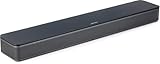


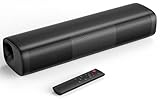

Top 3 picks at a glance
Quick Picks
| Product | Best for | Price |
|---|---|---|
| Assistrust Sound Bar | Multi-device households | $49.99 |
| RIOWOIS 17″ Sound Bar | Absolute lowest budget | $33.99 |
| Bose TV Speaker | Dialogue clarity above all else | $199 |
| ULTIMEA Poseidon M60 | Immersive surround on a mid-range budget | $158.58 |
| Samsung B-Series HW-B400F | Samsung TV owners | $89.99 |
| Amazon Fire TV Soundbar | Fire TV ecosystem users | |
| Saiyin 11.7-inch Sound Bar | Smallest spaces and tightest budgets | $28.99 |
| Amazon Fire TV Soundbar Plus | Best overall compact upgrade in 2026 | $149.99 |
How We Picked
We evaluated each bar on four criteria that consistently determine daily satisfaction: dialogue intelligibility (can you hear words without constantly adjusting volume?), connectivity breadth (does it offer ARC, optical, Bluetooth, or all three?), bass extension (how does it handle low frequencies without a separate subwoofer?), and overall value relative to the price bracket it occupies. A soundbar that sounds thin but costs twenty dollars is judged differently than one that sounds thin at two hundred.
The 8 Best TV Speakers in 2026
Assistrust Sound Bar for Smart TV
Assistrust packs an unusually wide range of inputs into a sub-$50 bar: Bluetooth, ARC, optical, and AUX. That alone makes it the most versatile option under a hundred dollars. The auto volume boost feature intelligently levels out quiet dialogue during action-heavy shows, which is a genuine quality-of-life improvement over cheap competitors that just add volume indiscriminately. Three equalizer modes let you shift from music to movies to night listening without fiddling with settings. The detachable two-piece design is a novelty that also adds flexibility for PC or projector setups. The con: at this price, bass is functional but not impressive. Skip this if your TV already has a quality sound system or if you want surround immersion.
- Four connectivity options make it the most flexible budget bar tested
- Auto volume boost solves the quiet-dialogue problem without a dedicated dialogue mode
- Low-frequency output remains shallow compared to bars costing twice as much
RIOWOIS 17″ Sound Bar
At $33.99, the RIOWOIS is the cheapest bar on this list that still feels like a real audio product rather than a novelty. Seventeen inches is short enough to fit under most 32- to 43-inch TVs without looking absurd. The surround effect it produces is simulated and imperfect, but it adds enough spatial width to make the difference from TV speakers immediately audible. For someone upgrading a bedroom TV, a rental unit, or a first apartment, the value proposition is hard to argue with. The build quality is plasticky, and volume headroom is limited before distortion creeps in. Skip this if your primary use case is loud movie watching or if your TV sits on a wide stand where the compact footprint looks underwhelming.
- Lowest entry price that still delivers a clear audible upgrade from TV speakers
- Compact 17-inch form factor suits smaller TVs and tight shelves
- Distortion becomes noticeable at high volume levels
Bose TV Speaker
Bose has always prioritized dialogue clarity over spec-sheet bass numbers, and the TV Speaker doubles down on that philosophy. The all-in-one compact design measures under twenty-four inches, making it one of the shortest premium bars available, and it fits under any TV without a stand. Bluetooth and HDMI-ARC cover the two connections that matter for most living-room setups, and the included remote is a small convenience that cheaper bars skip entirely. The sound signature is warm and articulate, with vocals sitting front and center without being harsh. The obvious trade-off is price: at $199 you are paying a Bose premium for a two-channel bar. Skip this if you want surround effects or if bass impact matters more to you than voice reproduction.
- Best-in-class dialogue clarity, even in scenes with competing background audio
- Compact footprint and included remote add convenience without clutter
- Price is significantly higher than bars with more channels or connectivity
ULTIMEA 5.1CH Surround Sound Bar System, Poseidon M60
The Poseidon M60 is a full 5.1-channel system with Dolby Atmos support at under $160, which is an impressive feat. It includes a dedicated subwoofer and two rear satellites, transforming a viewing space in a way no standalone bar can. Atmos content benefits noticeably from the overhead and spatial cues the system produces. The rear wireless connection keeps cable management reasonable for a multi-piece setup. Build quality and amplifier refinement lag behind what you would expect from legacy brands at this channel count, and setup complexity is higher than a single-bar solution. Skip this if you rent or live in a small room where rear speakers are impractical — in that scenario, the Fire TV Soundbar Plus delivers most of the benefit without the footprint.
- True 5.1 surround with Atmos support at a fraction of legacy-brand pricing
- Included wireless rear speakers and subwoofer create immersion single bars cannot match
- Multi-piece setup adds clutter and complexity that some buyers will find frustrating
Samsung B-Series Soundbar HW-B400F
Samsung’s B-Series is engineered to pair seamlessly with Samsung televisions, and that integration is its greatest strength. The built-in subwoofer adds low-end weight that many bars at this price lack, and Voice Enhance Mode is a dedicated dialogue feature that actually works well rather than just boosting midrange crudely. One Remote Control lets you power on and adjust the bar from your existing Samsung TV remote, eliminating desktop remote clutter. Surround Sound Expansion provides virtualized width that is pleasant if not transformative. At $89.99 it represents strong value for Samsung owners. Skip this if your TV is not a Samsung — you lose the one-remote convenience and optical pairing that make it worthwhile.
- Built-in subwoofer delivers genuine bass extension for the price
- One Remote Control integration with Samsung TVs eliminates a second remote
- Best value is heavily dependent on owning a compatible Samsung television
Amazon Fire TV Soundbar
The standard Fire TV Soundbar is a no-fuss 2.0-channel option designed to pair instantly with Fire TV devices and Amazon remotes. DTS Virtual:X and Dolby Audio support give it processing headroom for most streaming content, and Bluetooth handles music playback from phones. The form factor is sleek and compact, sitting unobtrusively under smaller TVs. It is the most obvious upgrade path for Fire TV Stick or Fire TV Cube owners who want a one-purchase solution with minimal setup friction. The con is straightforward: as a two-channel bar without a subwoofer, it cannot reproduce low-frequency impact convincingly. Skip this if you want bass-heavy movie nights or if you already have a premium audio setup you are trying to simplify.
- Seamless pairing with Fire TV devices and Alexa voice control out of the box
- Clean design and minimal setup make it ideal for small or shared rooms
- No dedicated subwoofer means bass is the clear limitation
Saiyin 11.7-inch Sound Bar
Under twenty-nine dollars, the Saiyin is the smallest and cheapest bar on this list, and it exists for a very specific use case: a small desk monitor, a bedroom TV under thirty inches, or a travel setup where space is the absolute constraint. At eleven and a half inches long it can hide completely behind a monitor or fit on a narrow shelf. The center-channel emphasis makes dialogue noticeably clearer than whatever your display already provides. Volume output is modest, and the build feels appropriately budget-conscious. Skip this for any main living-room TV over 43 inches — it simply cannot fill a large room with sound, and you will want to spend more for actual presence.
- Tiny footprint fits spaces where no other bar on this list would work
- Center-channel tuning makes dialogue clearly audible relative to its size and price
- Limited output and bass make it unsuitable for anything beyond small personal displays
Amazon Fire TV Soundbar Plus
The Soundbar Plus is our top overall pick. A built-in subwoofer combined with a 3.1-channel layout means this single bar delivers the bass punch that normally requires a separate speaker, while Dolby Atmos processing adds spatial dimension to supported content. Dialogue comes through clear and forward, and the Amazon integration means setup takes under two minutes with a Fire TV remote. At $149.99 it undercuts most 3.1-channel bars from legacy audio brands while matching their real-world performance. The only meaningful limitation is that Atmos here is virtualized from a single bar, so it will not match the immersion of a full surround system. Skip this if you want discrete rear speakers for true spatial audio.
- Built-in subwoofer in a 3.1 design eliminates the need for a separate bass box
- Dolby Atmos processing and Fire TV integration make it effortless to use daily
- Virtual surround cannot replicate the physical immersion of a multi-piece system
Buying Guide
Connectivity Is the Real Differentiator
Before evaluating sound quality, confirm that the bar can actually connect to your setup. HDMI-ARC or eARC is the single most valuable port because it carries a full digital audio signal and enables one-remote control from your TV. Optical is the reliable fallback for older TVs without ARC. Bluetooth matters if you want to stream music from your phone through the bar independently of TV content. A bar that lacks your required input is not just an inconvenience — it is a dead product on your shelf.
Channel Count vs. Real-World Impact
Marketing emphasizes channel counts, but the practical question is simpler: do you need a separate subwoofer? A 3.1-channel bar with a built-in sub, like the Fire TV Soundbar Plus, will outperform a 2.0-channel bar with no bass driver in almost every scenario except music with deep bass lines. Full 5.1 systems with discrete rear speakers provide genuine surround immersion but add visual clutter and setup complexity that many buyers find annoying within weeks. Match the system to how much you care about spatial effects versus convenience.
Size and Placement Constraints
A soundbar must physically fit under your TV and within your entertainment setup. Wall-mounted TVs with narrow shelves require shorter bars; desk monitors need bars under fourteen inches. Check the depth of your stand or shelf as well — some bars exceed four inches front to back and will not fit on shallow furniture. A bar that overhangs your shelf looks sloppy and wastes space, regardless of how well it sounds.
Our Verdict
Top pick: the Amazon Fire TV Soundbar Plus. A 3.1-channel design with a built-in subwoofer, Dolby Atmos, and frictionless Fire TV integration make it the best balance of sound quality, convenience, and price for the majority of buyers reading this guide.
Budget pick: the Assistrust Sound Bar at $49.99. Four input options, auto volume leveling, and EQ modes make it the most feature-complete sub-$50 bar available, and it will outperform any TV’s built-in speakers by a wide margin.
If you have a dedicated media room, a 60-inch-plus TV, and space for rear speakers, the ULTIMEA Poseidon M60 wins. True 5.1 surround with Dolby Atmos and a wireless subwoofer create immersion that no single-bar design can approach, and at $158.58 the value is exceptional for the channel count.
FAQ
Do I need a separate subwoofer?
Not always. Bars with built-in subwoofers, like the Fire TV Soundbar Plus and Samsung HW-B400F, produce adequate bass for dialogue-driven TV shows and most movies without a dedicated box. If you watch action films with deep explosions or listen to bass-heavy music regularly, a system with a discrete wireless subwoofer will deliver noticeably more low-end impact.
Is ARC the same as eARC?
No. eARC adds support for lossless and high-bitrate audio formats like Dolby Atmos TrueHD that ARC cannot carry. For most streaming content from Netflix or Disney Plus, ARC is sufficient. If you play lossless Atmos audio from a disc player or a compatible console, you will want an eARC-capable TV and bar pairing.
Can a soundbar replace a full home theater receiver system?
For the vast majority of viewers, yes. Modern bars have improved to the point where the sonic difference versus a five-speaker receiver system is smaller than most people can identify in blind listening. A soundbar is also dramatically simpler to set up, cleaner to look at, and easier to control day to day.
Will a soundbar fix my TV’s quiet dialogue problem?
A quality soundbar with a dedicated dialogue or voice enhancement mode will make dialogue substantially more intelligible without requiring you to crank overall volume. The key is finding a bar with forward-tuned midrange drivers that project speech clearly rather than one that only boosts treble.


