- Top Pick: Noctua NT-H1 3.5g: the proven all-rounder
- Runner-up: ARCTIC MX-4 4g (incl. Spatula)
- Also consider: Noctua NT-H2 3.5g: second generation with cleaning wipes
A high-end gaming PC puts its processor under long, heavy loads, and the thin layer of thermal paste between the CPU and the cooler base fills the microscopic gaps between those two metal surfaces. When that layer dries out or was applied unevenly, even an expensive cooler cannot do its job properly. Repasting is one of the simplest maintenance jobs in a gaming rig, and the five syringes here are the proven conventional pastes worth considering.
This guide stays with safe, electrically non-conductive pastes and ranks them by use case rather than headline numbers, because each maker measures conductivity differently and two of the five makers here publish no figure at all. Every pick is pinned to one exact syringe size, with notes on who it suits and how it is applied. Liquid metal is excluded entirely, for reasons covered below.
As an Amazon Associate, we earn from qualifying purchases.
Top 3 picks at a glance
Quick answer
For most high-end gaming PCs, Noctua NT-H1 or NT-H2 is the safe default: non-conductive, easy to apply, and rated by Noctua for years of service. Kryonaut suits overclockers who spread paste manually, ARCTIC MX-4 is the forgiving beginner option with a spatula included, and MX-6 is the pick for direct-die graphics card work.
Noctua NT-H1 3.5g: the proven all-rounder
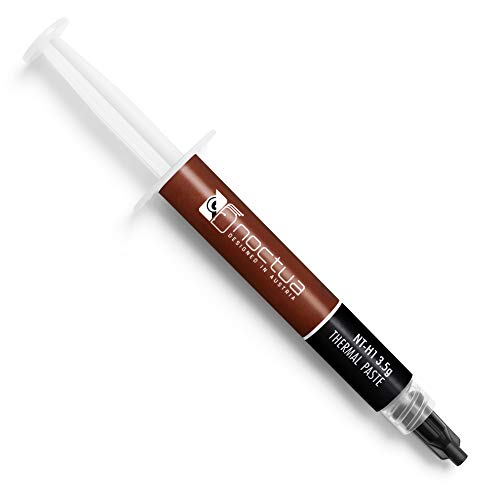
NT-H1 is Noctua’s original pro-grade compound and the benchmark for a stress-free application. It needs no manual spreading before the cooler goes on: a small amount on the CPU is distributed by mounting pressure alone, removing the most common beginner mistake. The paste is not electrically conductive and is non-corroding, and Noctua states it is safe with copper or aluminium coolers, nickel-plated or not.
The 3.5g syringe covers around 3 to 20 applications depending on CPU size, from around 3 for large CPUs such as TR4 up to around 20 for small CPUs such as LGA1151. Noctua rates it for storage at room temperature for at least 3 years and for use on the CPU for 5 years or more. Cleanup is simple, since residue wipes away with a dry tissue and no alcohol or solvent is required. Noctua publishes no thermal conductivity figure for NT-H1 at all, so judge it on its track record and ease of use rather than a number. Order the standard 3.5g syringe (model NT-H1); the 10g pack and the AM5 Edition are separate listings with different contents.
| Spec | Detail |
|---|---|
| Brand | Noctua |
| Product | NT-H1 3.5g |
| ASIN | B002CQU14A |
| Syringe size | 3.5g (1.4 ml) |
| Density | 2.49 g/cm³ |
| Coverage | Around 3-20 applications depending on CPU size |
| Electrical properties | Not electrically conductive, non-corroding |

Noctua NT-H2 3.5g: second generation with cleaning wipes

NT-H2 is the second generation of Noctua’s compound, built on a fine-tuned mixture of metal oxide micro-particles for lower thermal resistance and reduced bond-line thickness. Like NT-H1, it needs no manual spreading before the heatsink goes on, and it keeps the same safety profile: not electrically conductive and non-corroding.
The practical difference is in the box: the pinned 3.5g syringe includes 3 NA-CW1 cleaning wipes pre-moistened with an isopropyl alcohol mixture, which makes removing old paste tidier. Coverage matches NT-H1 at around 3 to 20 applications depending on CPU size, with recommended storage of up to 3 years and usage on the CPU of up to 5 years. As with NT-H1, no conductivity figure is published. Pick it over NT-H1 if the wipes and newer formulation appeal, and choose the standard 3.5g version; the 10g pack is a different listing with its own coverage figures.
| Spec | Detail |
|---|---|
| Brand | Noctua |
| Product | NT-H2 3.5g |
| ASIN | B07MZ45X9G |
| Syringe size | 3.5g (1.2 ml) |
| Density | 2.81 g/cm³ |
| Included extras | 3 NA-CW1 cleaning wipes |
| Electrical properties | Not electrically conductive, non-corroding |
Thermal Grizzly Kryonaut 1g: the overclocker’s pick

Kryonaut is Thermal Grizzly’s high-performance paste, designed with overclocking in mind. Its listing prints a thermal conductivity of 12.5 W/mk, the figure to use for this standard version; figures quoted for other variants do not apply to this syringe. It uses nano-aluminum and zinc-oxide particles, and its specialised structure does not dry out even at temperatures of up to 80°C, with no curing required.
Application is more involved: Kryonaut is spread across the heatspreader with the included spatula rather than left to mounting pressure. The box also includes a certificate of origin, a bag and a manual; checking the certificate is the maker’s own authenticity safeguard. The pinned 1g syringe is a single-build size with no application count stated, so plan on one careful application. Electrically it is inert, with the listing stating no electrical conductivity.
| Spec | Detail |
|---|---|
| Brand | Thermal Grizzly |
| Product | Kryonaut 1g |
| ASIN | B011F7W3LU |
| Syringe size | 1g |
| Thermal conductivity | 12.5 W/mk (as printed on the listing) |
| Thermal resistance | 0.0032 K/W (as printed) |
ARCTIC MX-4 4g with spatula: the forgiving classic
MX-4 is ARCTIC’s premium paste, composed of carbon microparticles rather than metal oxides. It is metal-free and not electrically conductive, so ARCTIC positions it as safe even for beginners. Apply it so no air pockets remain between processor and cooler; the pinned 4g variant includes a spatula to help.
ARCTIC’s own published technical data for MX-4 states a thermal conductivity of 8.5 W/mK; the Amazon listing itself prints no numeric figure, so treat 8.5 W/mK as the maker’s datasheet figure rather than a listing claim. The listing claims long durability without stating a number of years. An ARCTIC Authenticity Check applies to the product, worth using before installation. Order carefully: this pick is the 4g syringe with spatula; other pack sizes and the no-spatula version are different listings.
| Spec | Detail |
|---|---|
| Brand | ARCTIC |
| Product | MX-4 4g (incl. Spatula) |
| ASIN | B0795DP124 |
| Syringe size | 4g |
| Thermal conductivity | 8.5 W/mK (ARCTIC’s published figure) |
| Viscosity | 31,600 Poise (as printed) |
ARCTIC MX-6 4g: the direct-die specialist

MX-6 is ARCTIC’s newer carbon filler-based compound, and its listing highlights behaviour rather than a conductivity number; ARCTIC publishes no W/mK figure for MX-6, so none should be quoted for it. The listing states it reaches maximum performance without burn-in, directly after application, and that distribution comes from even contact pressure when mounting the heatsink, so no spatula work is needed. Its non-drying, non-bleeding properties and pump-out-resistant viscosity suit long service intervals.
The standout trait is scope: the listing states MX-6 is suitable for direct-die cooling scenarios such as graphics cards and console processors, making it the natural pick for GPU repasting as well as CPU work. It is neither electrically conductive nor capacitive and contains no liquid metal components. Next to MX-4, the listing claims a measurably lower thermal resistance, stated qualitatively. The pinned version is the plain 4g syringe; bundles and other sizes are separate listings.
| Spec | Detail |
|---|---|
| Brand | ARCTIC |
| Product | MX-6 4g |
| ASIN | B09VDL3CW6 |
| Syringe size | 4g |
| Specific gravity | 2.60 g/cm³ |
| Viscosity | 45,000 Poise (as printed) |
| Continuous use temperature | -50 to 150 °C (as printed) |
How to Choose
Start with how many builds the syringe must cover. The 1g Kryonaut is a single-application size for one careful build, while the 3.5g Noctua syringes stretch to roughly 3 to 20 applications depending on CPU size, and the 4g ARCTIC syringes are similar. Next, match the method to your confidence: NT-H1, NT-H2 and MX-6 spread under mounting pressure, while Kryonaut and the spatula version of MX-4 reward a deliberate manual spread and, for MX-4, care to avoid air pockets.
Do not choose by comparing conductivity numbers across brands. Each maker measures differently, Noctua publishes no figure for either of its pastes, and ARCTIC publishes none for MX-6, so the only honest comparisons are use case, longevity and handling. For longevity, Noctua’s stated figures are the clearest here, while ARCTIC states long durability without a year count. Whatever you pick: clean every trace of old paste off the CPU and cooler base first (the NT-H2 wipes exist for exactly this), apply a small pea- or rice-sized amount per the maker’s directions, and mount the cooler evenly.
Finally, understand why liquid metal is not in this guide. Liquid-metal compounds are electrically conductive, so a spill or squeeze-out can short components, they corrode and react with aluminium cooler bases, and using them can void hardware warranties. They are never the recommended route here.
Who should skip
Skip the whole category if your cooler already ships with quality pre-applied paste; repasting is maintenance, not a ritual. Skip Kryonaut if you want one syringe to cover several machines, since the pinned 1g size is a single-build quantity. Skip manual-spread pastes if you are a first-time builder wanting mounting pressure to do the work; NT-H1 or MX-6 fit you better. Skip direct-die work such as graphics card repasting if the device is still under a warranty you care about, and skip liquid metal in all cases for the safety reasons above.
FAQ
How much thermal paste should I apply?
A small pea- or rice-sized amount is the standard guidance, applied exactly as the maker directs. Too little leaves dry gaps, while far too much simply squeezes out around the edges. Noctua’s pastes and MX-6 spread under mounting pressure, Kryonaut is spread with its included spatula, and MX-4 should be applied so no air pockets remain.
How often should thermal paste be replaced?
Replace it whenever the cooler comes off, since the seal is broken anyway. Beyond that, follow the maker’s figures: Noctua rates NT-H1 and NT-H2 for up to 5 years on the CPU, ARCTIC describes MX-4 and MX-6 as long-durability pastes without a stated year count, and Kryonaut’s structure is designed not to dry out even at high operating temperatures.
Why is liquid metal not recommended here?
Liquid metal is electrically conductive, so any spill or squeeze-out can short and damage components. It also corrodes aluminium cooler bases and can void warranties. Conventional pastes avoid all three risks, so liquid metal is treated here as a risk category, not an upgrade path.
Can I use these pastes on a graphics card?
MX-6 is the clearest fit, since its listing states it is suitable for direct-die scenarios such as graphics cards and console processors. The other picks are listed for processors and heatsinks, so follow each maker’s directions before using one on a GPU, and remember that opening a graphics card can affect its warranty.
Final Verdict
For a single safe recommendation, Noctua NT-H1 in the 3.5g syringe is the paste to buy: effortless application, generous coverage and a stated service life of 5 years or more. NT-H2 adds cleaning wipes and a newer formulation. Kryonaut is the enthusiast’s choice for a deliberate spatula application, MX-4 remains the forgiving classic with ARCTIC’s published 8.5 W/mK figure behind it, and MX-6 is the one to reach for when the job includes a graphics card. All five are non-conductive, in the exact syringe sizes pinned above.
Related guides
More from Amazon
Programs that pair well with the guide above. Offers and eligibility are set by Amazon and may change.
Free shipping on eligible items, Prime Video and more. Eligible new members can start with a free trial.
Start a Prime free trialAd-free music streaming. Eligible new subscribers can start with a free trial.
Try Music Unlimited freeA Prime membership for ages 18-24 with a trial period. Eligibility is set by Amazon.
See Prime for Young AdultsAudiobooks and podcasts to listen to on the go. Eligible new members can start with a free trial.
Try Audible freeAs an Amazon Associate we earn from qualifying purchases.