Editing 4K footage on a smaller screen forces an uncomfortable trade: shrink the interface until the timeline is unreadable, or scale the picture and stop seeing your footage pixel for pixel. A 32-inch 4K panel ends that compromise, but the real decision is what happens after size. The panel has to hold the color space your delivery target uses, handle the HDR format your platform asks for, and connect to the decks, drives and laptops already on your desk.
This guide is for editors cutting long-form projects, colorists grading HDR masters, and solo creators who finish everything at one workstation. Every monitor below is a 32-inch class 4K model, and each one was picked from the product names and specifications published on its Amazon listing, with the grading and connectivity figures taken from those listings rather than from marketing summaries elsewhere.
Top 3 picks at a glance

Quick Picks
As an Amazon Associate we earn from qualifying purchases.
| Product | Best for | Key spec from title |
|---|---|---|
| ASUS ProArt Display PA32UCDM | HDR grading with true black levels | QD-OLED, 240Hz, 99 percent DCI-P3 |
| BenQ PD3225U | SDR grading for broadcast and web delivery | IPS Black, 98 percent P3, Thunderbolt |
| Dell UltraSharp U3223QE | Laptop edit bays that need a built-in dock | IPS Black, 2000:1 contrast, RJ45 Ethernet |
| ASUS ProArt Display PA329CRV | A second seat or first grading desk | IPS, 98 percent DCI-P3, DisplayHDR 400 |
How to Choose
Screen Size and Resolution for Full-Resolution Timelines
A 3840 x 2160 panel at 32 inches shows a 4K timeline at a scale where track headers, audio waveforms and effect controls stay legible without shrinking the program picture into a corner. That matters during long edits: you can park the viewer at full resolution, check focus and noise on a 1:1 crop, and still keep bins and scopes open beside it. Panels sold as 32-inch class usually measure 31.5 inches diagonally, which is the size used by every pick in this guide, and the pixel density stays high enough that text in titles and captions renders cleanly at normal viewing distances.
Color Gamut and HDR Formats for Grading
Match the panel to the space you deliver in. Rec.709 coverage is the baseline for broadcast and most web work, while DCI-P3 headroom lets you grade once and trim safely for platforms that accept wider color. HDR is a separate question: a DisplayHDR 400 badge signals basic HDR handling, but mastering for streaming delivery calls for the formats named in the listing, such as Dolby Vision, HDR10 or HLG, plus the peak brightness to show them. Read the gamut and HDR lines on the Amazon listing for the exact model, because sibling models in the same range often differ.
Refresh Rate and Ports for Playback and Capture Hardware
Most delivery timelines run at 24, 25, 30 or 60 frames per second, so a 60Hz panel keeps playback honest for the work most editors ship. A faster panel earns its place when you cut high-frame-rate material or want scrubbing and playhead movement to feel fluid during long sessions. Ports decide the rest of the setup: DisplayPort and HDMI feed the workstation, a DisplayPort output or Thunderbolt connection chains a second screen, and a USB hub takes the shuttle controller, card reader and backup drives that gather around an edit desk.
Hardware Calibration and Panel Uniformity
Factory calibration with a stated Delta E figure tells you how the panel leaves the box, but grading work drifts over time, so the question is how the monitor takes correction later. Hardware calibration writes the adjustment into the monitor’s own lookup table, which keeps the grade consistent when the screen moves between computers. Software-only correction lives in one machine’s profile and vanishes on another. Uniformity compensation is the other quiet feature worth having: it evens out brightness and color across the panel, so a vignette you add is yours, not the backlight’s.
The 4 Best Options
ASUS ProArt Display PA32UCDM

Editors who finish in HDR get the most from the PA32UCDM. Its QD-OLED panel holds true black in dark scenes, so shadow detail in a grade reads the way it will on an OLED television, and the listing’s Dolby Vision, HDR10 and HLG support covers the formats streaming delivery asks for. A 240Hz refresh rate keeps high-frame-rate timelines and fast scrubbing fluid, while ASUS ProArt Hardware Calibration stores correction inside the monitor itself, so the grade stays put when the screen moves between machines. Dual Thunderbolt 4 ports anchor a laptop-based bay.
Specs
- Panel: 31.5-inch QD-OLED, 3840 x 2160 (4K UHD)
- Refresh rate: 240Hz; response time 0.1ms (GTG)
- Color gamut: 99 percent DCI-P3, 100 percent sRGB
- Color accuracy: Delta E under 1, factory calibrated
- HDR: Dolby Vision, HDR10, HLG, VESA DisplayHDR True Black 400, 1000 nits peak brightness
- Calibration: ASUS ProArt Hardware Calibration, Calman Ready
- Ports: Thunderbolt 4 with up to 96W power delivery, HDMI 2.1, USB hub
Best for: Colorists grading HDR masters who need true black levels and per-pixel contrast.
Watch out for: OLED panels can retain static interface elements over time, so plan on the panel care routines and avoid leaving a fixed timeline layout up for days.
ASIN: B0D23BYB66
BenQ PD3225U
The PD3225U suits editors who grade in SDR all week and hand off to broadcast or web targets. Its IPS Black panel doubles the contrast of a standard IPS screen, and the listing pairs 98 percent DCI-P3 with full sRGB and Rec.709 coverage, so a Rec.709 timeline and a P3 social cut live on the same desk. Factory calibration at a Delta E of 2 or less, plus uniformity compensation, keeps flat backgrounds even from corner to corner. Thunderbolt with daisy chaining and a KVM switch let one keyboard serve both an edit workstation and a laptop.
Specs
- Panel: 32-inch IPS Black, 3840 x 2160 (4K UHD)
- Refresh rate: 60Hz; response time 5ms (GTG)
- Contrast ratio: 2000:1
- Color gamut: 98 percent DCI-P3, 100 percent sRGB, 100 percent Rec.709
- Color accuracy: Delta E of 2 or less, factory calibrated, uniformity technology
- HDR: HDR10
- Ports: Thunderbolt 3 (USB-C with 85W power delivery), HDMI, DisplayPort, USB hub, daisy chain, KVM switch
Best for: Editors grading SDR for broadcast and web who switch between a workstation and a laptop.
Watch out for: The 60Hz refresh rate is fine for standard delivery frame rates, but editors cutting high-frame-rate projects may want the faster panel above.
ASIN: B0CT441B25
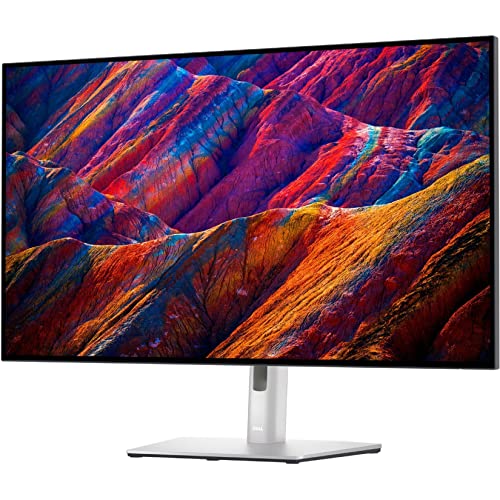
Dell UltraSharp U3223QE
The U3223QE is the hub-first pick for a bay built around a laptop and shared peripherals. Its IPS Black panel lists a 2000:1 contrast ratio and 98 percent DCI-P3 coverage with factory calibration, which covers SDR editing and light grading comfortably. Where it pulls ahead is wiring: USB-C with up to 90W of power delivery, an RJ45 Ethernet port, a deep USB hub and a KVM switch turn the monitor into the dock, and a DisplayPort output chains a second 4K screen that can carry the full-screen program feed.
Specs
- Panel: 31.5-inch IPS Black, 3840 x 2160 (4K UHD)
- Refresh rate: 60Hz
- Contrast ratio: 2000:1
- Color gamut: 98 percent DCI-P3, 100 percent sRGB, 100 percent Rec.709
- Color accuracy: Factory calibrated, Delta E under 2
- HDR: VESA DisplayHDR 400
- Ports: USB-C with up to 90W power delivery, DisplayPort 1.4 with output for daisy chaining, HDMI, RJ45 Ethernet, USB hub, KVM switch
Best for: Laptop-based editors who want the monitor to replace a separate docking station.
Watch out for: DisplayHDR 400 is basic HDR handling rather than a mastering specification, so treat this as an SDR-first screen with HDR checking on the side.
ASIN: B09TVZHV4W
ASUS ProArt Display PA329CRV

The PA329CRV gives a second edit seat, or a first serious grading desk, the essentials without the flagship extras. The IPS panel lists 98 percent DCI-P3 and full sRGB coverage with Calman Verified accuracy at a Delta E under 2, and VESA DisplayHDR 400 covers basic HDR checking. USB-C carries picture, data and up to 96W of charging, DisplayPort supports daisy chaining a second screen, and the ergonomic stand adjusts through a full day of timeline work. It tops out at 60Hz, which matches the delivery frame rates most editors actually ship.
Specs
- Panel: 31.5-inch IPS, 3840 x 2160 (4K UHD)
- Refresh rate: 60Hz; response time 5ms
- Color gamut: 98 percent DCI-P3, 100 percent sRGB
- Color accuracy: Delta E under 2, Calman Verified
- HDR: VESA DisplayHDR 400, VESA MediaSync
- Ports: USB-C with 96W power delivery, HDMI, DisplayPort with daisy chain support, USB hub
Best for: Studios adding a second seat or editors stepping up to a calibrated wide-gamut screen.
Watch out for: There is no hardware calibration write-back on this model, so color correction lives in the connected computer’s profile.
ASIN: B0C2Z16LB2
Which One Fits Your Situation
You Grade HDR Masters for Streaming Delivery
Take the PA32UCDM. Its QD-OLED panel shows true black, its listing names Dolby Vision alongside HDR10 and HLG, and hardware calibration keeps the panel honest between sessions. The Dell and the PA329CRV can display an HDR signal, but their DisplayHDR 400 specification is a checking tool, not a mastering reference, so the ASUS OLED is the one that belongs at the grading seat.
You Cut Long-Form Projects All Day
The BenQ PD3225U fits the editor who lives in a timeline for eight hours at a stretch. IPS Black contrast keeps dark footage readable without OLED panel care on your mind, uniformity compensation keeps backgrounds even, and the KVM switch means the same keyboard and mouse run your workstation and the laptop you take to set. Factory calibration at a Delta E of 2 or less means it grades accurately from the first session.
You Edit on a Laptop and Dock at One Desk
The U3223QE turns docking into a single cable habit. USB-C carries the picture and up to 90W of charging, the RJ45 port puts the laptop on wired networking, and the USB hub holds your reader, shuttle and drives. When a client or director visits, the DisplayPort output chains a second 4K screen so they watch the program feed while you keep the timeline.
You Are Fitting Out a Small Edit Bay on a Budget
The PA329CRV covers the fundamentals a working bay needs: a calibrated 31.5-inch 4K panel, 98 percent DCI-P3 for P3 deliverables, single-cable USB-C connection for whichever laptop lands at the desk, and daisy chaining when a second screen arrives later. What you give up against the flagship picks is HDR depth and hardware calibration, which a supervised second seat rarely misses.
Common Mistakes
- Buying a wide-gamut panel and then editing with the monitor left in the wrong color mode, so P3 footage is judged through an sRGB window or the reverse.
- Reading a DisplayHDR 400 badge as HDR mastering capability, when it only certifies basic HDR handling and modest peak brightness.
- Running the editing interface at a scaled resolution that hides the 1:1 pixel view, then wondering why focus checks and noise judgments feel unreliable.
- Counting ports after the purchase and finding no free connection for a capture deck, card reader or the second screen the bay was planned around.
- Skipping recalibration for months because the panel was factory calibrated once, even though grading panels drift with age and backlight hours.
Frequently Asked Questions
Is 60Hz Enough for Video Editing, or Should I Pay for a Faster Panel?
For most editing, yes. Delivery timelines run at 24 to 60 frames per second, and a 60Hz panel displays those rates exactly as the audience will see them. A faster panel such as the 240Hz PA32UCDM helps when you cut high-frame-rate material, scrub long timelines constantly, or share the desk with motion graphics work that benefits from smoother playhead movement.
What Is the Difference Between DCI-P3 and Rec.709 Coverage?
Rec.709 is the color space for broadcast television and most web video, so full coverage is the baseline for SDR editing. DCI-P3 is a wider cinema space that streaming platforms and theatrical work draw on. A monitor listing 98 percent DCI-P3 alongside full Rec.709 lets you grade a P3 master and still check an accurate Rec.709 trim on the same panel.
Can One of These Monitors Drive a Second Screen?
Yes, through daisy chaining. The BenQ PD3225U chains over Thunderbolt, the Dell U3223QE offers a DisplayPort output, and the PA329CRV supports DisplayPort daisy chaining, so a second 4K screen can run from the first monitor instead of taking another port on the computer. Editors often use that second screen for a clean full-screen program feed while the timeline stays on the main panel.
Do I Still Need a Calibrator if the Monitor Is Factory Calibrated?
Eventually, yes. Factory calibration sets the panel accurately when it ships, but brightness and color drift as the backlight ages. A calibrator lets you restore the original targets, and on the PA32UCDM the correction can be written into the monitor itself through ASUS ProArt Hardware Calibration, so the accuracy follows the screen rather than one computer.
Related guides
More from Amazon
Programs that pair well with the guide above. Offers and eligibility are set by Amazon and may change.
Free shipping on eligible items, Prime Video and more. Eligible new members can start with a free trial.
Start a Prime free trialAd-free music streaming. Eligible new subscribers can start with a free trial.
Try Music Unlimited freeA Prime membership for ages 18-24 with a trial period. Eligibility is set by Amazon.
See Prime for Young AdultsAudiobooks and podcasts to listen to on the go. Eligible new members can start with a free trial.
Try Audible freeAs an Amazon Associate we earn from qualifying purchases.