
Designing a home streaming setup involves a constant tug-of-war between high-end video aesthetics and realistic interior spatial limits. When optimizing your camera feed, lighting does far more heavy lifting than your webcam or mirrorless sensor. However, bringing commercial lighting gear into a dual-purpose bedroom or home office creates immediate design challenges. When evaluating a softbox light vs panel key light for streaming, the choice rarely comes down to sheer brightness alone. Instead, it hinges on square footage, visual clutter, heat output, and how gracefully the equipment integrates into your daily living space.
Traditional softboxes use physical depth and fabric diffusion hoods to scatter light gently across skin tones, minimizing facial harshness. Slim LED panel lights, by contrast, use edge-lit technology and compact diffusion layers to compress full-spectrum lighting into a fixture barely an inch thick. Understanding how these two distinct approaches interact with your room layout—and your daily workflow—is essential to making a durable purchase for your home.
As an Amazon Associate we earn from qualifying purchases at no extra cost to you.



Top 3 picks at a glance
Quick Verdict
If your streaming setup resides in a multi-use room, small apartment, or tight desk nook, a slim panel key light is the winner. Modern panel key lights clamp directly onto your desk frame, removing floor-trip hazards and preserving precious square footage while delivering instant control over brightness and color temperature. If you have a dedicated studio space or prioritized maximum visual diffusion on skin contours above all else, a classic softbox light delivers cinematic wrap-around light quality at a significantly lower price point per watt. For most home creators balancing interior aesthetics with performance, the desk-mounted panel key light takes the crown.
Side by Side
| Feature Category | Softbox Light | Panel Key Light |
|---|---|---|
| Comfort & Eye Strain | Superior deep diffusion; easy to look near for hours | Direct flat beam; can cause eye fatigue if un-diffused |
| Durability & Hardware | Fabric hood, metal ribs, easily swappable E27/LED bulbs | Solid aluminum or hardened ABS plastic housing |
| Price Range | Budget-friendly ($35 – $90 per light) | Mid-range to premium ($45 – $180 per light) |
| Maintenance | Fabric acts as a dust magnet; requires periodic lint removal | Smooth surface wipe-down; virtually zero dust collection |
| Space Needed | Requires 2–3 sq ft of floor footprint per tripod stand | Zero floor space when mounted via C-clamp to desk edge |
| Visual Look in Room | Bulky, commercial studio aesthetic; dominant visual footprint | Sleek, minimalist interior design blend; subtle profile |
| Resale Value | Moderate; bulky to ship on secondary market | High; compact shape makes re-selling and shipping simple |
| Best For | Dedicated studio rooms, cosmetic streams, high-wattage needs | Small home offices, dual-purpose spaces, daily video calls |
Where Softbox Light Wins
The primary advantage of a softbox light lies in basic physics: physical volume creates softer light. Softboxes use an umbrella-like metal frame covered by silver reflective interior lining and an outer fabric diffuser panel. This interior volume allows light rays to bounce around internally before passing through the front diffuser sheet, creating a multi-directional light beam that eliminates sharp shadows under the chin and nose.
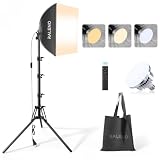
When evaluating cost-to-output ratios, softboxes remain incredibly efficient. Entry-level options—such as the Torjim Softbox Photography Lighting Kit featuring a 16″ x 16″ hood and an 85W LED studio bulb ($39.98)—provide exceptional illumination across wide spaces without breaking the bank. Similarly, the RALENO Softbox Photography Lighting Kit, priced at $39.99 for a 16″x16″ LED soft box unit, delivers generous photon scatter that smoothly wraps around a creator’s face. This characteristic visual warmth reduces the appearance of skin blemishes, structural wrinkles, and eye-bag shadows without requiring heavy digital camera filters.
Furthermore, maintenance on softbox lights often involves basic bulb swaps. If an LED bulb burns out after years of use, you simply unscrew the standard socket fixture and insert a fresh high-CRI LED bulb. The open air circulation inside a wide fabric hood also keeps high-wattage bulbs cooler naturally, extending the operational life of cheap interior electronics.
Where Panel Key Light for Streaming Wins
While softboxes excel at light softness, LED panel lights dominate interior practicality and spatial efficiency. As home office design trends evolve, keeping floor surfaces clear of tripod legs has become a top priority for remote professionals and live streamers alike. Panel lights feature ultra-thin profiles—often under 1.5 inches thick—allowing them to hover directly behind desktop monitors without pushing your desk away from the wall.
Desktop mounting options, such as the NEEWER 25W 12.9″ Streaming Key Light with Desk Stand and 2.4G Remote (GL25B, $89.99), attach directly to desk lips using heavy-duty C-clamps. This completely clears up carpet or hardwood floor space, eliminating trip hazards from extended tripod legs. In dual-light configurations, complete kits like the 2-Pack LED Video Light Kit by NiceVeedi ($49.99)—which provides 2800K–6500K color adjustment—offer flexible positioning via lightweight 73″ stands or desk mounts while consuming a fraction of the physical room volume of two standard fabric softboxes.
Panel lights also excel in operational convenience. Almost all modern LED streaming panels come with wireless remotes or desktop app controllers, allowing you to fine-tune brightness levels (1% to 100%) and alter color temperature (from warm 2800K candle tones to cool 6500K daylight) without getting up from your office chair. They don’t attract lint, don’t require assembly or frame-stretching, and can be wiped clean with a micro-fiber cloth in seconds.
Cost Over 5 Years
Calculating the true cost of streaming lighting requires looking past the initial sticker price to examine energy usage, component longevity, and hardware replacements over half a decade.
- Initial Hardware Purchase: Softbox setups carry a lower barrier to entry, running between $35 and $80 for complete two-light configurations. LED panel setups average between $50 and $180 depending on desk-clamp quality and wireless control integrations.
- Energy Costs: Operating two 25W to 45W panel lights for 20 hours per week draws negligible electricity—costing roughly $5 to $12 per year depending on local electrical rates. A pair of high-output 85W softbox bulbs running on maximum power will consume roughly double that energy, adding $15 to $25 annually.
- Maintenance and Replacement Cycles: Integrated LED panels usually carry a lifespan rating between 30,000 and 50,000 hours. Because the LEDs are permanently soldered onto internal circuit boards, a failed panel unit requires a full fixture replacement. Conversely, softbox frames are mechanical; if the light source fails, replacing a standard E27 LED bulb costs only $10 to $15, making long-term repair simple and low-cost.
Over a 5-year timeline, both lighting styles cost roughly $100 to $220 total per light fixture when factoring in electricity and minor component updates. The real financial factor comes down to spatial convenience: if a bulky softbox forces you to buy a larger desk or adjust your room layout, those structural home changes quickly outweigh any minor savings on the initial light fixture price.
Which One for Your Home
Small Apartment or Micro-Desk Setup
If your streaming station sits in a studio apartment nook or bedroom corner, a panel key light attached to a desk clamp is the clear choice. A softbox requiring a 16-inch depth behind your desk will push your seating position into the center of your living space. A 12-inch or 14-inch edge-lit panel mounted to an adjustable arm hovers inches from the back wall, keeping your home feeling open and uncluttered.
Family Home with Kids or Pets
Wide tripod bases from traditional light stands are magnet points for pets, children, and vacuum cords. A softbox on a tall light stand carries a high center of gravity and can easily tip over if bumped. Panel key lights secured directly to heavy desk tops via steel C-clamps remain completely stable, protecting both your lighting equipment and your household members from sudden knocks.
Rental Property or Temporary Studio
If you move frequently or live in a rental home, lighting portability matters. Softboxes require dismantling fabric hoods, removing structural ribs, and packing away fragile glass bulbs. Panel lights collapse flat in under thirty seconds, fitting into slim carrying sleeves that slip into standard luggage or closet shelves without occupying bulky storage containers.
Long-Term Home Office with Dedicated Lighting Boom
If you are blessed with a dedicated, permanent room for content creation, a softbox light offers unbeatable light quality. When mounted permanently on a ceiling track or wall-mounted boom arm, the softbox’s physical volume no longer interferes with floor traffic. You get full cinematic diffusion, flattering skin illumination, and affordable high-wattage light output without compromise.
FAQ
Do panel key lights require an extra fabric diffuser to match softbox quality?
Most modern panel key lights designed for streaming utilize built-in frosted acrylic or multi-layer edge-lit diffusers that smooth out raw LED points. While a physical fabric softbox still provides deeper, softer diffusion due to its interior depth, high-quality panels produce plenty of soft light for webcam and mirrorless camera feeds without needing external fabric add-ons.
Can I mount a softbox light on a desk-clamp arm?
While technically possible with heavy-duty metal arms, it is rarely practical. A typical 16″ x 16″ softbox with an internal bulb assembly weighs between 3 and 5 pounds and exerts significant forward leverage. Standard desk-clamp arms tend to sag under this weight, whereas lightweight panel lights stay balanced effortlessly.
Which light style generates less heat during long streaming sessions?
Both styles utilize energy-efficient LED technology, making them significantly cooler than older halogen photography lights. However, slim aluminum-body LED panels act as giant heat sinks, dispersing warmth through their back plates smoothly without raising ambient room temperatures during extended 4- to 6-hour broadcasts.
What is the minimum desk depth needed to use a panel key light comfortably?
Because panel key lights attach to the far back edge of your desk using C-clamps, they work comfortably on desks as shallow as 18 to 24 inches. Since the panel sits behind your monitor setup, it leaves your main desktop surface completely open for keyboards, audio mixers, and notebooks.


