Our Short List of 3

- Best for: Palm-grip players with larger hands who want ergonomic comfort in long FPS sessions.
- Focus Pro 30K Optical Sensor, up to 30,000 DPI
- 63 g, ergonomic right-handed shape
- Up to 90 hours of battery life
- Razer HyperSpeed Wireless

- Best for: Claw and fingertip players who want a proven ultralight wireless mouse with on-mouse DPI controls.
- Focus Pro 30K Optical Sensor, up to 30,000 DPI
- 58 g, symmetrical shape
- Up to 90 hours of battery life
- Razer HyperSpeed Wireless, 1,000 Hz polling

- Best for: Players who want months of play from one AA battery and a simpler wireless setup.
- Focus Pro 30K Optical Sensor, up to 30,000 DPI, 750 IPS, 70 G acceleration
- 82 g with the included AA battery, 59 g without
- Up to 280 hours of battery life at 1,000 Hz
- Razer HyperSpeed Wireless, 1,000 Hz polling
All 4 Picks at a Glance
| Product | Specs | Action |
|---|---|---|
| Razer DeathAdder V3 Pro |
| Check price on Amazon |
| Razer Viper V2 Pro |
| Check price on Amazon |
| Razer Viper V3 HyperSpeed |
| Check price on Amazon |
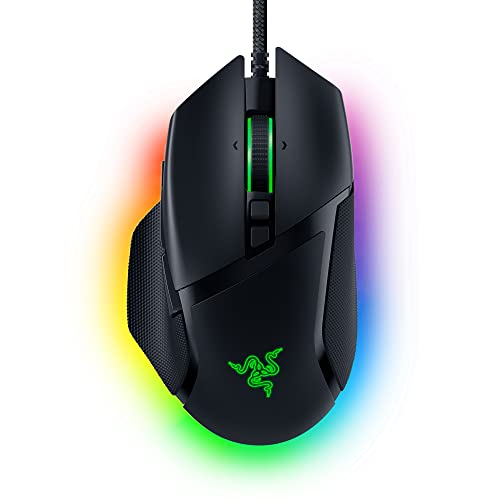 Razer Basilisk V3 |
| Check price on Amazon |
In a first-person shooter, your mouse is the only thing standing between a flick that lands and one that misses by a few pixels. Razer builds its whole FPS lineup around that fact, but the lineup itself is the problem: five or six mice with similar sensors, similar names, and very different shapes. Pick the wrong one and you end up with a heavy ergonomic mouse when your low-sensitivity flicks needed something ultralight, or a bare-bones esports shell when your hand actually wanted a fuller grip.
This guide is for competitive FPS players who want a Razer mouse matched to their grip and sensitivity, whether that means ranked Valorant and CS2 or long Apex Legends sessions. Every mouse below is a Razer gaming mouse built for fast shooters, chosen from the names and specifications on its Amazon product page, and each one is still selling on Amazon US. The five cover ultralight wireless flagships, a long-battery mid-range pick, and a wired ergonomic option.
Our Top Picks
- Razer Basilisk V3 Customizable RGB Wired Ergonomic GamingMouse2.96 x 5.12 x 1.67 inches0.2 poundsCheck on Amazon
Top 3 picks at a glance
Quick Picks
As an Amazon Associate we earn from qualifying purchases
| Product | Best for | Key spec from title |
|---|---|---|
| Razer Viper V3 Pro | Ultralight competitive play at the highest polling rate | Focus Pro 35K sensor, 54 g, 8,000 Hz polling |
| Razer DeathAdder V3 Pro | Palm-grip comfort in long FPS sessions | Focus Pro 30K sensor, 63 g, 90-hour battery |
| Razer Viper V2 Pro | Lightweight wireless play with on-mouse DPI controls | Focus Pro 30K sensor, 58 g, 90-hour battery |
| Razer Viper V3 HyperSpeed | Long battery life on a single AA cell | Focus Pro 30K sensor, 82 g with AA, 280-hour battery |
| Razer Basilisk V3 | Ergonomic wired play with extra programmable buttons | Focus+ 26K sensor, 101 g, 11 programmable buttons |
How to Choose
Weight and shape first
Weight decides how fast you can stop a flick, and shape decides whether your hand stays relaxed while you do it. An ultralight symmetrical mouse near 54 grams suits claw and fingertip grips and low-sensitivity players who move their whole arm, while a fuller ergonomic shell suits palm-grip players who rest their hand on the mouse for hours. A mouse that is too small for a large hand forces a cramped grip and tired fingers, and a mouse that is too large for a small hand makes micro-adjustments feel clumsy. Check the listed length and width against your hand before anything else, because no sensor can fix a shape that fights you.
Sensor quality matters more than the DPI number
Every mouse in this guide tracks at 26,000 DPI or higher, which is far above the 400 to 1,600 DPI range most FPS players actually use. What matters instead is how cleanly the sensor tracks fast swipes, how it handles lift-off when you reposition, and whether it keeps a steady aim at low sensitivity. Look for a sensor with high tracking speed and acceleration ratings, and for lift-off distance you can tune in software. A newer sensor generation also helps on more surfaces, including glass, so check the surface compatibility in the listing if your desk setup is unusual.
Polling rate and battery life pull in opposite directions
A polling rate of 1,000 Hz reports your mouse position a thousand times per second, and most players will never feel the difference between that and 8,000 Hz. The higher rate only helps if your monitor refresh rate is high enough to show the extra updates, and it drains the battery far faster. A mouse rated for 95 hours at 1,000 Hz can drop to a fraction of that at 8,000 Hz. If you play long sessions, decide your polling rate first, then check the battery rating at that rate, not the headline number. Wired mice skip this trade-off entirely.
Switches, buttons, and software
Optical switches last longer than mechanical ones because they use light instead of metal contacts, so they avoid the double-click failures that wear out older mice. For FPS play, the click should feel crisp and reset quickly, because a mushy click slows down repeated shots. Extra side buttons help if you bind grenades, melee, or push-to-talk, but a mouse with too many buttons can crowd your thumb and cause accidental presses. Check whether the mouse stores settings on board, so your sensitivity and button layout survive a move to another PC, and confirm the software runs on your operating system.
The 5 Best Options
Razer Viper V3 Pro
The Viper V3 Pro is the mouse Razer built with professional players, and it shows in every number on the listing. At 54 grams it is one of the lightest wireless mice you can buy, so fast flicks and long tracking sessions feel effortless. The Focus Pro 35K Gen-2 sensor tracks cleanly on glass as well as cloth, and the included HyperPolling dongle pushes the polling rate to 8,000 Hz. Gen-3 optical switches give a crisp click with no double-click risk, and grip tape comes in the box for players who want extra hold.
Specs
- Focus Pro 35K Optical Sensor Gen-2, up to 35,000 DPI, 750 IPS, 70 G acceleration
- 54 g, symmetrical shape, 127.1 x 63.9 x 39.9 mm
- Up to 8,000 Hz polling with the included HyperPolling Wireless Dongle
- Up to 95 hours of battery life
- Gen-3 optical switches, 8 programmable buttons
- Razer HyperSpeed Wireless, USB-C charging, grip tape included
- Model RZ01-05120100-R3U1
Best for: Competitive players who want the lightest Razer mouse with the fastest polling rate.
Watch out for: Battery life drops sharply at 8,000 Hz, so check the rating at the polling rate you will actually use; the white version is a separate listing with its own ASIN.
Razer DeathAdder V3 Pro
- Best for: Palm-grip players with larger hands who want ergonomic comfort in long FPS sessions.
- Focus Pro 30K Optical Sensor, up to 30,000 DPI
- 63 g, ergonomic right-handed shape
- Up to 90 hours of battery life
- Razer HyperSpeed Wireless
Palm-grip players with larger hands who want ergonomic comfort in long FPS sessions.
The shape is right-handed only, and the symmetrical Viper line suits claw and fingertip grips better.
The DeathAdder V3 Pro keeps the ergonomic right-handed shape that made the DeathAdder line famous, but strips the weight down to 63 grams. That combination suits palm-grip players who want comfort in long sessions without giving up esports-level tracking. The Focus Pro 30K sensor handles fast swipes and low-sensitivity aim, and the HyperSpeed wireless connection keeps latency low. Five programmable buttons keep the layout clean, and the 90-hour battery means a full week of play between charges for most players.
Watch out for: The shape is right-handed only, and the symmetrical Viper line suits claw and fingertip grips better.
Razer Viper V2 Pro
- Best for: Claw and fingertip players who want a proven ultralight wireless mouse with on-mouse DPI controls.
- Focus Pro 30K Optical Sensor, up to 30,000 DPI
- 58 g, symmetrical shape
- Up to 90 hours of battery life
- Razer HyperSpeed Wireless, 1,000 Hz polling
Claw and fingertip players who want a proven ultralight wireless mouse with on-mouse DPI controls.
8,000 Hz polling needs the HyperPolling dongle, which is sold separately for this model; check that the listing is the black version, since other editions use different ASINs.
The Viper V2 Pro is the previous flagship in the Viper line, and it still covers everything an FPS player needs. At 58 grams it is only a little heavier than its successor, with the same Focus Pro 30K sensor and the same 90-hour battery. On-mouse DPI controls let you change sensitivity without opening software, which helps when you switch between games. The symmetrical shape suits claw and fingertip grips, and grip tape comes in the box. It is a proven esports shape at a step below the newest flagship.
Watch out for: 8,000 Hz polling needs the HyperPolling dongle, which is sold separately for this model; check that the listing is the black version, since other editions use different ASINs.
Razer Viper V3 HyperSpeed
- Best for: Players who want months of play from one AA battery and a simpler wireless setup.
- Focus Pro 30K Optical Sensor, up to 30,000 DPI, 750 IPS, 70 G acceleration
- 82 g with the included AA battery, 59 g without
- Up to 280 hours of battery life at 1,000 Hz
- Razer HyperSpeed Wireless, 1,000 Hz polling
Players who want months of play from one AA battery and a simpler wireless setup.
There is no Bluetooth and no wired mode, so keep a spare AA cell handy; 4,000 Hz polling needs the HyperPolling dongle, sold separately.
The Viper V3 HyperSpeed trades the rechargeable battery for a single AA cell, and the result is the longest battery life in this guide. One cell runs for up to 280 hours at 1,000 Hz, so you can play for months before swapping it. The Focus Pro 30K sensor is the same one used in the pricier Viper models, and the symmetrical shape suits claw and fingertip grips. At 82 grams with the battery fitted it is heavier than the ultralight flagships, but it stays light enough for fast FPS play.
Watch out for: There is no Bluetooth and no wired mode, so keep a spare AA cell handy; 4,000 Hz polling needs the HyperPolling dongle, sold separately.
Razer Basilisk V3
- Best for: Palm-grip players who want a wired mouse with many programmable buttons and a tilt wheel.
- Focus+ 26K Optical Sensor, up to 26,000 DPI, 650 IPS, 50 G acceleration
- 101 g, ergonomic right-handed shape with thumb rest
- Wired USB connection
- Gen-2 optical switches rated for 70 million clicks, 0.2 ms actuation
Palm-grip players who want a wired mouse with many programmable buttons and a tilt wheel.
At 101 grams it is the heaviest mouse in this guide, so low-sensitivity flick players may prefer a lighter Viper; the cable is fixed, not detachable.
The Basilisk V3 is the wired ergonomic pick for FPS players who want extra controls without going wireless. Its thumb rest and right-handed shape support long sessions, and the 11 programmable buttons give room for grenades, melee, and push-to-talk without crowding your grip. The HyperScroll tilt wheel switches between tactile steps for weapon cycling and free spin for fast scrolling. The Focus+ 26K sensor tracks cleanly for competitive play, and the wired connection removes battery worries entirely.
Watch out for: At 101 grams it is the heaviest mouse in this guide, so low-sensitivity flick players may prefer a lighter Viper; the cable is fixed, not detachable.
Which One Fits Your Situation
You play claw or fingertip grip and flick a lot
Take the Razer Viper V3 Pro. Its 54-gram symmetrical shell and 8,000 Hz polling rate are built for fast arm movement and quick stops, and the Focus Pro 35K sensor keeps tracking clean through the fastest swipes. If the flagship is more than you need, the Viper V2 Pro gives you nearly the same shape and sensor at a step below, with on-mouse DPI controls for switching between games.
You palm grip and play for hours at a time
Take the Razer DeathAdder V3 Pro. Its ergonomic right-handed shape supports a full palm grip, so your hand stays relaxed through long ranked sessions, and at 63 grams it is light for its size. The 90-hour battery covers a full week of play. If you prefer a cable and want more buttons, the Basilisk V3 offers the same ergonomic idea with a thumb rest and 11 programmable buttons.
You want the longest battery life and the simplest setup
Take the Razer Viper V3 HyperSpeed. One AA cell runs for up to 280 hours at 1,000 Hz, so you stop thinking about charging entirely and just swap the cell every few months. It still carries the Focus Pro 30K sensor from the pricier Viper models, and the symmetrical shape suits claw and fingertip grips. Keep a spare AA cell in your desk drawer and you will never lose a match to a dead battery.
You want extra buttons for binds and utility
Take the Razer Basilisk V3. Its 11 programmable buttons cover grenades, melee, push-to-talk, and utility binds without moving your fingers off the main clicks, and the HyperScroll tilt wheel makes weapon cycling fast. The wired connection means no battery to manage. If you also want wireless, the DeathAdder V3 Pro keeps five programmable buttons in a lighter ergonomic shell, though it gives up the thumb rest and the tilt wheel.
Common Mistakes
- Buying on the DPI number alone: every mouse here tracks far above the sensitivity most FPS players use, so shape and weight matter more than the headline figure.
- Ignoring grip style: a symmetrical ultralight mouse suits claw and fingertip grips, while a palm grip needs an ergonomic shell, and the wrong match causes fatigue.
- Running 8,000 Hz polling without checking battery life: the highest polling rate can cut battery life to a fraction of the headline rating.
- Forgetting the dongle: the Viper V2 Pro and Viper V3 HyperSpeed need a HyperPolling dongle, sold separately, for polling above 1,000 Hz.
- Ordering the wrong variant: white and special-edition versions of these mice are separate listings with their own ASINs, so check the model and colour in the listing before buying.
Frequently Asked Questions
Do I need 8,000 Hz polling for FPS games?
Most players do not. A polling rate of 1,000 Hz already reports your position a thousand times per second, and the gain from 8,000 Hz is only visible on high-refresh monitors. It also drains the battery much faster. Choose 8,000 Hz only if you play competitively on a fast monitor and you are willing to charge more often.
Is a lighter mouse always better for aiming?
Not always. A lighter mouse makes flicks easier and reduces wrist fatigue, which is why competitive players favour mice near 54 grams. But if the mouse is too light for your grip, it can feel twitchy and hard to stop precisely. Players with a steady palm grip often aim better with a slightly heavier ergonomic mouse, so match the weight to your hand and sensitivity, not to the spec sheet.
Wired or wireless for competitive FPS?
Wireless is fine for competitive play now. Razer HyperSpeed wireless matches wired latency closely enough that professional players use it in tournaments, and it removes cable drag. Wired still wins if you never want to think about batteries or charging, and it costs less in this guide. Pick wireless for freedom of movement, and wired for simplicity and a lower outlay.
Which Razer mouse suits small hands?
The Viper V3 Pro and Viper V2 Pro suit small hands best in this guide. Both use a compact symmetrical shape that works well for claw and fingertip grips, and their low weight makes them easy to control. The DeathAdder V3 Pro and Basilisk V3 are larger ergonomic mice built for bigger hands, so small-handed players usually find them harder to flick quickly.
Related guides
More from Amazon
Programs that pair well with the guide above. Offers and eligibility are set by Amazon and may change.
Free shipping on eligible items, Prime Video and more. Eligible new members can start with a free trial.
Start a Prime free trialAd-free music streaming. Eligible new subscribers can start with a free trial.
Try Music Unlimited freeA Prime membership for ages 18-24 with a trial period. Eligibility is set by Amazon.
See Prime for Young AdultsAudiobooks and podcasts to listen to on the go. Eligible new members can start with a free trial.
Try Audible freeAs an Amazon Associate we earn from qualifying purchases.