
The Short Answer
No, a ring light is not inherently bad for streaming with glasses, but it depends entirely on where you position the light. If you place a ring light directly behind your camera—the standard setup recommended for most content creators—it will be highly problematic. It will cast distracting, bright white glowing circles directly onto your spectacle lenses, completely obscuring your eyes from your audience. However, if you position the ring light off-camera at a 45-degree angle to the side and slightly above your eye line, you can completely eliminate the glare while still enjoying bright, even, and flattering facial illumination.
What You Actually Get
When you buy a ring light, you are purchasing a circular array of light-emitting diodes (LEDs) designed to provide shadow-free, radial illumination. The physical design of a ring light is meant to wrap light around your face, minimizing harsh shadows under your nose and chin. However, for those of us who wear glasses, this unique shape presents a distinct optical challenge based on basic physics: the angle of incidence equals the angle of reflection.
As an Amazon Associate we earn from qualifying purchases at no extra cost to you.
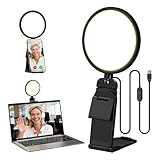

If a ring light is positioned directly in front of you, the light waves bounce off the curved surface of your lenses and reflect straight back into your webcam. This creates the dreaded “halo eye” effect—two bright, glowing white rings floating on your glasses that hide your eyes and detach you from your audience. In 2026, viewers expect high-production value and personal connection, and staring at two glowing circles instead of your eyes makes it incredibly difficult to build rapport during a live stream.
To combat this, you need to understand the physical footprints of the tools available. Standard budget models, such as the LitONES Ring Light for Computer (priced at $29.99), feature a compact 6-inch diameter, a lightweight 0.9-pound build, and draw about 10 watts of power via a simple USB connection. Because of its smaller surface area, this type of light creates smaller, highly concentrated reflections. If you step up to a flat panel style like the HumanCentric Video Conference Lighting (priced at $59.99), which features a rectangular 6.3 x 3.8-inch diffuse LED panel pulling up to 12 watts, the reflection changes from a sharp ring to a wider, softer block of light. While still visible, a diffused rectangular source is often easier to position out of your line of sight than a harsh, circular ring light.
Ultimately, using a ring light with glasses requires a compromise. To get rid of the glare, you must move the light off-center. But when you move a single light source to the side, you introduce shadows on the opposite side of your face. To get a truly professional, glare-free look, you will likely need to pair your off-axis ring light with a secondary, dimmer “fill” light or a reflective bounce board to balance out the shadows.
Pros
- Flattering, Soft Light: When positioned correctly, ring lights provide excellent, even illumination that softens skin tones and minimizes facial blemishes.
- Affordable Entry Point: With options like the LitONES Ring Light starting at around $29.99, they offer a very budget-friendly way to drastically improve your video quality.
- Adjustable Color Temperature: Most modern ring lights offer a range from warm amber (3000K) to cool daylight (6500K), allowing you to match the ambient lighting of your room.
- Compact Footprints: Most consumer ring lights weigh under 1.5 pounds and use clamp mounts or small desktop tripods, saving valuable desk real estate.
Cons
- Severe Glare When Centered: Placing the light directly behind your camera is a non-starter for glasses wearers; the circular reflection is incredibly distracting to viewers.
- Unbalanced Shadows When Angled: Moving the light to a 45-degree angle to avoid glare creates a high-contrast shadow on the opposite side of your face, often requiring a second light source to correct.
- Eye Strain: Staring near a direct, concentrated ring of LED beads for multi-hour streaming sessions can cause dry eyes and fatigue, especially if the light lacks a high-quality diffuser.
- Lens Coating Sensitivity: If your glasses do not have a high-grade anti-reflective (AR) coating, even minor peripheral reflections will show up as bright green or blue flares on camera.
Who Should Buy It
You should buy a ring light if you are a budget-conscious streamer who has a spacious desk setup that allows for flexible light placement. If you can place the light at least two to three feet away from your face, angled off to the side, and slightly elevated, you will get fantastic results. This setup works exceptionally well if your glasses are equipped with a premium anti-reflective (AR) coating, which naturally dampens minor peripheral reflections. It is also an excellent choice for casual content creators, remote workers doing occasional Zoom calls, and streamers who do not mind a slightly dramatic, high-contrast shadow aesthetic on their faces.
Who Should Skip It
You should skip a ring light if your desk is crammed against a wall or if you are forced to mount your light directly on top of your monitor or webcam. In tight spaces, you cannot achieve the angle required to throw the reflection out of the camera’s view, meaning your viewers will be treated to a constant, blinding white halo on your lenses. Additionally, if you wear high-index lenses without an anti-reflective coating, or if you prefer a perfectly balanced, shadow-free “beauty” look without buying a secondary fill light, you should opt for a diffused key light panel instead. Dedicated flat panels, such as the HumanCentric Video Conference Lighting, offer built-in diffusion layers that disperse light much more gently, making reflections far less harsh and much easier to manage.
Cheaper Alternatives
If you are hesitant to invest in a dedicated ring light or flat panel, or if you want to test your streaming setup before spending money, there are several budget-friendly alternatives to consider:
| Option | Cost | Trade-off |
|---|---|---|
| Standard Desk Lamp with Parchment Paper | $10 – $15 | Bulky footprint; lacks color temperature control; DIY diffusion can look untidy on your desk. |
| Natural Window Light | $0 | Completely dependent on the time of day and weather; highly inconsistent for scheduled evening streams. |
| USB Monitor Light Bar | $30 – $45 | Designed to illuminate your keyboard and desk rather than your face; can still catch the very top rim of your glasses if not angled precisely. |
FAQ
How do I completely stop my ring light from reflecting in my glasses?
The most effective way to eliminate the reflection is to move the light source out of your camera’s direct line of sight. Place your ring light approximately 45 degrees to the left or right of your webcam, and raise it so it shines down on your face at a 45-degree downward angle. This ensures that the light hitting your glasses bounces downward and outward, completely missing your camera lens.
Does an anti-reflective (AR) coating on my glasses help with streaming glare?
Yes, immensely. An anti-reflective coating allows more light to pass through your lenses rather than bouncing off them. While it will not completely eliminate reflections from a light source pointing directly at your face, it will turn a blinding white glare into a much softer, duller green or purple reflection that is far less distracting to your audience.
Is a flat LED panel better than a ring light for glasses wearers?
Generally, yes. Flat LED panels, like the HumanCentric model, feature built-in, heavy-duty frosted diffusers. This spreads the light out over a larger surface area, resulting in a softer, less intense reflection. Furthermore, rectangular reflections tend to look more like natural window light, which viewers find much less distracting than glowing circular halos.
Can I use two ring lights to eliminate shadows while wearing glasses?
Yes, a two-light setup (known as a key light and a fill light) is highly effective. You place one ring light at a 45-degree angle to your left as your main light source, and a second, much dimmer ring light (or a reflector board) at a 45-degree angle to your right. By keeping both lights off-center, you avoid glare on your glasses while successfully filling in the shadows on both sides of your face.


