
Top 3 picks at a glance

Best Chalk Bags for Rock Climbing: Size & Features
The best chalk bags for rock climbing balance a roomy opening with a closure that contains loose chalk, a brush holder you can reach while climbing, and a belt that stays secure without getting in the way. For most climbers, a medium bag with a stiff rim, drawcord closure, and adjustable waist belt is the most versatile choice; boulderers may prefer a compact bag with a roll-top-style closure, while long-route climbers benefit from extra capacity.
Choose by how you climb
| Climbing situation | Useful capacity | Closure to prioritize | Brush holder and belt fit |
|---|---|---|---|
| Gym sessions and short sport routes | About 0.5–0.8 L | Drawcord with a snug fabric cuff | One easy-access brush sleeve; belt that adjusts over a T-shirt or light layer |
| Long routes or frequent re-chalking | About 0.8–1.2 L | Drawcord; prioritize a wide opening over a complicated seal | Two brush sleeves can be useful; belt should sit comfortably over a harness |
| Bouldering and pad-to-problem sessions | About 0.4–0.8 L | Fold-over or roll-top-style closure to limit spills in a pack | Compact profile, secure belt or clip-on option, and a brush sleeve that won’t snag |
| Small hands or a preference for less bulk | About 0.4–0.6 L | Simple drawcord that opens without two-handed fiddling | Check the opening width and belt adjustment range before choosing |
These capacity figures are practical estimates, not a universal sizing standard: brands measure and describe bag volume differently. The useful test is whether you can chalk your whole hand without scraping your knuckles on the rim, while still being able to close the bag reliably.
As an Amazon Associate we earn from qualifying purchases at no extra cost to you.

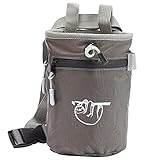

Closure: access versus spill resistance
A drawcord is the dependable all-rounder. It opens quickly between moves and cinches closed when you pack up. Its weak point is that loose chalk can escape if the bag tips over, the cord is left open, or the fabric cuff is too short to fold inward. A drawcord bag is a good fit for roped climbing, where the bag is usually upright on your waist and frequent access matters.
Fold-over and roll-top-style closures generally offer better containment inside a bouldering pack. They take an extra motion to open and close, so they can be less convenient when you want a quick dip between attempts. Look for a design that remains easy to secure with chalky hands; a closure that stays half-open in practice doesn’t provide much spill protection.
Whichever style you choose, check that the rim holds its shape. A stiff opening makes it easier to find the chalk by feel and reduces the chance of brushing a hand against the outside of the bag. A soft, collapsing rim may be lighter, but can be frustrating to use on a steep route.
Size and capacity: a practical way to decide
Use your normal climbing session—not the manufacturer’s largest capacity claim—as the sizing reference. If you take several re-chalks per route or climb for long stretches without returning to the ground, choose a larger bag. If you mainly boulder, carry the bag in a pack, or want minimal hip bulk, a compact model is usually easier to live with.
Here’s a simple packing estimate: if your usual session takes roughly 60 g of loose chalk and you want a 25% reserve, plan for about 75 g (60 × 1.25). That is a target amount to carry, not a guaranteed volume rating: chalk density varies with grain size and how tightly it settles. Before buying, check whether the maker gives a capacity in liters or a recommended chalk fill, and avoid filling a bag to the brim. Leaving space makes it easier to dip and close without chalk puffing out.
Consider the opening as well as volume. A deep, narrow bag can hold plenty yet be awkward for a broad hand; a wide, shallow design can be quick to use but may expose more chalk when tipped. If possible, compare the opening diameter with a bag you already find comfortable.
Brush holders and belt fit: small details with real consequences
A brush holder works best when its opening is reachable from your normal stance and holds the brush securely while you move. A sleeve that is too loose lets a brush fall out; one that is too tight can make retrieval awkward. If you commonly carry different brush sizes, check whether the holder is elastic or sized for a particular handle.
For roped climbing, set the belt so the bag sits where your hand naturally reaches behind your hip without catching the rope or harness. It should not rotate around your waist when you chalk up. Try adjusting it over the layers you actually climb in: a belt that fits over a summer shirt may be uncomfortable over a jacket. For bouldering, a short, stable belt or a secure clip-on arrangement keeps the bag portable between problems, but confirm that the attachment is intended for carrying a chalk bag and won’t swing into the wall.
Which bag type is the best fit?
- Best all-round configuration: medium capacity, stiff rim, drawcord closure, one brush sleeve, and an adjustable waist belt. It suits gym sessions and most roped climbing.
- Best for bouldering portability: compact capacity, a closure that folds or rolls shut, and a secure way to carry the bag in or on a pack. Choose quick access over maximum capacity if you frequently move between problems.
- Best for long sessions: larger capacity and a wide, easy-to-reach opening. A second brush sleeve is useful only if you actually carry two brushes.
- Best for minimal bulk: a small, shallow bag with a simple opening. Make sure it still fits your hand comfortably and is easy to cinch closed.
Before you buy: three useful checks
- Check hand access. Compare the opening width with your hand and preferred chalking motion; volume alone doesn’t tell you whether the bag will feel cramped.
- Check closure behavior. Look for a design that closes fully without forcing chalk through the rim. If you pack it beside clothing or gear, favor a more secure closure.
- Check belt adjustment and brush retention. Confirm the belt fits over your usual layers and that the brush holder suits the handle you use.
For a single bag that covers the widest range of climbing, start with a medium-sized drawcord model with a firm rim and adjustable belt. Move smaller and toward a more pack-friendly closure for bouldering; move larger when long sessions and frequent re-chalking matter more than carrying less bulk.
Frequently asked questions
Can I use the same chalk bag for gym climbing and bouldering?
You can, but the most convenient design depends on how you carry and use it. A medium drawcord bag with a firm rim suits gym sessions and most roped climbing, while bouldering often benefits from a compact profile and a fold-over or roll-top-style closure. That closure helps limit spills when the bag is carried in a pack.
How do I know whether a chalk bag opening is large enough?
The opening is large enough when you can chalk your whole hand without scraping your knuckles on the rim. Compare its width with a bag you already find comfortable, if possible. Volume alone is not enough: a deep, narrow bag may feel cramped, while a wide, shallow bag may expose more chalk when tipped.
Should I fill my chalk bag all the way to the brim?
You should avoid filling a chalk bag to the brim. Leaving some space makes it easier to dip your hand and close the bag without chalk puffing out. Your target amount depends on your normal session and desired reserve, but chalk density varies with grain size and how tightly it settles, so a fill amount is not a guaranteed volume rating.
Where should a chalk bag sit while I am climbing?
A chalk bag should sit behind your hip where your hand naturally reaches, without catching on the rope or harness. Adjust the belt over the layers you actually climb in, since clothing changes the fit. The bag should remain stable when you chalk up rather than rotating around your waist or interfering with movement.
What should I look for in a chalk bag brush holder?
Look for a brush holder that you can reach from your normal stance and that holds the brush securely while you move. A loose sleeve may let the brush fall out, while a tight one can make retrieval awkward. If you carry different brush sizes, check whether the holder is elastic or intended for a particular handle.


