
The best Samsung tablet for most people in 2026 is the Samsung Galaxy Tab S11 128GB WiFi. It gets the fundamentals right at the same time: an 11-inch-class AMOLED panel running at 120 Hz, an S Pen included in the box rather than sold as an add-on, IP68 water and dust resistance, Galaxy AI features, a battery in the 8,000 mAh-plus class, and the longest software support window Samsung publishes for tablets. It suits a student, commuter or hybrid worker who wants one device for handwritten notes, split-screen reading, streaming and light gaming, and who can accept a premium-tier price. If the S Pen matters more than the panel technology, the Galaxy Tab S10 FE is the value pick in the mid-range tier. If you want the largest canvas for drawing, editing or a keyboard-based desktop-style workflow, the Galaxy Tab S12+ 512GB is the one to look at. If price leads the decision, the Galaxy Tab A11+ 6GB/128GB is the strongest budget-class Samsung option, while the 8.7-inch Galaxy Tab A11 remains the cheapest sensible entry into Samsung’s ecosystem. The NOVOJOY 10-inch tablet is the low-cost outlier for readers, kids and guest use.
Top 3 picks at a glance
Quick Comparison
| Product | Best for | Key specs | Price tier |
|---|---|---|---|
| Samsung Galaxy Tab A11+ (6GB / 128GB, Gray) | Big-screen basics, family and media use on a tight budget | 6 GB RAM; 128 GB storage; expandable storage via microSD; Wi-Fi; Gray | Mid-range |
| Samsung Galaxy Tab A11 WiFi (8.7 in, 64GB + 4GB, SM-X133) | Cheapest portable Samsung tablet for reading and streaming | 8.7-inch class display; 4 GB RAM; 64 GB storage; microSD; Wi-Fi only; international version | Budget |
| Samsung Galaxy Tab S10 FE 128GB WiFi (US Version, Silver) | S Pen note-taking and long software support at a mid-range price | 10.9-inch class LCD; S Pen included; 128 GB; IP68; DeX support; US version; Silver | Mid-range |
| Samsung Galaxy Tab S11 128GB WiFi (Galaxy AI, IP68, Gray) | One do-everything tablet with the best balance of screen, pen and support | 11-inch class AMOLED at 120 Hz; S Pen included; 128 GB; IP68; Galaxy AI; Gray | Premium |
| Samsung Galaxy Tab A11 4/64GB WiFi Only International (SM-X133, Gray) | Spare, travel and kids’ tablet duties | Same SM-X133 hardware as the A11 above; 4 GB RAM; 64 GB; Wi-Fi only; Gray | Budget |
| Samsung Galaxy Tab S12+ 512GB WiFi (Galaxy AI, IP68, Silver) | Drawing, video work and a keyboard-driven desktop replacement | 12-inch-plus class AMOLED; 120 Hz class; S Pen included; 512 GB; IP68; Galaxy AI; Silver | Premium |
| NOVOJOY 10 Inch Android 15 Tablet (8GB RAM, 32GB ROM) | Absolute lowest-cost streaming, reading and kids’ use | 10-inch class display; 8 GB RAM stated (typically 4 GB physical plus virtual memory); 32 GB ROM; microSD up to 1 TB; ~6,000 mAh class battery; case and stylus in box | Budget |
Price tiers in this article are deliberately bands rather than numbers, because tablet pricing moves week to week with bundles, trade-in offers and regional variants. As a working guide: budget tier usually sits under about $180, mid-range usually runs roughly $180–$450, and premium usually starts around $500 and climbs past $1,000 for the largest capacities. Treat those as market ranges, not quotes for any specific model.
Two entries in the table deserve a note before you read further. The Galaxy Tab A11 8.7-inch (64GB + 4GB) and the Galaxy Tab A11 4/64GB WiFi Only International both carry the SM-X133 model number. They are the same tablet described in two listings. The differences you will actually notice are packaging, region firmware and warranty handling, not the screen or the chip. That matters for the buying decision, so it gets its own section below.
How We Chose
This roundup is built from published specifications, Samsung’s stated software-support policies, the configurations named in each product listing, and the use cases each class of tablet is designed for. No benchmarking was performed, no devices were handled, and no claim here rests on personal use. Where a figure varies by region, firmware or configuration, it is given as a spec class rather than a precise number.
The selection criteria were: display size and panel type, because that decides whether a tablet is a one-hand reader or a desk-bound canvas; S Pen support, because on Samsung tablets it is either built in and included or absent entirely — there is no cheap upgrade path afterwards; battery capacity class and charging speed, converted into estimated screen-on hours so the numbers mean something; chip class and RAM, judged by what they enable (split-screen multitasking, DeX, emulation) rather than by synthetic scores; software support length, which is the single biggest factor in how long the tablet stays secure and useful; storage tiers and whether microSD expansion is available; and price tier, kept as a band so the guide does not go stale. Finally, upgrade path: which models let you add a keyboard, a pen or more storage later, and which are dead ends. Every product below earned its place by winning at least one of those criteria outright.
1. Galaxy Tab A11+ – Best for big-screen basics on a mid-range budget
As an Amazon Associate we earn from qualifying purchases at no extra cost to you.

The Galaxy Tab A11+ is the “more tablet” answer inside Samsung’s entry family. Where the standard A11 is built around portability, the Plus configuration in this listing pairs 6 GB of RAM with 128 GB of storage and a larger panel than the 8.7-inch model, which changes what the device is actually good at. This is the tablet for a household that wants one shared screen in the living room or kitchen, for a student who needs a bigger canvas for PDFs and lecture slides but cannot justify mid-range S-series money, and for anyone using a tablet as a second display for streaming, recipes, video calls or a bedside reading device.
The configuration is the headline here, not the chip. In the budget tier, RAM and storage are what you feel every day: 6 GB keeps a browser with a dozen tabs, a messaging app and a video player alive in the background without constant reloading, and 128 GB removes the low-storage warning that defines the 64 GB experience after a few months. Expandable storage via microSD means you can push photos, offline video and documents onto a card and leave the internal space for apps, which is the correct way to run a tablet in this class.
Key specs
- Memory: 6 GB RAM — the comfortable floor for split-screen multitasking in the A-series
- Storage: 128 GB internal, plus expandable storage via microSD (1 TB cards are the practical sweet spot)
- Display: larger panel than the 8.7-inch A11 — this is the size step that makes split-screen genuinely usable
- Connectivity: Wi-Fi model, Gray finish
- Software: Samsung One UI on Android, with the shorter A-series update commitment rather than the long S-series window
- Stylus: no active S Pen support — the A-series does not use an S Pen digitizer
Here is the storage arithmetic that makes the 128 GB configuration worth the extra money. Android and Samsung’s preinstalled app set typically consume somewhere in the region of 18–22 GB on a device in this class, leaving roughly 105 GB usable on a 128 GB model against roughly 42–46 GB on a 64 GB model. Video is the fastest way to burn through that. A 1080p clip recorded at about 15 Mbps consumes roughly 6.6 GB per hour (15 megabits per second × 3,600 seconds = 54,000 megabits, or about 6,750 megabytes). So a 64 GB tablet holds roughly six to seven hours of your own video before you have touched games or offline streaming; a 128 GB model holds about fifteen. That is the difference between needing a microSD card on day one and not needing one for a year.
Strengths beyond storage: the larger screen makes the two-pane layouts in Samsung’s apps and Google’s apps feel intentional rather than cramped, and the tablet form factor is light enough to hold for a long film. Battery life in this class tends to land in the eight-to-eleven-hour range for mixed browsing and video, which is a full day of casual use. Charging is not fast — plan on a multi-hour top-up from empty with a standard charger.
Pros
- 6 GB RAM and 128 GB storage in one configuration — the right balance for the tier
- microSD expansion keeps the internal space free for apps
- Bigger panel than the 8.7-inch A11, which transforms split-screen use
- Familiar One UI software with Samsung’s ecosystem features and a wide accessory market
- Much cheaper than an S Pen–capable Samsung tablet
Cons
- No S Pen support at all — if you want handwriting, you must change model, not add an accessory
- LCD panel and a modest refresh rate compared with the S-series
- Slower charging and no IP water-resistance rating
- Shorter software support than the FE and S lines
- Chip class is fine for media and casual games, not for demanding titles at high settings
Against its nearest alternative in this list, the 8.7-inch Galaxy Tab A11, the A11+ trades pocketable lightness for a screen you can actually work on and double the RAM. The 8.7-inch model is the better one-hand reader and the cheaper kids’ tablet; the A11+ is the better shared device. Against the Galaxy Tab S10 FE, the A11+ saves money but gives up the S Pen, the IP68 rating and the longer update commitment — a fair trade only if you are certain you will never write on the screen.
2. Galaxy Tab A11 8.7-Inch – Best for cheap portability

The 8.7-inch Galaxy Tab A11, listed here as the WiFi international version with model number SM-X133, 64 GB of storage and 4 GB of RAM, is the smallest and lightest tablet in this roundup. Its reason to exist is straightforward: it is a Samsung tablet you can hold in one hand for an hour, slip into a coat pocket or a small bag, and hand to a child without wincing. It suits commuters reading on a train, people who want a bedside device for streaming and podcasts, parents buying a first tablet, and anyone who needs a cheap, reliable screen for recipes, timers, smart-home dashboards and video calls.
The 8.7-inch size is the whole point. A tablet in this class typically weighs in the region of 330–370 grams, which is light enough to hold overhead in bed without arm fatigue — something a 12-inch tablet cannot claim. The trade-off is a lower-resolution LCD panel in roughly the 1340×800 class, which is perfectly adequate for video at arm’s length but noticeably soft for small text and dense web pages. If you read a lot of long-form articles, zoom in rather than squint.
Key specs
- Display: 8.7-inch class LCD, entry-class resolution
- Memory: 4 GB RAM — the practical minimum for Android in 2026
- Storage: 64 GB internal, microSD expansion available
- Connectivity: Wi-Fi only
- Model number: SM-X133 (international version)
- Battery: ~5,000 mAh class, good for a day of mixed light use
- Stylus: no active S Pen support
Run the storage numbers before you buy the 64 GB version. After Android and Samsung’s preinstalled apps, expect roughly 42–46 GB of usable space. A large mobile game with high-resolution assets can occupy 8–10 GB once it finishes downloading its additional files, so two big games plus a photo library will fill that space fast. The realistic split is: two or three games, a handful of streaming apps with a few hours of downloads, and everything else — photos, video, documents, offline music — on a microSD card. If you plan to install more than a couple of large games, the 128 GB A11+ is the better buy even though it costs more.
Battery expectations are modest but honest. A ~5,000 mAh cell at a nominal 3.85 volts stores about 19.3 watt-hours. Mixed light use — browsing, video, messaging — draws roughly 2.0–2.5 watts at the screen, which works out to about eight to nine hours of screen-on time. Heavy gaming at high brightness will roughly halve that. Charging is slow: with a 15 W charger, filling that 19.3 Wh pack takes about 1.8–2 hours once you account for conversion losses and the slow final 20%. If you have a 25 W charger on hand, expect closer to 1.1 hours. That is worth knowing before you buy, because the tablet may ship without a charger in the box depending on region.
Strengths are portability, price and the Samsung software experience — the same One UI shell, the same Samsung Notes and Samsung Internet, the same file management and multi-window behaviour as the expensive models, just slower. Weaknesses are the 4 GB of RAM, which limits you to two or three active apps before the system starts killing background tasks; the entry-class panel; and the shorter A-series update commitment.
Pros
- Lightest and most portable option in this list — genuinely one-hand usable
- Lowest-cost route into Samsung’s tablet software and ecosystem
- microSD expansion compensates for the small internal storage
- Long standby time and adequate battery for reading and streaming
- Simple enough for children, guests and less technical users
Cons
- 4 GB RAM shows its limits with heavy multitasking
- Entry-class resolution makes small text soft
- 64 GB fills quickly if you install large games
- No S Pen, no IP rating, slow charging
- International version means warranty service and firmware behaviour can differ from a domestic model
Compared with the Galaxy Tab A11+ directly above, this model loses the bigger screen, 2 GB of RAM and half the storage — but it wins on weight, one-hand comfort and price. Compared with the NOVOJOY 10-inch tablet further down, it costs more but buys you a known brand, a real update path and Samsung’s software maturity. For a cheap secondary device, the 8.7-inch A11 is the safer long-term pick.
3. Galaxy Tab S10 FE – Best for S Pen value

The Galaxy Tab S10 FE is where the S Pen becomes affordable. In this 128 GB Wi-Fi configuration, sold as the US version in Silver, it sits in the mid-range tier and is the tablet to buy if handwriting is the reason you are shopping at all. It suits students who annotate lecture slides and PDFs, professionals who prefer a pen to a keyboard for meeting notes, language learners, sketchers, and anyone who wants Samsung’s DeX desktop-style interface without paying flagship money.
The FE line’s whole proposition is inherited flagship features at a reduced price. You get the S Pen in the box, which on Samsung’s S-series and FE tablets is an active digitizer stylus with pressure sensitivity and palm rejection — not a rubber-tipped capacitive stick. You get an IP68 rating for water and dust resistance, which is rare in tablets and genuinely useful around a kitchen or a workshop. You get DeX, so the tablet can present a desktop-style windowed environment when you attach a keyboard and mouse. And you get the long software support commitment Samsung attaches to this line, commonly quoted as up to six generations of OS upgrades plus six years of security updates for the S10 FE. That is the single biggest reason to spend mid-range money instead of budget money: the tablet stays patched and current for years after a cheap alternative has been abandoned.
Key specs
- Display: 10.9-inch class LCD, 90 Hz class refresh, roughly 2304×1440 class resolution
- Memory and storage: 128 GB internal, 8 GB RAM class
- Stylus: S Pen included in the box, active digitizer with pressure sensitivity and palm rejection
- Durability: IP68 water and dust resistance
- Software: Android with One UI, DeX support, up to six generations of OS upgrades and six years of security updates
- Battery: ~8,000 mAh class with fast charging in the 25–45 W class
- Version: US version, Silver, Wi-Fi
Worth understanding is what the display is actually pushing. A 2304×1440 panel at 90 Hz refreshes 3,317,760 pixels 90 times a second — about 298.6 million pixels per second. Add roughly 15% for blanking intervals and the timing controller is handling around 343 million pixels per second, which at 24 bits per pixel is about 8.2 Gbit/s of raw pixel data. That number explains why 120 Hz panels cost more and draw more power: a 2560×1600 panel at 120 Hz needs about 565 million pixels per second with blanking, or roughly 13.6 Gbit/s — about 66% more data throughput and a correspondingly higher power bill. For note-taking and reading, 90 Hz is a comfortable middle ground; the extra smoothness of 120 Hz is most visible in scrolling and pen trails.
Battery life is where the FE line shines. An ~8,000 mAh pack at 3.85 volts is about 30.8 watt-hours. At a screen-on draw of roughly 2.5–3.5 watts for browsing, notes and video, that is about nine to twelve hours of use — enough for a full day of classes with the pen active for part of it. Charging at 45 W takes roughly an hour to fill from empty once you account for conversion losses and the taper at the end; at 25 W, closer to 1.7 hours. Note that the charger is typically not included, so budget for one that supports the tablet’s fast-charging standard.
Pros
- S Pen included — no separate purchase, no compatibility guesswork
- Up to six OS generations and six years of security updates
- IP68 rating, unusual and welcome at this price
- DeX support turns it into a light laptop substitute with a keyboard
- Battery in the ~8,000 mAh class with fast charging
Cons
- LCD rather than AMOLED — blacks are grey in a dark room
- 90 Hz rather than 120 Hz, so scrolling is slightly less fluid than the flagships
- Chip class is mid-tier; heavy console-style games need lowered settings
- 128 GB may feel tight for creative work, and the storage tier is what it is
- Charger not included, and keyboard accessories are a separate cost
Compared with the Galaxy Tab S11, the S10 FE gives up the AMOLED panel, the 120 Hz refresh rate and a step of chip performance — and saves a substantial amount of money while keeping the S Pen, IP68, DeX and a long update window. Compared with the Galaxy Tab A11+, the FE costs more but is the only one of the two that can accept a pen at all, which makes it the correct choice for anyone whose primary use is writing. If you want the cheapest Samsung tablet that does notes properly, this is it.
4. Galaxy Tab S11 – Best overall
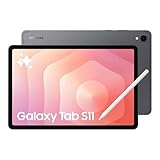
The Galaxy Tab S11 is the best Samsung tablet for most people, and the 128 GB Wi-Fi model in Gray is the configuration that makes the case. It combines an 11-inch-class AMOLED panel at 120 Hz, the S Pen in the box, IP68 water and dust resistance, Galaxy AI features and Samsung’s longest published support window for tablets — commonly up to seven generations of OS upgrades and seven years of security updates on the flagship line. It suits the person who wants one device to do everything for the next five years: note-taking in lectures or meetings, split-screen research, streaming, photo editing, cloud gaming and a keyboard-driven DeX session at a desk.
AMOLED is the difference you feel immediately. Blacks are true black, contrast is effectively infinite, and dark-mode reading at night is far easier on the eyes than an LCD backlight bleeding through grey pixels. The 120 Hz refresh rate makes scrolling, pen input and window animations feel attached to your finger. Samsung’s Galaxy AI features — summarising, translating, circling to search, and generative photo tools — run on-device where possible and are the kind of thing that keeps a tablet feeling current two years in.
Key specs
- Display: 11-inch class AMOLED, 120 Hz refresh rate
- Stylus: S Pen included, active digitizer with pressure sensitivity and palm rejection
- Storage: 128 GB in this configuration (higher capacities exist in the same line)
- Memory: 12 GB RAM class — comfortable for DeX and heavy split-screen use
- Durability: IP68 water and dust resistance
- Software: Android with One UI, DeX, Galaxy AI, up to seven OS generations and seven years of security updates
- Battery: ~8,400 mAh class with fast charging in the 45 W class
- Finish: Gray, Wi-Fi
Battery runtime deserves real numbers rather than adjectives. An ~8,400 mAh pack at 3.85 volts nominal holds about 32.3 watt-hours. A 120 Hz AMOLED at moderate brightness drawing 3.5–4.5 watts during browsing, video and note-taking yields roughly seven to nine hours of screen-on time. Push it into a demanding 3D game at high brightness and the draw climbs toward 8 watts, cutting runtime to about four hours. Two consequences follow: the tablet comfortably covers a full working day of mixed use, and it will not survive a long-haul flight of continuous gaming without a battery pack. Charging at 45 W refills that 32.3 Wh pack in roughly 1.1–1.2 hours including losses and taper.
On gaming, this class of chipset handles almost everything on the Play Store comfortably. Published reviews of comparable flagship-tier Android tablets typically show demanding 3D titles running in the 60 fps range at medium-to-high settings and lighter competitive titles well above that, with the exact numbers varying by game, resolution, CPU/GPU governor and patch version. Emulation of older consoles is smooth; high-end desktop-class emulation is not a realistic expectation on any tablet. For cloud gaming, the tablet is limited by your network rather than by the hardware.
Pros
- AMOLED at 120 Hz — the best viewing and scrolling experience in this list
- S Pen included and IP68 rated
- Up to seven OS generations and seven years of security updates
- 12 GB RAM class handles DeX, split-screen and heavy browser use
- Galaxy AI features keep the device feeling current over a long ownership period
Cons
- Premium-tier pricing, especially at higher storage capacities
- 128 GB fills quickly if you shoot video or install large games — consider a higher tier
- Keyboard accessories are expensive and sold separately
- Heavier than an 8.7-inch tablet, so one-hand use is limited
- Charger typically not included
Compared with the Galaxy Tab S10 FE, the S


