
The best concrete vibrators are chosen by matching vibrator type, motor power, shaft length, frequency, and head diameter to the size and reinforcement of your pour—not by buying the most powerful unit available.
As an Amazon Associate we earn from qualifying purchases at no extra cost to you.
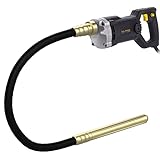


Top 3 picks at a glance
Quick picks by concrete-pour scenario
| Pour or job | Best vibrator type | Useful specification | Why it fits |
|---|---|---|---|
| Small slab, repair, steps | Compact cordless internal vibrator | 12–18 V battery, 0.75–1.25 in head, 4–8 ft shaft | Portable and easy to control without over-vibrating thin sections |
| Garage slab or driveway | Electric flexible-shaft internal vibrator | 1–2 hp motor, 1–1.5 in head, 10–14 ft shaft | Enough radius and runtime for repeated slab sections |
| Footings and grade beams | Heavy-duty internal vibrator | 1.5–3 hp motor, 1.25–2 in head, 10–20 ft shaft | Handles dense mixes and deeper forms efficiently |
| Reinforced columns and walls | Small-head internal vibrator | 0.75–1.25 in head, high frequency, flexible shaft | Fits between reinforcing bars and reduces honeycombing |
| Precast tables or thin forms | External form vibrator | Electric or pneumatic, sized for the form mass | Vibrates without inserting a head into the concrete |
| Remote or large commercial work | Gas-powered or industrial electric unit | 2–5 hp drive, long shaft, 1.5–2 in head | Provides extended duty time where mains power is unavailable |
Internal versus external concrete vibrators
Internal vibrators: the general-purpose choice
An internal vibrator, also called a poker or immersion vibrator, places the vibrating head directly into fresh concrete. It is normally the best choice for slabs, footings, beams, columns, walls, and most cast-in-place work. The head liquefies the mix locally, allowing trapped air to rise and aggregate to settle around reinforcement.
Common examples include the Makita DVR450Z cordless concrete vibrator and the Milwaukee M18 FUEL Concrete Vibrator 2810-20. These compact models are useful for repair work, small slabs, and locations where a power cord is inconvenient. For continuous commercial work, a flexible-shaft electric unit or a gas-powered drive generally offers longer duty cycles.
External vibrators: useful for forms and precast work
An external vibrator mounts to the outside of a form or table. It is appropriate when the form is too narrow for an immersion head, when the concrete contains closely spaced reinforcement, or when producing precast parts. External vibration is more sensitive to form stiffness: a rigid, heavy form may require substantially more force than a thin mold.
Do not assume an external vibrator is a drop-in replacement for an internal unit. Its output must be matched to the combined mass of the form and concrete, and mounting hardware must be able to withstand repeated vibration.
How to choose the specifications
1. Head diameter: start with reinforcement spacing
The head should fit between reinforcing bars with room to move. As a practical rule, choose a head no larger than about one-third of the narrowest clear opening, then confirm the manufacturer’s recommended radius.
- 0.75–1 inch: columns, walls, narrow footings, congested rebar, and thin sections.
- 1–1.5 inches: general residential slabs, steps, beams, and moderately reinforced footings.
- 1.5–2 inches: deep footings, large slabs, grade beams, and less-congested forms.
- Over 2 inches: large pours with generous spacing; usually excessive for small residential forms.
A larger head covers more concrete per insertion, but it may jam against reinforcement and can displace aggregate or damage a delicate form. A small head used with closer insertions is usually safer than a large head that cannot reach the right locations.
2. Frequency: match the mix and the job
Many internal vibrators operate in the approximate range of 10,000–15,000 vibrations per minute under load. Higher frequency helps mobilize ordinary concrete and fine mixes, while lower-frequency, high-force equipment can be useful in stiff or heavily aggregated concrete. Frequency alone does not determine performance: eccentric weight, head size, and power all matter.
For normal ready-mix concrete, a variable-speed or conventional high-frequency internal vibrator is usually suitable. Use the lowest effective setting on thin forms and around fragile inserts. Excessive vibration can separate coarse aggregate from cement paste, especially in a very fluid mix.
3. Motor power and duty cycle
Compact battery units are convenient but have a limited energy budget. For example, a nominal 18-volt, 5 Ah battery contains about:
18 V × 5 Ah = 90 Wh
If the tool averages 400 watts while vibrating, the theoretical runtime is 90 ÷ 400 = 0.225 hours, or about 13.5 minutes. Real runtime is lower because of conversion losses, intermittent high load, battery cutoffs, and cold conditions. If each insertion lasts 15 seconds and you vibrate for 8 seconds of every 30-second work cycle, that 13.5-minute active runtime can cover roughly 50 minutes of elapsed placement time. A second battery is worthwhile for a large slab.
Corded drives in roughly the 1–3 hp class are better for repeated footings, beams, and slabs. Gas-powered drives provide independence from electrical outlets, but they add noise, exhaust, fuel handling, and maintenance. Check whether the rated power applies to continuous duty and whether the drive is compatible with the shaft and head you intend to use.
4. Shaft length
- 4–8 feet: steps, small pads, repairs, and shallow forms.
- 10–14 feet: most residential slabs, walls, and footings.
- 15–20 feet: deep forms or placements where the operator must remain outside the form.
A shaft that is too short encourages leaning into the pour or failing to reach the bottom. A shaft that is unnecessarily long is heavier, harder to control, and more likely to form sharp bends. Measure the maximum depth and add enough length to keep the drive unit safely outside the form.
Insertion technique matters more than a larger motor
Use this sequence for an internal vibrator:
- Place concrete in lifts rather than filling a tall form in one uncontrolled dump. A lift of about 12–20 inches is manageable for many residential forms.
- Insert the head vertically through the fresh lift and allow it to penetrate a few inches into the layer below. This knits the layers together.
- Space insertions so their working zones overlap. A practical starting point is 1–2 feet apart for a 1–1.5 inch head, then adjust based on the concrete and the manufacturer’s stated radius of influence.
- Run the vibrator for roughly 5–15 seconds at each location. Stop when large bubbles largely disappear, the surface briefly glistens, and the concrete settles around reinforcement.
- Withdraw slowly—about one inch per second—so the hole closes behind the head.
Do not drag the vibrator horizontally through concrete, use it to move a pile of concrete, or leave it running against reinforcement or formwork. Those practices can produce segregation, damage the equipment, or leave unvibrated pockets elsewhere.
Decision matrix for common pours
| Situation | Recommended setup | Adjustment to make |
|---|---|---|
| 4-inch residential slab with moderate mesh | 0.75–1.25 in head, compact cordless or 1 hp electric | Short insertions, close spacing; avoid holding the head against the base |
| 8–12-inch footing with open reinforcement | 1.25–2 in head, 1.5–3 hp drive, 10–14 ft shaft | Use overlapping insertions through each lift |
| Narrow reinforced column | 0.75–1 in head, flexible shaft, high-frequency internal unit | Insert between bars; use several positions rather than forcing a large head |
| Deep wall with dense rebar | Small-head internal vibrator, long shaft, variable speed if available | Vibrate each lift before the next lift hides access |
| Precast panel or small mold | External vibrator sized to mold and concrete mass | Use rigid mounts and test a short cycle before the full pour |
Models and price expectations
For occasional small work, a cordless model such as the Makita DVR450Z or Milwaukee M18 FUEL Concrete Vibrator 2810-20 offers useful portability, provided you already use the corresponding battery platform. They are not substitutes for a continuous-duty commercial drive on a large foundation.
Flexible-shaft electric systems from established construction-equipment manufacturers, including Wacker Neuson and Multiquip, are more appropriate for frequent slab and foundation work. Exact head, shaft, voltage, and frequency combinations vary by configuration, so compare the complete assembly rather than the motor name alone. Compact cordless units often fall in the general $200–$500 range before batteries or accessories, while professional flexible-shaft systems commonly cost several hundred to well over $1,000. Gas-powered and industrial systems can cost more.
Buying checklist
- Confirm the head fits the narrowest reinforcement opening.
- Choose a shaft long enough to reach the bottom without unsafe posture.
- Check continuous-duty rating, not just peak motor power.
- Verify that the drive, shaft, and head are a matched system.
- For battery tools, budget for at least one spare battery on a sizable pour.
- Look for sealed bearings, replaceable shafts, serviceable couplings, and strain relief at the motor.
- Use ground-fault protection and keep electrical connections away from wet concrete.
For most homeowners, the best concrete vibrator is a compact cordless or 1 hp electric internal model with a 0.75–1.25 inch head. For repeated footings, beams, and large slabs, step up to a flexible-shaft system with a 1.25–2 inch head and a motor designed for continuous duty. The correct head size, insertion pattern, and controlled timing will produce a stronger, cleaner pour than simply choosing the largest vibrator.
Frequently asked questions
How long can a cordless concrete vibrator run on one battery?
A cordless vibrator’s active runtime depends on battery capacity, tool load, and work-cycle pattern. An 18-volt, 5 Ah battery contains about 90 Wh, while a tool averaging 400 watts has a theoretical runtime of 13.5 minutes. Actual runtime is lower because of conversion losses, intermittent high load, battery cutoffs, and cold conditions. A second battery can help on a large slab.
How far apart should I place the vibrator insertions?
Start with insertions 1–2 feet apart when using a 1–1.5 inch head, then adjust for the concrete and the manufacturer’s stated radius of influence. The working zones should overlap so unvibrated pockets do not remain. The correct spacing depends on the head and mix, so use the concrete’s response and the equipment guidance rather than relying only on a fixed distance.
How can I tell when to stop vibrating at one location?
Stop after roughly 5–15 seconds when large bubbles have largely disappeared, the surface briefly glistens, and the concrete settles around the reinforcement. Do not continue simply because the motor is still running. Excessive vibration can separate coarse aggregate from cement paste, particularly in a very fluid mix, so use the lowest effective setting on thin forms and around fragile inserts.
Can I use an external vibrator instead of an internal vibrator?
Not automatically, because an external vibrator must be matched to the combined mass of the form and concrete. It is useful when a form is too narrow for an immersion head, when reinforcement is closely spaced, or for precast parts. The form’s stiffness affects the required force, and the mounting hardware must withstand repeated vibration. It is not a drop-in replacement for an internal unit.
What should I do if the vibrator shaft cannot reach the bottom of the form?
Choose a shaft long enough to reach the maximum depth while keeping the drive unit safely outside the form. Shafts of 4–8 feet suit shallow forms, while 10–14 feet cover many residential slabs, walls, and footings; 15–20 feet may suit deep forms. A shaft that is too short encourages leaning into the pour or failing to reach the bottom.


