The best CPU for a server depends on the workload it runs: a home lab doing light file serving can thrive on a Ryzen-class desktop chip under 100W, while virtualization hosts need high core counts plus large memory channels, and business database servers justify the platform cost of EPYC or Xeon only when uptime and PCIe lane counts actually get used.
As an Amazon Associate we earn from qualifying purchases at no extra cost to you.

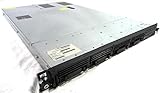
Top 3 picks at a glance
How to Match a CPU to a Server Workload
Before comparing models, work through these criteria in order — each one eliminates a tier of hardware:
- Concurrent threads, not clock speed. Count the VMs or services you’ll run simultaneously. Each VM typically wants 2–4 vCPU minimum. 8 VMs × 4 vCPU = 32 threads needed, which points to 16+ physical cores.
- Memory capacity and channels. Desktop platforms (AM5, LGA1700) cap out around 192GB of dual-channel DDR5. Server platforms offer 8–12 channels and 1TB+ capacity. If your workload needs more than ~128GB RAM, the CPU choice is made for you.
- ECC support. For anything storing data you care about, ECC RAM catches bit flips before they corrupt data. Ryzen Pro and most EPYC/Xeon chips support it; standard consumer Intel chips do not.
- PCIe lanes. Multiple NVMe drives, 10/25GbE NICs, and HBAs add up fast. Desktop platforms offer ~24 usable lanes; EPYC offers 128.
- Power draw at idle, not load. Servers idle most of the time. A desktop chip idles around 20–30W for the whole system; a dual-socket board can idle above 100W before drives.
Best CPU for Home Lab Servers
For a home lab running a hypervisor with a handful of VMs, network services, and media storage, the sweet spot is an 8–16 core desktop CPU on a platform that supports ECC.
- AMD Ryzen 9 7950X or 9950X (16 cores): The strongest home lab value. Unofficial-but-working ECC support on most AM5 motherboards, ~170W TDP that idles much lower, and enough cores to overcommit VMs comfortably.
- AMD Ryzen 5 7600 / Intel Core i5 (6–14 cores): For a NAS-plus-a-few-VMs box, a midrange chip under 105W is plenty. Ryzen wins on ECC support; Intel wins on integrated GPU Quick Sync for media transcoding.
- Used EPYC 7002/7003 series: Older-gen EPYC chips on the used market remain a home lab favorite — 32–64 cores, 8 memory channels, and 128 PCIe lanes, often at used-market prices well below the original launch cost. The trade-off is a full-size board, higher idle power, and no iGPU.
Best CPU for Virtualization Hosts
Virtualization eats cores and RAM. The rule of thumb: provision physical cores equal to at least half your total vCPU allocation, and enough memory channels to feed them.
- AMD EPYC 9004/9005 series (“Genoa”/”Turin”): Up to 128–192 cores, 12-channel DDR5, and 128 PCIe 5.0 lanes per socket. For dense VM hosts, nothing else competes on consolidated platform cost — one socket does what two Xeons did a generation ago.
- AMD EPYC 8004 series (“Siena”): The efficient edge option — up to 64 cores at 70–225W on a smaller, cheaper platform. Ideal for branch-office virtualization or low-noise rack servers.
- Intel Xeon 6 series: Competitive for environments standardized on Intel tooling and management stacks, with strong per-core performance and mature platform support.
Best CPU for Business and Database Servers
Business workloads fall into two camps. Databases licensed per-core (Oracle, some SQL Server deployments) want fewer, faster cores — the licensing cost dwarfs hardware. Per-socket licensed or open-source software wants maximum core density.
- High-frequency EPYC variants or Xeon 6 P-cores for per-core-licensed databases.
- High-core-count EPYC for ERP systems, containerized microservices, and analytics where open-source stacks scale across cores.
- Xeon W / EPYC Threadripper-class workstation chips for small businesses running a single physical Windows Server or file/application box — server features (ECC, IPMI-capable boards) at workstation platform prices, typically $1,500–$3,500 for CPU plus board.
Comparison Table: Server CPU Classes
| CPU Class | Cores | Max RAM / Channels | PCIe Lanes | TDP Range | Typical CPU+Board Cost |
|---|---|---|---|---|---|
| Desktop (Ryzen 9 / Core i9) | 16–24 | 192GB / 2 | ~24 | 65–170W | $700–$1,200 |
| Workstation (Xeon W / Threadripper) | 24–96 | 1–2TB / 4–8 | 88–128 | 250–350W | $2,500–$6,000 |
| EPYC 8004 (Siena) | 16–64 | 1.1TB / 6 | 96 | 70–225W | $2,000–$5,000 |
| EPYC 9004/9005 | 16–192 | 6TB+ / 12 | 128 | 200–500W | $4,000–$15,000+ |
| Xeon 6 | 16–128 | 4TB+ / 8 | 88–96 | 150–500W | $3,500–$12,000+ |
Worked Example: Power Budget for a Home Virtualization Host
Say you’re choosing between a 16-core Ryzen 9 build and a used 32-core EPYC build for a host running 10 VMs. The CPU price difference looks small; the electricity is not.
- Ryzen 9 system: ~35W idle platform + ~25W for 4 drives = ~60W average. At $0.16/kWh: 60W × 24h × 365 ÷ 1000 × $0.16 ≈ $84/year.
- Used EPYC system: ~110W idle platform + drives = ~135W average. Same math: ≈ $189/year.
- Difference: ~$105/year, or ~$525 over a 5-year lifespan — often more than the CPU itself cost on the used market.
The conclusion flips only if the Ryzen would run at high utilization: pushing 16 desktop cores at 90% constantly while a 32-core EPYC idles at 45% wastes money in a different way. Match capacity to the real workload, not the theoretical maximum.
Decision Matrix: Situation to Recommendation
| Your Situation | Recommended Class | Why |
|---|---|---|
| NAS + 2–4 light VMs, quiet, low power | Ryzen 5/7 or Core i5 | ECC (AMD) or Quick Sync (Intel), ~$800 total build |
| Home lab with 10+ VMs | Ryzen 9 16-core or used EPYC | Cores + ECC; EPYC if you need >128GB RAM or many lanes |
| Production virtualization host, SMB | EPYC 8004 or Xeon 6 | Vendor warranty, IPMI, ECC UDIMM/RDIMM, validated platform |
| Dense datacenter consolidation | EPYC 9004/9005 | Highest core density and lanes per socket |
| Per-core licensed database | Fewer, faster cores (EPYC high-freq or Xeon P-core) | Licensing cost exceeds hardware cost |
FAQ
Is a desktop CPU good enough for a server?
Yes for home labs and light business use — the CPU itself is fine; what you lose is ECC guarantee (on Intel consumer chips), remote management (IPMI), registered memory support, and PCIe lanes. If none of those block your workload, a desktop chip saves hundreds.
How many cores does a virtualization host need?
Total vCPU ÷ 2 is a safe starting point. A host running 12 VMs averaging 4 vCPU each (48 vCPU) wants ~24 physical cores, which rules out every desktop platform.
Should I buy used server CPUs in 2026?
For home labs, used EPYC and Xeon chips remain excellent value since CPUs rarely wear out. For production business use, the lack of warranty and higher power draw usually makes current-gen midrange parts the smarter buy.