
For most pilots, the best DJI Air drone is the Air 3S; choose the Air 3 for a lighter, often better-value dual-camera platform, or the Air 2S if a 1-inch camera matters more than flight time and modern obstacle sensing.
As an Amazon Associate we earn from qualifying purchases at no extra cost to you.

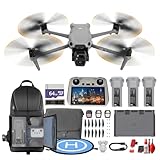


Top 3 picks at a glance
Best DJI Air drones at a glance
| Model | Main camera | Second camera | Maximum flight time | Obstacle sensing | Best fit |
|---|---|---|---|---|---|
| DJI Air 2S | 1-inch, 20 MP, 22 mm equivalent | None | 31 minutes | Four-directional sensing with downward sensing; no full omnidirectional coverage | Single-camera photographers and existing DJI owners |
| DJI Air 3 | 1/1.3-inch, 48 MP, 24 mm equivalent | 1/1.3-inch, 48 MP, 70 mm equivalent | 46 minutes | Omnidirectional sensing plus Advanced Return to Home | Travel, landscapes, social video, and value-conscious buyers |
| DJI Air 3S | 1-inch, 50 MP, 24 mm equivalent | 1/1.3-inch, 48 MP, 70 mm equivalent | 45 minutes | Omnidirectional sensing, forward-facing LiDAR, and improved low-light obstacle detection | Serious creators, night scenes, and the broadest safety margin |
Flight-time figures are manufacturer maximums measured under controlled conditions. Wind, cold temperatures, repeated acceleration, payloads, and the battery reserve used for a safe landing all reduce usable time.
DJI Air 3S: the best all-round choice
The Air 3S is the strongest recommendation for a new buyer who wants one drone for travel, real-estate work, landscape photography, and cinematic video. Its 1-inch primary sensor gives it an advantage over the Air 3 in dim interiors, sunsets, forests, and night city scenes. The 70 mm-equivalent telephoto camera remains useful for compressing distant subjects, framing architecture, and creating cleaner-looking portraits from a greater working distance.
Its obstacle-sensing system is more than a safety checkbox. Forward-facing LiDAR helps the drone detect obstacles in low-light conditions where ordinary vision sensors have less information to work with. Omnidirectional sensing also makes sideways and backward movement less stressful when tracking a subject or orbiting a building.
What the Air 3S does better
- Produces cleaner low-light footage with its larger primary sensor.
- Offers two useful focal lengths instead of forcing every shot into a wide perspective.
- Provides the most capable obstacle awareness in the Air range discussed here.
- Records up to 4K/120 fps slow-motion video, subject to the selected recording mode and storage requirements.
- Retains a travel-friendly folding design despite its larger camera system.
The main compromise is price: the Air 3S usually costs more than the Air 3, commonly around $1,000–$1,400 depending on the controller and battery bundle. It is also not pocket-sized in the way a Mini-series drone is. If you mainly post daylight clips and do not need the 1-inch sensor, some of that extra cost will not produce a visible improvement.
DJI Air 3: the best value for dual-camera flying
The Air 3 is the better choice when flexibility matters more than maximum low-light quality. Its wide camera and 70 mm-equivalent medium-tele camera use the same 1/1.3-inch sensor class, which makes switching between perspectives more consistent during a shoot. The telephoto camera is particularly valuable for revealing patterns in landscapes, isolating a subject against a background, and filming people without flying as close to them.
Its 46-minute rated flight time is the longest of these three models. In practical planning, however, the difference between 46 and 45 minutes is negligible; the larger difference is between either Air 3 model and the Air 2S.
Why choose the Air 3 instead of the Air 3S?
- You mostly fly during daylight or in well-lit locations.
- You want dual cameras but prefer to spend less, usually around $800–$1,200 depending on the package.
- You value long endurance for landscapes, mapping-style visual work, or repeated takes.
- You want omnidirectional obstacle sensing without paying for the Air 3S’s newer low-light system.
- You are upgrading from an older single-camera DJI drone and want a noticeable compositional upgrade.
The Air 3’s cameras are not simply a wide camera plus a digital zoom. The 70 mm lens is an optical perspective change, so it can produce more natural subject separation and less exaggerated foreground perspective. The trade-off is that its smaller sensors are less forgiving at dusk and indoors than the Air 3S’s 1-inch main camera.
DJI Air 2S: still worthwhile for the right photographer
The Air 2S remains compelling when image quality from the main camera is the priority and the drone is available at a substantially lower market price, often around $500–$800 depending on condition and included accessories. Its 1-inch, 20 MP camera can capture excellent daylight and sunset images, and its 22 mm-equivalent lens is familiar and versatile.
Its limitations are equally clear. There is no telephoto camera, rated endurance is only 31 minutes, and its obstacle sensing is less comprehensive than the Air 3 and Air 3S. It also lacks some newer subject-tracking, transmission, and controller conveniences. A used Air 2S can be a sensible purchase, but inspect battery health, gimbal operation, propeller-arm damage, and whether the controller and charging equipment are included.
Who should buy the Air 2S?
- A still photographer who wants a 1-inch sensor at the lowest reasonable cost.
- An existing owner who already has compatible batteries and a controller.
- A pilot who flies deliberately in open daylight rather than close to trees or structures.
- Someone who does not need a second focal length or the newest tracking features.
Do not choose the Air 2S solely because its camera has a larger sensor. If you frequently reframe subjects, fly around buildings, or spend long sessions in the air, the Air 3’s endurance and dual-camera system may save more time than the Air 2S’s sensor advantage.
Camera choice: sensor size versus focal length
The Air 3S has the best primary camera, but the Air 3’s two-camera system can create more usable footage in a real shoot. A wide lens is good for showing scale, while a 70 mm-equivalent lens makes a distant subject occupy more of the frame without flying closer. This is useful for wildlife viewed from a legal and safe distance, mountain ridges, towers, and people who look distorted when filmed with a very wide lens.
For video, start with 4K at 30 or 60 fps for general work. Use 4K/120 fps when you specifically want slow motion and have enough light. Higher frame rates require more shutter speed, which reduces the light reaching each frame. In bright conditions, a shutter speed around twice the frame rate is a useful starting point: approximately 1/60 for 30 fps, 1/120 for 60 fps, and 1/240 for 120 fps. ND filters can help maintain those settings in sunlight, but they should not be used simply to make footage darker in already dim conditions.
Controller options and what they change
The Air 3 and Air 3S commonly ship with either a phone-connected RC-N2 controller or the DJI RC 2 controller, depending on the package. The RC-N2 is usually cheaper and uses your phone as the display. That makes it a good choice if you already have a bright, modern phone and want the smallest initial purchase.
The RC 2 has an integrated screen, so there is no phone cable, incoming call, notification, or phone battery issue during a flight. It is the better operational choice for frequent pilots, travel days, and cold-weather flying, although it costs more and adds another device to charge.
The Air 2S is associated with the older RC-N1 controller family and older DJI transmission ecosystem. Do not assume that a controller, battery, or charging hub from one Air generation will work with another. Check the exact compatibility list before buying a drone-only package or attempting to reuse accessories.
Portability and real-world flight planning
All three drones fold, but “portable” does not mean “pocketable.” The Air 3 and Air 3S are larger and heavier than DJI’s Mini-class models, while the Air 2S is also a substantial aircraft once its controller, spare batteries, charger, and filters are packed. For a day trip, a Fly More-style bundle can be more practical than a cheaper single-battery kit because charging time, not aircraft size, often becomes the limiting factor.
A useful planning calculation is to reserve roughly 25% of the rated battery time rather than treating the specification as filming time. For an Air 3S, 45 minutes × 0.75 gives 33.75 minutes of planned maximum use. If wind and repeated climbs reduce that by another 20%, the practical estimate becomes about 27 minutes. That is still excellent, but it explains why a two-battery kit is much more useful than the headline number suggests.
Which DJI Air drone should you buy?
| Your priority | Recommended model | Reason |
|---|---|---|
| Best overall camera and safety features | Air 3S | 1-inch main camera, telephoto camera, LiDAR-assisted low-light sensing |
| Two cameras at a lower price | Air 3 | Strong dual-camera system and 46-minute rated endurance |
| Lowest-cost route to a 1-inch sensor | Air 2S | Excellent main camera value if older safety and endurance features are acceptable |
| Night or dusk urban footage | Air 3S | Larger primary sensor and improved forward obstacle detection |
| Long daylight landscape sessions | Air 3 | Longest rated flight time and useful wide/telephoto pairing |
| Existing Air 2S owner with batteries and controller | Keep the Air 2S or upgrade to Air 3S | Upgrade only if dual cameras, endurance, or newer sensing solves a real limitation |
Frequently asked questions
How much flight time should I plan for in practice?
Plan for less than the manufacturer’s maximum flight-time figure. Wind, cold temperatures, repeated acceleration, payloads, and keeping a battery reserve for a safe landing all reduce usable time. The article does not give a single expected real-world duration, so allow a margin rather than planning to use the full rated flight time.
Which camera is better for filming people without flying close?
The Air 3 and Air 3S can use a 70 mm-equivalent telephoto camera to frame people from a greater working distance. That perspective can also avoid the exaggerated foreground look of a very wide lens. The Air 2S has no second focal length, so it does not offer the same camera option.
Do I need ND filters for video?
ND filters can help maintain a suitable shutter speed in bright conditions, but they should not be used simply to darken footage when light is already limited. The article suggests a shutter speed around twice the frame rate as a starting point—for example, 1/60 for 30 fps—and notes that higher frame rates need more shutter speed.
Can I reuse my batteries or controller when upgrading between Air models?
Do not assume accessories from one Air generation work with another. The article notes that the Air 2S belongs to an older controller and transmission ecosystem, and advises checking the exact compatibility list before buying a drone-only package or reusing a controller, battery, or charging hub.
Is a single-battery kit enough for a day trip?
A Fly More-style bundle may be more practical for a day trip than a single-battery kit. The article points out that charging time, rather than aircraft size, often becomes the limiting factor. It does not specify how many flights a bundle provides, so consider your schedule and charging access when choosing.
Final verdict
The Air 3S is the best DJI Air drone for the widest range of pilots in 2026 because it combines the strongest primary camera, a practical telephoto camera, nearly 45 minutes of rated endurance, and the most advanced obstacle awareness here. The Air 3 is the smarter value pick for daylight creators who want two perspectives and long flights. The Air 2S remains a good budget and still-photography option, but its shorter battery life and older sensing make it harder to recommend at a price close to either newer Air model.


