
The best FPV drones depend on whether you want race-level control, freestyle durability, cinematic stabilization, or a beginner-friendly package: for most experienced pilots, a repairable 5-inch quad such as the iFlight Nazgul Evoque F5 V2 or GEPRC Mark5 is the strongest all-round choice, while the DJI Avata 2 is easier to fly but less suitable for aggressive racing.
As an Amazon Associate we earn from qualifying purchases at no extra cost to you.



Top 3 picks at a glance
Quick picks for different pilots
| Best for | Recommended type or model | Typical price range | Main reason to choose it | Main limitation |
|---|---|---|---|---|
| Racing and fast open-space flying | 5-inch custom or bind-and-fly quad | $300–$700 before goggles and radio | High thrust, low latency, and replaceable parts | Requires setup, maintenance, and a suitable flying area |
| Freestyle with flips and dives | iFlight Nazgul Evoque F5 V2 or GEPRC Mark5 | $350–$700 before goggles and radio | Strong motors, protective frame design, and broad parts availability | Larger and more dangerous than small beginner quads |
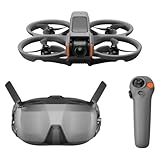
| Easy entry into FPV | DJI Avata 2 | $700–$1,100 as a system | Stable flight modes, integrated camera system, and approachable controls | Heavy ducts, proprietary components, and less agile racing behavior |
| Indoor practice and low-risk learning | BetaFPV Cetus X or a comparable whoop kit | $180–$400 as a kit | Small propellers, low weight, and included goggles and transmitter | Wind sensitivity and limited outdoor performance |
| Small freestyle in parks | 3.5-inch or 4-inch freestyle quad | $250–$600 before goggles and radio | Quieter and more efficient than a 5-inch quad | Less momentum and payload capacity for large action cameras |
What makes a good FPV drone?
Speed is more than the advertised top speed
Top-speed claims are less useful than thrust-to-weight ratio, propeller choice, battery voltage, and how quickly the drone changes direction. A typical 5-inch racing or freestyle quad uses four motors with roughly 1,700–2,200 KV ratings on a 6S battery. It can accelerate aggressively and maintain speed through turns, but that performance demands precise throttle control.
Racing builds usually use a lightweight frame, compact electronics, low-profile batteries, and efficient racing propellers. Freestyle builds accept extra weight for stronger arms, protective camera mounts, and a larger capacitor. The result is usually a little slower but more resistant to hard landings.
Controller response and video latency
The control link and the video link are separate decisions. A radio system such as ExpressLRS can provide very fast command response and strong range when configured correctly, but the pilot still needs a low-latency video feed to react in time. Digital video generally looks clearer than analog, while analog can still offer a very direct, inexpensive racing setup.
For racing, prioritize consistent latency and a stable signal over maximum image resolution. For freestyle, higher-quality digital video makes it easier to judge branches, gaps, and landing surfaces. DJI’s digital ecosystem offers a polished experience, while HDZero is particularly associated with low-latency digital FPV racing. Walksnail Avatar systems offer another digital option with a broad range of camera and goggles configurations.
Durability and repairability
The most durable drone is not necessarily the one least likely to break. A good FPV quad is one that turns an unavoidable crash into a fast, affordable repair. Look for replaceable arms, standard motor mounting patterns, accessible screws, separate camera and video-transmitter wiring, and a flight controller stack that is not buried under unnecessary structural parts.
Common replacement items include propellers, arms, motors, camera plates, battery straps, and antennas. A molded consumer drone may survive many minor impacts, but a damaged proprietary arm or camera assembly can be more expensive and slower to replace than a complete arm on a conventional 5-inch quad.
Head-to-head: 5-inch quad versus DJI Avata 2
5-inch racing or freestyle quad
A 5-inch quad gives you the fastest control response, the most freedom to tune the flight characteristics, and the best access to inexpensive replacement parts. It can fly in full manual mode, where the pilot controls attitude and throttle directly. This is the preferred format for racing, power loops, split-S maneuvers, dives, and technical freestyle.
The trade-off is ownership complexity. You need to bind a radio, configure arming and failsafe behavior, charge LiPo batteries safely, inspect the frame, and learn basic soldering. A crash can bend an arm or damage a motor, and flying without a spotter or suitable permission can create safety and legal problems.
DJI Avata 2
The Avata 2 is a ducted digital FPV drone designed to make immersive flying more accessible. Its integrated camera, goggles, stabilization modes, and assisted controls reduce the setup burden. A beginner can start with a stabilized mode and gradually move toward manual control.
Its propeller guards help with certain low-speed contacts, but they do not make the aircraft crash-proof. The ducts add weight and drag, so the Avata 2 does not turn or accelerate like a lightweight 5-inch racing quad. It is better suited to cinematic FPV, controlled proximity flying, and learning than to competitive racing or repeated high-energy freestyle crashes.
Beginner-friendly setup: choose the whole system, not only the drone
A ready-to-fly kit is usually the least frustrating starting point. A kit such as the BetaFPV Cetus X includes a small quad, radio, and goggles, allowing a new pilot to practice indoors or in a garden-sized area. Its low mass reduces damage risk, although small whoops can struggle in wind.
For a more capable long-term system, buy a compatible radio with ExpressLRS and a simulator before moving to a 5-inch drone. Simulator practice teaches throttle control without consuming propellers or batteries. Start with stabilized mode if available, then learn angle control, altitude management, and finally full manual mode.
- Small whoop: best for indoor practice, low noise, and inexpensive crashes.
- 3.5-inch quad: a useful compromise for parks and moderate wind.
- 5-inch quad: best for racing, freestyle, and learning the standard repair ecosystem.
- DJI-style integrated system: best when fast setup and clear digital video matter more than open hardware.
A practical power and flight-time calculation
Battery size alone does not predict flight time. Suppose a 5-inch quad carries a 6S 1,300 mAh battery. Its nominal energy is approximately:
22.2 volts × 1.3 amp-hours = 28.9 watt-hours.
If the quad averages 500 watts during energetic freestyle, the theoretical runtime is 28.9 ÷ 500 hours, or about 3.5 minutes. Since pilots normally avoid fully emptying a LiPo battery, a practical flight may be closer to three minutes. Gentle cruising at an average of 250 watts would theoretically last about seven minutes, with a practical usable time of roughly five to six minutes.
This explains why a larger battery does not always help. Adding a 1,800 mAh pack increases available energy, but also adds weight, which raises motor demand and can make the drone less responsive. Racing pilots often accept shorter flights for lower mass; freestyle pilots may choose a heavier pack when they want more recovery time after a long climb or dive.
Goggles and video systems
Analog goggles remain attractive for budget racing because the hardware is inexpensive and image breakup can be predictable. However, the picture is comparatively low-resolution and interference may appear as static or lines. Digital goggles provide a clearer view and make it easier to identify obstacles, but cameras, air units, and goggles must be compatible with the same ecosystem.
Before buying, check four things:
- Video system: analog, DJI-compatible digital, HDZero, or Walksnail Avatar.
- Latency behavior: racing favors a stable low-latency mode rather than the highest image quality.
- Goggle fit: poor face seals and uncomfortable focus adjustment can end a flight early.
- Spare availability: antennas, camera lenses, and replacement video transmitters should be obtainable separately.
Decision matrix: which setup fits your situation?
| Your priority | Choose | Why | Avoid if |
|---|---|---|---|
| Learn with minimum repair cost | Small whoop kit and simulator | Low weight and simple replacement parts | You need strong performance in wind |
| Race competitively | Lightweight 5-inch or racing-class build with low-latency video | Fast acceleration and precise response | You do not want to tune or repair equipment |
| Perform freestyle tricks | Durable 5-inch BNF or custom quad | High thrust and repairable frame | You mainly fly indoors or near people |
| Capture smooth FPV footage | DJI Avata 2 or a digital 5-inch build carrying a separate camera | Clear video and stabilized recording options | You want the lightest, fastest racing machine |
| Keep noise and size down | 3.5-inch or sub-250-gram class quad | More practical for smaller spaces | You expect 5-inch-level momentum and wind resistance |
What to buy with the drone
Budget for goggles, a radio transmitter, several batteries, a balance charger, spare propellers, a battery strap, an antenna, and basic tools. For a 5-inch quad, also keep spare arms and at least one spare motor. A smoke stopper is useful during first power-up after wiring work because it can limit damage from a short circuit.
Always configure failsafe behavior before the first flight, confirm that the motors spin in the correct direction, inspect propeller orientation, and test the disarm switch at low altitude in an open area. Follow local aviation rules, keep away from people and property, and never rely on an automatic return function as a substitute for a working control link.
Final recommendation
For the broadest combination of speed, controller response, durability, and repairability, choose a well-supported 5-inch FPV quad such as the iFlight Nazgul Evoque F5 V2 or GEPRC Mark5, paired with a radio using ExpressLRS and a video system that matches your priorities. Choose the DJI Avata 2 if simple setup and assisted flight matter more than racing agility. Choose a BetaFPV Cetus X or similar whoop kit if you are starting from zero and want to learn safely before investing in the best FPV drones for serious freestyle or racing.


