
The best tire pressure monitoring system for most people is the Tymate TM12 — a six-sensor kit that covers a tow vehicle and a dual-axle trailer on one screen, with solar charging and cap-style sensors you can move between wheels in minutes. If four wheels are all you need and you want to spend as little as possible, the Tymate TM7 and the Masoll M13 do the core job at a budget tier. If you run a big rig, a stacker or a three-axle toy hauler, the GUTA GT80 and its ten flow-through sensors are the pick that will not have you unscrewing caps at every fuel stop. The biggest fork in this category is cap versus internal sensors: caps screw onto the valve stem, cost less, install without a tire machine and travel between vehicles, while internal sensors mount inside the wheel, cannot be knocked off or stolen, and last far longer — but they need the tire dismounted. Everything below compares those two approaches on accuracy, battery life, display type and install difficulty, then maps them onto cars, RVs and trailers.
Top 3 picks at a glance
Quick Comparison
| Product | Best for | Key specs | Price tier |
|---|---|---|---|
| Tymate TM7 | Budget travel trailers and single-axle campers | 4 cap sensors, solar + USB monitor, colour display, five alarm modes | Budget |
| Tymate TM2 | Mid-range four-wheel coverage on trailers and Class C rigs | 4 cap sensors, solar + USB monitor, larger display, longer working range | Mid-range |
| Avutrel TPMS | Cheapest solar kit for cars and light trailers | 4 cap sensors, solar + USB charging, five alarm modes, real-time monitoring | Budget |
| Tymate TM12 | Best overall — tow vehicle plus dual-axle trailer | 6 cap sensors, solar + USB monitor, colour display, multi-alarm | Premium |
| Masoll M13 | Simple trailer monitoring on a tight budget | 4 cap sensors, RV/trailer monitor, solar or USB powered | Budget |
| Tymate TM8 | Cars, SUVs and light trailers | 4 cap sensors, compact monitor, solar charging | Budget |
| Masoll RV TPMS (4 sensors) | Premium four-sensor builds with better hardware | 4 cap sensors, premium monitor hardware, RV/trailer focus | Premium |
| GUTA GT20 | Long trailers and ten-wheel coverage | 10 cap sensors, trailer-focused monitor, multi-alarm | Premium |
| Tymate TM3 | Mid-range value with four sensors | 4 cap sensors, solar + USB, colour display | Mid-range |
| Tirpresmos TPMS | Cars with no spare dash space or sun exposure | 4 cap sensors, 12 V socket powered, adjustable display angle, voltage readout | Budget |
| GUTA GT80 | Big rigs and anyone tired of removing caps to inflate | 10 flow-through sensors, RV monitor, multi-alarm | Premium |
| Hyphoon Bluetooth TPMS | Phone-first drivers in cars and SUVs | 4 external sensors, Bluetooth app display, car/SUV fitment | Mid-range |
How We Chose
This roundup is assembled from published manufacturer specifications, product listings, owner reports in RV and towing communities, and the physics of how these systems actually behave on the road. We have not handled or driven these units, and nothing here depends on bench work — it depends on what the spec sheets say and on how the category fails in practice.
Four filters did most of the work. First, sensor architecture: cap versus internal, because that single choice determines accuracy behaviour, battery life, install difficulty and whether the kit can move to your next vehicle. Second, coverage count: four sensors is a car or a single-axle trailer, six covers a tow vehicle rear axle plus a dual-axle trailer, and ten is the floor for triple-axle and multi-axle rigs. Third, display type — a self-contained solar dash monitor, a 12 V socket unit, or a Bluetooth app — each with a different failure mode when the sun is low, the socket is occupied or the phone is on the charger. Fourth, upgrade path: whether the same monitor can be expanded with additional sensors later, which is the difference between a one-season purchase and a five-year one. Price tiers reflect where each kit sits against the rest of the category rather than any single listing.
1. Tymate TM7 – Best for Budget Travel Trailers
As an Amazon Associate we earn from qualifying purchases at no extra cost to you.

The TM7 is the entry point into solar TPMS: four cap sensors, a dash monitor with its own solar panel, and USB as a backup for the weeks when the sun does not cooperate. It suits owners of single-axle and lighter dual-axle travel trailers, pop-ups, boat trailers and utility trailers — anyone who wants to watch pressure and temperature while driving instead of crouching at every rest stop. If you tow four wheels or fewer and you are not trying to monitor the tow vehicle at the same time, this is the least expensive sensible way into the category.
- Four cap-style external sensors that screw onto standard valve stems
- Solar-charging monitor with USB input as a fallback
- Colour display with adjustable alert thresholds
- Five alarm modes: high pressure, low pressure, rapid leak, high temperature and low sensor battery
- Windshield or dash mounting hardware included
- Pressure range sized for the placards on most travel trailers and Class C motorhomes
The reason the TM7 works is that it removes the two barriers that keep people from buying a TPMS at all. There is no cable run, because the monitor’s solar cell keeps it topped up in daylight and the USB port is genuinely a backup rather than the primary supply. There is also no shop visit, because cap sensors thread on by hand with the supplied wrench and can be moved to a different trailer in under ten minutes. Accuracy in this class typically lands within about ±1.5 psi and ±3 °C, which sounds unimpressive until you consider the failure it is designed to catch: a slow leak that bleeds 15–20 psi over a few hundred miles and turns into a blowout at highway speed. The rapid-leak alarm is the feature that earns the money, because it fires within seconds of a pressure drop and gives you time to reach a shoulder before the tire damages a wheel arch or a fender skirt.
The honest limitations are coverage and stem load. Four sensors means the tow vehicle’s rear axle and the spare are unmonitored, so a leaking truck tire will not show up here. Cap sensors also add mass to the valve stem, which is why metal stems or stem supports are worth the small extra cost — rubber stems can flex and crack under a cap at highway speed. Battery replacement in this class is usually a coin cell in each cap, so budget for that every year or two.
Pros
- Lowest-cost way to get real-time trailer pressure and temperature
- Solar monitor means no wiring and no dash clutter beyond the mount
- Sensors transfer between trailers without tools or a tire machine
- Five alarm types, including the rapid-leak warning that matters most
Cons
- Only four sensors, so no tow-vehicle or spare coverage
- Cap sensors can be unscrewed by anyone and add weight to the stem
- No data logging or trip history to review after the fact
- Display brightness in direct sun is typical of the budget tier rather than class-leading
Against the Masoll M13 — the other budget four-sensor kit here — the choice is mostly about interface preference. Both cover four wheels at the same tier, and both rely on cap sensors with solar or USB power. The TM7 leans on the maturity of Tymate’s solar monitor line and its alarm behaviour; the M13 is positioned squarely at RV and trailer owners and keeps things simple. If you already know you need six wheels, neither is the right starting point — go straight to the TM12.
2. Tymate TM2 – Best for Mid-Range Four-Wheel Coverage

The TM2 is the four-sensor kit for people who want a step up from the budget tier without paying for extra sensors they will never use. It fits Class C motorhomes, dual-axle travel trailers and tow dollies where the monitor sits farther from the last axle than a budget unit comfortably reaches. If your rig has four tires that matter and you would rather spend the difference on a better display and more reliable link than on two additional sensors, this is the middle of the range.
- Four cap-style external sensors
- Solar charging with USB input on the monitor
- Larger display than the budget Tymate kits, with adjustable viewing angle
- Multiple alarm modes covering pressure, temperature and sensor battery
- Improved working range compared with the entry-level units
- Windshield or dash mount
What you are buying with the TM2 is link reliability and legibility rather than a longer feature list. The mid-range step in this category is mostly about the radio link between the sensors and the monitor: the farther the monitor is from the last axle, the more often a budget system drops a reading, and a dropped reading is exactly the moment you cannot tell whether a tire is genuinely fine or the signal is simply missing. The TM2’s larger screen also matters more than it sounds, because at 65 mph you get a fraction of a second to read a value and decide whether to pull over. A display you can interpret at a glance is a safety feature, not a cosmetic one.
Installation is identical to the budget kits: thread the caps on, set the baseline pressures, mount the monitor, and confirm each wheel reports before you leave the driveway. Because the sensors are external, you keep the ability to move the whole system to a different trailer, which is a real advantage if you own more than one. The trade-off is the same as every cap system — physical exposure. A cap can be unscrewed or clipped by debris, and it adds a small amount of mass to the stem.
Pros
- Better link stability than the entry-level tier, which matters on longer trailers
- Larger, easier-to-read display for at-a-glance checks at speed
- Same simple cap installation and same portability between trailers
- Solar plus USB means it keeps working in low-light storage and winter
Cons
- Still only four sensors, so no tow-vehicle coverage
- Costs more than the budget kits without adding wheels
- Cap sensors remain removable and stem-mounted
- No Bluetooth app, so the dash monitor is the only place to see data
The nearest alternative is the Tymate TM3, which sits in the same mid-range band and offers a similar four-sensor, solar-and-USB package. The practical difference is emphasis: the TM2 leans toward range and display size for longer rigs, while the TM3 is the value-oriented pick in the middle tier. If your trailer is short and your budget is tight, the TM3 makes more sense; if you tow something long enough that the monitor-to-sensor distance is a real concern, the TM2 is the safer of the two. If you need to watch six wheels, skip both and look at the TM12.
3. Avutrel TPMS – Best for the Cheapest Solar Setup

The Avutrel kit is for the buyer whose first question is price and whose second question is whether the thing will still work after a season in the sun. It offers the core package — four cap sensors, a solar-and-USB monitor, five alarm modes and real-time monitoring — at the budget tier, which makes it a reasonable first TPMS for a small trailer, a camper or a car. It suits someone who wants the safety benefit of live pressure readings without committing to a premium kit before they know whether they will actually use it.
- Four external cap sensors
- Solar charging plus USB charging for the monitor
- Five alarm modes
- Real-time pressure and temperature monitoring
- Adjustable alert thresholds
- Dash or windshield mounting
The value proposition is straightforward: the feature list reads like the established budget kits, and the solar-plus-USB power arrangement is the correct design for a dash monitor. A unit that charges only from a cable will eventually be left unplugged, and an unplugged monitor is a monitor that is not watching anything. Five alarm modes cover the realistic failure set — over-pressure from heat soak, under-pressure from a slow leak, rapid loss from a puncture or a blown stem, over-temperature from a dragging brake or a failing bearing, and low sensor battery. Real-time monitoring at a refresh interval of a few seconds is enough to catch a rapid deflation while there is still time to react.
Where a budget kit like this asks for patience is in the details. Radio link quality varies more between individual budget units than between premium ones, so placement matters: mount the monitor as centrally and as high as you reasonably can, and keep the antenna end away from metal dashboard structure. Sensor battery life depends on how often the caps transmit and how cold the winter gets, so a coin-cell swap is a normal annual or biennial chore. And because the brand is smaller, documentation and support are thinner than with the better-established names — expect to work out the alarm thresholds yourself rather than following a detailed manual.
Pros
- One of the lowest entry prices for a solar four-sensor system
- Five alarm modes, including rapid leak and high temperature
- Solar plus USB charging removes the daily cable routine
- Cap sensors install by hand and move between vehicles
Cons
- Budget-tier link stability, so sensor placement matters more
- Thinner documentation and support than the established brands
- Four sensors only — no tow-vehicle coverage
- No app, no logging, no expansion path to a larger sensor count
Compared with the Tymate TM7, the Avutrel kit is the same idea at the same tier: four caps, solar power, five alarms. The TM7’s advantage is the track record of the monitor platform and the breadth of the Tymate line if you later want six or more sensors; the Avutrel’s advantage is simply that it competes hard on price. If you are buying once and want a family of products to graduate into, start with Tymate. If you want the cheapest credible solar kit for a light trailer or a car, this one covers the essentials.
4. Tymate TM12 – Best for a Tow Vehicle Plus Trailer

The TM12 is the best overall pick here because six sensors solve the most common towing problem: a dual-axle trailer has four wheels, and the two rear tires of the tow vehicle are the ones carrying the tongue weight and the ones most likely to be overloaded. With six caps you monitor both, on one screen, with one alarm system. It suits fifth-wheel and travel-trailer owners, anyone towing with a half-ton or three-quarter-ton truck, and drivers who would rather see a warning than feel a wobble.
- Six cap-style external sensors
- Solar-charging monitor with USB input
- Colour display with adjustable thresholds
- Multiple alarm modes across pressure, temperature and sensor battery
- Expanded coverage for a tow vehicle rear axle plus a dual-axle trailer
- Dash or windshield mounting
Six sensors is not just “four plus two.” It changes which failures you can catch. A trailer tire that loses pressure usually announces itself as heat first, and a rear truck tire that loses pressure announces itself as a handling change you may not notice until it is serious — with a monitor, both show up as a number on a screen before either becomes an event. On a long climb in summer heat, the temperature column is often the more useful of the two readings, because pressure rises with temperature at roughly 2% per 10 °F, which means a hot tire can look “fine” on pressure while it is actually running dangerously warm.
The TM12 sits at the premium tier, and the extra money buys sensor count and a more capable monitor rather than exotic hardware. Installation is still cap-based and tool-light: thread each cap on, set the baseline, confirm all six report, then verify at the first stop that nothing has shifted. Because the caps are external, the system moves with you if you change trailers, and you can run it as a four-sensor kit on a car and add the remaining caps when you hook up the trailer. That flexibility is the main argument against internal sensors for anyone who tows more than one thing.
Pros
- Six sensors cover the realistic towing configuration in one system
- Solar monitor keeps the display charged without a cable run
- Temperature and pressure both visible, which is what actually predicts failure
- Portable between trailers and usable as a four-sensor kit on a car
Cons
- Premium-tier price for a cap-sensor system
- Six caps means six batteries to replace on a maintenance schedule
- No flow-through design, so you remove a cap to add air
- Ten-wheel rigs will still run out of sensors
Against the GUTA GT20, the TM12 wins on sensor count for a standard truck-and-trailer combination and loses on total coverage — the GT20 carries ten sensors and is built for long trailers and multi-axle setups. Against the TM2, the TM12 is the upgrade you make when you realise you want the tow vehicle included. If your rig is a single-axle trailer behind a car, the TM2 or TM3 is plenty; if you are towing a dual-axle trailer with a truck, six sensors is the number that matches your wheels.
5. Masoll M13 – Best for Simple Trailer Monitoring

The M13 is a four-sensor RV and trailer system at the budget tier, aimed at owners who want a straightforward readout and no configuration rabbit hole. It suits travel-trailer and camper owners who tow the same rig every season, park it for months at a time, and want to know before they pull out whether a tire has bled down over the winter. It is also a sensible first system for someone who has never used a TPMS and wants to learn what normal looks like before spending more.
- Four cap-style external sensors
- Monitor designed around RV and trailer use
- Solar or USB power for the display unit
- Pressure and temperature readout per wheel
- Adjustable alert thresholds
- Dash mounting for the tow vehicle
The M13’s appeal is that it does not try to be a dashboard computer. You mount it, you set your trailer’s placard pressure as the baseline, and you set the low-pressure alarm a sensible margin below that. From then on the display is a four-number check: if all four are within a few psi of each other and the temperatures are broadly matched across the axle, the trailer is fine. Mismatched temperatures across an axle are the quiet warning sign most owners miss — a dragging brake or a failing bearing shows up as one wheel running noticeably hotter than its partner long before the tire itself fails.
Because the sensors are external caps, there is no tire work: no dismounting, no rebalancing, no shop appointment. The trade-offs are the standard cap-sensor ones — removable by hand, exposed to debris, and adding mass to the stem, so metal valve stems are worth having. Battery life is a coin-cell matter, and cold weather shortens it, which is why a pre-season battery check belongs on the same list as checking the trailer’s bearings and brake shoes.
Pros
- Budget-tier price for full four-wheel trailer coverage
- Simple interface with no app dependency
- Solar or USB power means it is always ready to switch on
- Cap installation needs no tire machine or shop visit
Cons
- Four sensors only, so the tow vehicle is not covered
- Fewer display refinements than the mid-range and premium kits
- No expansion path to six or ten sensors
- Cap sensors are physically removable and stem-mounted
The nearest alternative is the Tymate TM7, which sits at the same tier with a very similar four-sensor, solar-powered, cap-based recipe. The M13 is the more RV-specific product in presentation; the TM7 has the deeper product family behind it if you might later want six sensors. Both will do the same job on a four-wheel trailer, and neither will cover your truck’s rear axle — that is a job for the TM12 or the GT20.
6. Tymate TM8 – Best for Cars and Small SUVs

The TM8 is the car-oriented four-sensor kit in this list: a compact solar monitor and four cap sensors, sized for a daily driver, a small SUV or a light trailer rather than a heavy tow rig. It suits drivers whose vehicles either lack a factory TPMS or whose factory system only tells them that “a tire is low” without saying which one or by how much. It also suits anyone who wants a live pressure readout on a car they regularly load up for road trips.
- Four cap-style external sensors
- Compact monitor with solar charging
- Per-wheel pressure and temperature display
- Alarm modes for pressure deviation, rapid loss and sensor battery
- Adjustable thresholds to match the vehicle placard
- Dash or windshield mount
For a car, the accuracy question is different from a trailer’s. Passenger-car placards sit in the 30–36 psi band, and a TPMS that is accurate to within about ±1.5 psi is reading a range where 4 psi is the difference between a comfortable ride and a visibly soft tire. That is why setting the baseline correctly matters more than the hardware: fill the tires cold to the placard value on the door jamb, not to the number on the sidewall, and set the low-pressure alarm roughly 10% below that. On a 33 psi placard that is about 30 psi — early enough to warn you, late enough not to chirp every cold morning.
The other car-specific benefit is temperature visibility. Pressure moves roughly 1 psi for every 10 °F of ambient change on a typical passenger tire, so a system that alarms on raw pressure alone will cry wolf on the first cold snap. Better kits let you set the low threshold low enough to absorb seasonal swings, or they compensate for temperature internally. Whichever the TM8 does in practice, the habit is the same: check the reading on a cold morning before you decide anything is wrong.
Pros
- Compact enough to live on a car dash without dominating the windscreen
- Solar charging removes the cable routine on a daily driver
- Per-wheel readings beat a factory “low tire” light that names no tire
- Cap sensors install in minutes and can move to a second car
Cons
- Four sensors, so no coverage for a trailer behind the car
- Cap sensors are removable and add mass to the stem
- No phone app, so the dash unit is the only display
- Budget-tier hardware rather than premium
Its nearest rivals are the Tirpresmos unit, which powers from the 12 V socket instead of the sun, and the Hyphoon Bluetooth kit, which puts the display on your phone. The TM8’s advantage is that it needs neither a socket nor a phone — it simply sits there and charges itself. If your car’s 12 V socket is already occupied or your windscreen never sees direct sun, the Tirpresmos makes more sense; if you would rather have logging and a phone interface, the Hyphoon is the better fit.
7. Masoll RV TPMS (4 Sensors) – Best Premium Four-Sensor Kit

This Masoll kit is the premium option for owners who want exactly four sensors and would rather have better hardware than more coverage. It suits a motorhome with four wheels, a single-axle trailer where the tow vehicle is already covered by a factory system, or a car owner who wants the most robust cap system available rather than the cheapest one. It is also the sensible pick if you have had a budget kit drop readings and you want to stop thinking about the link quality.
- Four cap-style external sensors
- Premium-tier monitor hardware and build
- RV and trailer-focused display layout
- Multiple alarm modes across pressure, temperature and sensor battery
- Adjustable alert thresholds
- Dash or windshield mounting
The argument for spending premium money on four sensors rather than mid-range money on six is that sensor count is not the only variable. A system that reliably reports every wheel, every few seconds, with a display you can read in glare, is worth more than a system with more caps that occasionally loses one. Dropped readings are the specific failure that erodes trust in a TPMS: once you have seen a wheel go blank for ten minutes on the interstate, you stop believing the display, and a TPMS you do not believe is a TPMS you will not act on.
Premium hardware in this category typically shows up in three places — a brighter, higher-contrast screen; a more sensitive receiver; and better-sealed sensor bodies that survive pressure washers and road salt. None of those are headline features, and all of them matter over a five-year ownership period. Installation is unchanged: cap sensors thread on by hand, you set the baseline from the vehicle placard, and you confirm each wheel reports before you drive.
Pros
- Better display legibility and link reliability than the budget tier
- Four-sensor simplicity with premium build quality
- Cap installation with no tire machine required
- Portable between vehicles if you change rigs
Cons
- Premium price for only four wheels of coverage
- No tow-vehicle monitoring unless the vehicle already has a factory system
- Still a cap-sensor design, so the same stem load and theft considerations apply
- Overlaps in price with six-sensor kits from other brands
Its closest competition is the Tymate TM12, and the decision comes down to what you value. The TM12 gives you six wheels for premium money; this Masoll gives you four wheels with better hardware. If your rig has exactly four tires that matter and you want the display to be flawless, take the Masoll. If you tow a trailer with a truck and want both covered, take the six-sensor TM12 — no amount of display quality replaces a missing sensor on a loaded rear axle.
8. GUTA GT20 – Best for Long Trailers and Ten-Wheel Coverage

The GT20 is a ten-sensor trailer system, which puts it in a different class from every four- and six-sensor kit here. It suits triple-axle toy haulers, stacker trailers, car haulers, horse trailers and small commercial fleets — anything where the tire count runs past six and a partial picture is worse than no picture. If you have ever had to guess which of ten tires is soft at a truck stop, this is the category of product that ends that guessing.
- Ten cap-style external sensors
- Trailer-focused monitor with per-wheel readout
- Multiple alarm modes including rapid leak and high temperature
- Adjustable thresholds per wheel position
- Solar or USB power for the display unit
- Dash mounting for the tow vehicle
Ten sensors change the reading discipline. With four wheels you can compare each tire against the others and spot the outlier by eye; with ten, you need a baseline you trust and a display that groups wheels sensibly, usually by axle. The useful habit is to set the placard pressure as your reference, set the low alarm about 10% below it, and then watch the spread rather than the absolute numbers — on a healthy trailer the pressures across an axle track within a couple of psi of each other and the temperatures within a few degrees. A single wheel drifting away from its partner is the earliest signal you will get.
Ten caps also means ten batteries and ten chances for a sensor to be knocked loose, so a pre-trip walk-around becomes part of the routine: confirm all ten report on the monitor before you pull out. That check takes less than a minute and catches the most common failure mode of any cap system — a sensor that was fine when you parked and is missing when you leave.
Pros
- Covers trailers that four- and six-sensor kits simply cannot
- Per-wheel readout makes axle-to-axle comparison practical
- Rapid-leak and high-temperature alarms across the whole set
- Solar or USB power keeps the monitor alive between trips
Cons
- Premium-tier price and ten sensor batteries to maintain
- Cap design means removing a sensor to add air
- Overkill for a single-axle or dual-axle trailer
- Setup takes longer because every position needs its own baseline
Its nearest alternative is the GUTA GT80, which also carries ten sensors but uses a flow-through design so you can inflate without unscrewing anything. If you check and adjust pressures frequently — a fleet, a rental, a trailer that sits for months — flow-through saves real time. If you set pressures once a season and mostly want monitoring, the GT20’s standard caps are the simpler, cheaper version of the same coverage. Against the Tymate TM12, the GT20 is the right answer the moment your tire count exceeds six.
9. Tymate TM3 – Best Mid-Range Value

The TM3 is the value pick in the middle tier: four cap sensors, a solar-and-USB monitor with a colour display, and the alarm set you expect from a Tymate kit, at a price between the budget entry points and the six-sensor premium option. It suits travel-trailer owners, small motorhome owners and anyone towing a single-axle trailer who wants a dependable system without paying for wheels they do not have.
- Four cap-style external sensors
- Solar charging with USB backup
- Colour display with adjustable thresholds
- Multiple alarm modes for pressure, temperature and sensor battery
- Windshield or dash mounting
- Pressure range suited to trailer and light commercial placards
The mid-range position buys a bit more polish than the budget kits without the premium jump. In practice that means a display that handles glare better, a receiver that holds a link to a trailer a few car lengths back, and alarm behaviour that is less prone to nuisance triggers on cold mornings. Those are small improvements individually and meaningful together, because the failure mode of a cheap TPMS is not that it misses a real problem — it is that it cries wolf until you start ignoring it, and an ignored alarm is worse than no alarm at all.
The setup routine is the same as any cap system, and it is worth doing properly. Inflate to the cold placard value, mount the monitor where you can see it without taking your eyes off the road for more than a moment, set the low alarm around 10% below placard, and set the high alarm around 20% above so that a hot day on a long climb does not trigger a false alert. Then verify every wheel reports before you move.
Pros
- Mid-tier polish at a price closer to the budget kits
- Solar plus USB means it is always charged when you need it
- Colour display and adjustable thresholds
- Cap sensors move between trailers without tools
Cons
- Four sensors only, so no tow-vehicle coverage
- No app or data logging
- Cap design means stem load and removable sensors
- Less link headroom than the premium kits on very long trailers
Compared with the Tymate TM2, the TM3 is the better buy for shorter rigs: same tier, same four-sensor approach, similar features, generally keener pricing. The TM2’s case rests on longer trailers and a bigger display. If your trailer is under about 25 feet and your monitor sits within a few feet of the windscreen, the TM3 covers you. If you tow longer, or you want the tow vehicle included, step up to the TM2 or the TM12 respectively.
10. Tirpresmos TPMS – Best for Cars With No Spare Dash Space
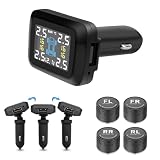
The Tirpresmos kit powers from the 12 V socket and mounts with an adjustable display angle, which makes it the practical choice for cars where a solar monitor will not work: garaged vehicles that never see direct sun, cars with steeply raked windscreens, and dashboards already crowded with a phone mount and a dashcam. It also displays vehicle voltage alongside tire data, which is a small but genuinely useful extra for older cars.
- Four external cap sensors
- 12 V socket power for the display
- Adjustable display angle for awkward dashboards
- Vehicle voltage readout alongside tire pressure
- Alarm modes for pressure deviation and rapid loss
- Wireless sensor-to-display link
The 12 V socket is the whole point. Solar monitors are excellent until the car lives in a garage, parks under cover, or spends winter under a carport — then the solar cell is decorative and the monitor quietly dies. A socket-powered unit is always live when the car is running, which is exactly when you need it, and it costs you one socket that most drivers use for nothing but a phone charger anyway. The adjustable angle matters more than it sounds on modern cars, where a windscreen-mounted display can end up reflecting sky rather than showing numbers.
Installation is the standard cap routine: thread the sensors on, set the baseline from the door-jamb placard, set the low alarm around 10% below that, and confirm all four wheels report. The voltage readout is a bonus rather than a TPMS feature, but it earns its place — a car that is quietly undercharging will show up as a low voltage reading long before the battery fails to start.
Pros
- Works regardless of sun exposure or parking situation
- Adjustable angle suits awkward or crowded dashboards
- Voltage readout adds a second useful data point
- Budget-tier price with four-wheel coverage
Cons
- Occupies the 12 V socket permanently
- Four sensors only, so no trailer coverage
- No solar fallback if the socket loses power
- Cap sensors are removable and stem-mounted
Its nearest alternative is the Tymate TM8, which does the same job on solar power, and the Hyphoon kit, which uses a phone app instead of a dedicated display. Choose the Tirpresmos if your car’s sun exposure is poor or your dash is full; choose the TM8 if you want the display to look after itself; choose the Hyphoon if you would rather not have a device on the dash at all.
11. GUTA GT80 – Best for Big Rigs and Flow-Through Convenience

The GT80 is the ten-sensor RV system with flow-through sensors, which means you can add air through the sensor without unscrewing it. That single design choice makes it the best pick for anyone who adjusts pressures often: motorhome owners who change load, fleet operators, rental yards, and anyone who has stood in the rain at a truck stop unscrewing and refitting ten caps. It suits large motorhomes, multi-axle trailers and commercial setups where tire count is high and pressure checks are routine.
- Ten flow-through external sensors
- Inflate and check without removing the sensor
- RV-focused monitor with per-wheel readout
- Multiple alarm modes including rapid leak and high temperature
- Adjustable thresholds across all positions
- Dash mounting for the tow vehicle or cab
Flow-through sensors trade a little bulk for a lot of convenience. A standard cap has to come off before the chuck goes on, which means ten removals and ten refits every time you set pressures — and each removal is a chance to drop a sensor in gravel or cross-thread it on refitting. A flow-through sensor stays put and accepts the chuck directly. The cost is a slightly larger, heavier sensor body, which makes metal valve stems close to mandatory rather than merely advisable.
Ten sensors on a big rig also means the display has to earn its place. The useful setup is to sort the readout by axle and axle-end, set the placard pressure as the baseline, and set the low alarm about 10% below it and the high alarm about 20% above. On a vehicle with this many wheels, you are not watching absolute numbers — you are watching for a wheel that stops tracking its partner on the same axle, because that is the earliest reliable signal of a slow leak, a dragging brake or a failing bearing.
Pros
- Flow-through design saves real time on every pressure adjustment
- Ten sensors cover multi-axle rigs and small fleets
- Per-wheel readout supports axle-pair comparison
- Full alarm set including rapid leak and over-temperature
Cons
- Premium-tier price and ten sensor batteries to maintain
- Larger sensor bodies need metal valve stems
- More than most four-wheel RV owners will ever need
- Setup takes longer because every position needs its own baseline
Against the GUTA GT20, the GT80 is the same ten-wheel coverage with the flow-through upgrade — the difference is entirely about how often you touch your valves. Against the premium four-sensor Masoll kit, the GT80 is a different category of product: it exists because some rigs have more wheels than a four-sensor system can describe. If you have ten tires, buy a ten-sensor system; if you have four, the extra hardware is money spent on wheels you do not own.
12. Hyphoon Bluetooth TPMS – Best for Phone-First Drivers

The Hyphoon kit uses four external sensors and a Bluetooth link to a phone app instead of a dedicated dash monitor. It suits car and SUV drivers who already run their navigation and music through a phone, who dislike extra hardware on the windscreen, and who want the log-and-review behaviour an app can offer — pressure history over a trip, per-wheel trends, and alerts that arrive on the device you are already looking at.
- Four external cap sensors
- Bluetooth connection to a phone app for display
- Car and SUV fitment
- Per-wheel pressure and temperature readout in the app
- Configurable alert thresholds
- No dedicated dash monitor required
The advantage of the app approach is that the display is already excellent — a modern phone screen beats any small solar monitor for legibility, and it can show history rather than just the current value. The disadvantage is the dependency: the system only warns you if the app is running and the phone is in the car, and a phone that is charging in the console or has been force-closed will not alarm. The practical mitigation is to set the app to connect automatically and to leave it running in the background whenever you drive, which most owners manage within a week.
Installation is the same cap routine as everything else here: thread the four sensors on, set the baseline from the door-jamb placard, set the low alarm about 10% below that, and pair each sensor to its position in the app. On a car with a factory indirect system that only lights a generic warning, the app’s per-wheel numbers are a genuine upgrade, because they tell you which tire and by how much.
Pros
- No extra hardware on the dashboard or windscreen
- Phone display is clearer than any small solar monitor
- App can keep pressure history for trend checking
- Mid-range price with four-wheel coverage
Cons


