The Short Answer
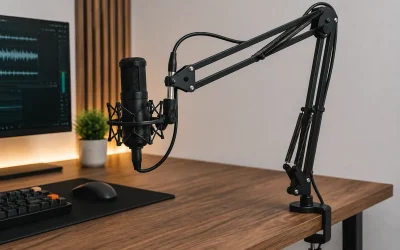
Yes — XLR microphones are compatible with USB audio interfaces. In fact, an XLR mic requires a mic preamp with an XLR input to work, and a USB audio interface provides exactly that. The one condition: your interface must supply +48V phantom power if your mic is a condenser (like the Audio-Technica AT2020 or Rode NT1). Dynamic mics such as the Shure SM58 or SM7B don’t need phantom power, so they’ll work with any interface that has an XLR input and a gain knob that reaches around 60 dB.
There’s nothing to “pair” or configure at the protocol level — XLR is a physical and electrical standard, not a driver-dependent one. If the plug fits and phantom power is set correctly, the signal flows.
Compatibility at a Glance
| Factor | Requirement | Notes |
|---|---|---|
| Connector | XLR female input on the interface | Virtually every USB interface made for recording has at least one. Combo jacks (XLR plus 1/4″ TRS in one hole) are standard. |
| Phantom power (+48V) | Required for condenser mics only | Labeled “48V” or “+48V” on the interface. Dynamic and most USB-repurposed mics don’t need it. |
| Gain range | 50–60+ dB for dynamic mics; 20–40 dB for condensers | Low-output dynamics like the SM7B benefit from interfaces with 60+ dB gain or an inline booster. |
| Drivers | Class-compliant on macOS; ASIO driver on Windows | Most interfaces are plug-and-play. Windows users should install the manufacturer’s ASIO driver for lowest latency. |
| Sample rate/bit depth | 24-bit/48 kHz is a safe default | Anything from 44.1 to 192 kHz works; the mic itself doesn’t care. |
| Power delivery | Bus-powered (USB) or wall adapter | Condenser phantom power draws more current; check the interface’s spec sheet if bus-powered. |
What Determines It
The Interface’s Preamp and Inputs
What causes it: Some ultra-budget or specialized interfaces (guitar-focused units, some 1/4″-only mobile interfaces) lack a true XLR mic input or have a very low-quality preamp.
How to check: Look at the physical jacks. A combo jack accepts both XLR and 1/4″ plugs. Check the spec sheet for “mic input” with a stated EIN (equivalent input noise) around −127 dBu or better and gain of at least 50 dB.
What to do: If your interface only has instrument-level 1/4″ inputs, add an inline preamp or a small mixer with XLR outs between the mic and interface.
How to undo: Simply unplug the inline preamp and reconnect the mic directly once you have a proper XLR input.
Phantom Power
What causes it: Condenser mics need +48V to charge their capsule; without it you get silence or a very weak, noisy signal. Conversely, sending phantom power to certain vintage or ribbon mics can damage them.
How to check: Find the “48V” switch or button on your interface (on Focusrite Scarlett units it’s a recessed switch on the rear; on Behringer interfaces it’s a front-panel button). Check your mic’s spec sheet: condenser = needs it; dynamic = doesn’t.
What to do: Engage 48V before setting gain for a condenser. For dynamics and ribbons, leave it off.
How to undo: Flip the 48V switch off. As good practice, disable phantom power before plugging or unplugging any mic, and wait a few seconds for it to discharge.
Drivers
What causes it: The mic doesn’t need drivers, but the interface does on Windows. Generic system drivers add 10–30 ms of latency, which makes monitoring painful.
How to check: On Windows, open your DAW’s audio settings (e.g., Reaper: Options → Preferences → Audio → Device) and see whether “ASIO” appears as a driver mode with your interface listed. On macOS, check Applications → Utilities → Audio MIDI Setup — the interface should appear without any install.
What to do: Download the ASIO driver from your interface manufacturer’s support page, install it, then select it in your DAW. Set buffer size to 128 or 256 samples for recording; raise it to 512+ if you hear clicks.
How to undo: In the same DAW menu, switch back to the default driver mode (e.g., “Wave Out” or “MME” on Windows, “CoreAudio” on Mac).
Firmware
What causes it: A few interfaces (notably units with DSP mixers like certain MOTU and Universal Audio models) ship with firmware that controls routing, sample-rate locking, or mixer app behavior. Outdated firmware can cause the interface to drop sample rates or refuse to enumerate after sleep.
How to check: Open the manufacturer’s control app (MOTU Pro Audio Console, Universal Audio’s software, Focusrite Control, etc.) — it typically shows the installed firmware version under a Settings or About tab. Compare against the version listed on the support page.
What to do: Run the manufacturer’s firmware updater with the interface connected by USB (not a hub), close your DAW first, and don’t disconnect during the flash.
How to undo: Firmware downgrades are rarely offered; if an update breaks something, use the updater’s “restore” option if present, or contact the manufacturer.
Form Factor and Power
What causes it: Bus-powered compact interfaces sometimes can’t supply full phantom power on all channels simultaneously, or their gain tops out low. Large diaphragm condensers are the most power-hungry combination.
How to check: Read the spec sheet for “phantom power current” (aim for 10 mA per channel or more) and confirm how the unit is powered. If the interface flickers or disconnects when you engage 48V, it’s starving.
What to do: Use the included wall adapter if one exists, swap to a powered USB hub, or use a shorter, higher-quality USB cable (under 3 meters, USB 2.0 certified or better).
How to undo: Return to bus power over a direct USB port if the adapter or hub caused ground-loop hum.
How to Check Yours
- Identify your mic type. Look up the model: if it’s a condenser, confirm 48V availability on your interface. If it’s a dynamic, confirm the interface’s max gain reaches at least 55 dB.
- Connect XLR to XLR. Use a standard balanced XLR cable — female end to the mic, male end to the interface’s combo input. Do not use an XLR-to-USB adapter cable if your goal is to use the interface.
- Set gain from zero. Turn the gain knob fully counterclockwise, speak into the mic at normal distance (6–12 inches), and raise gain until your peaks hit around −18 to −12 dBFS in your DAW’s meter.
- Verify the input is selected. In your DAW, arm the track and choose the correct input channel (Input 1, Input 2, etc.). On Windows, also confirm the interface is the recording device under Settings → System → Sound → Input.
- Do a 10-second test recording. Playback with headphones on the interface’s direct output. If you hear clean audio at healthy level, you’re fully compatible and configured.
If It’s Not Compatible
True incompatibility is rare, but here are your fallbacks:
- No XLR input on your interface: Add an external preamp with XLR in and line-level 1/4″ out, or a small analog mixer (a Behringer Xenyx-style unit) as a front end.
- Insufficient gain for a low-output dynamic mic: Use an inline active booster (a Cloudlifter-type device, typically +25 dB) between mic and interface, or choose an interface advertised with 60+ dB of gain.
- Bus power starvation: Move to a wall-powered interface or a powered Thunderbolt/USB hub rated for at least 15 W.
- You’d rather skip the interface entirely: A dedicated XLR-to-USB converter or a USB microphone is a valid simplification — though you lose upgrade flexibility and preamp quality.
FAQ
Can I plug an XLR mic directly into my computer?
No. A computer’s 3.5 mm jack is line- or mic-level consumer hardware and can’t provide phantom power or proper preamping. You need an interface, a mixer, or an XLR-to-USB converter between the mic and the computer.
Does phantom power hurt dynamic mics?
Generally no — modern balanced dynamic mics are designed to tolerate +48V. The real risk is with unbalanced wiring, damaged cables, or certain ribbon mics. It’s still good practice to keep 48V off when it isn’t needed and to avoid hot-plugging.
Why is my XLR mic so quiet through the interface?
Three likely causes: gain turned down (raise the knob and watch your meters), phantom power off on a condenser (engage 48V), or a low-output dynamic paired with a weak preamp (add an inline booster or upgrade the interface). Also verify you’re monitoring the recording input, not the interface’s direct monitor at low level.
Do I need a special XLR cable for USB interfaces?
No. Any standard balanced XLR cable (3-pin, male-to-female) works. Cheap cables can introduce noise over long runs, so keep runs under about 25 feet and choose cables with decent strain relief — but there’s no “USB-compatible” XLR cable variant.