
The best DJ controller depends on how you plan to play: the Pioneer DJ DDJ-FLX4 is the easiest all-round starter, the AlphaTheta DDJ-GRV6 gives growing performers room to experiment, and the Pioneer DJ DDJ-REV7 and Denon DJ SC LIVE 4 suit scratch-focused and laptop-free setups, respectively.
Choose by matching four things: how the jog wheels feel, which software you want to learn, whether the mixer layout fits your style, and how often you’ll carry the controller. A feature-rich model isn’t automatically a better fit if its workflow or size works against you.
As an Amazon Associate we earn from qualifying purchases at no extra cost to you.
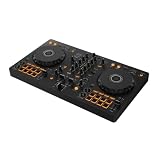


Top 3 picks at a glance
Quick comparison: which controller fits your setup?
| Controller | Jog-wheel feel and mixer layout | Software and key controls | Best fit | Approx. weight |
|---|---|---|---|---|
| Pioneer DJ DDJ-FLX4 | Compact, touch-sensitive jog wheels; conventional two-channel layout | Rekordbox and Serato DJ Lite; performance pads, Smart CFX and Smart Fader | Beginners, bedroom practice, and portable laptop setups | 2.1 kg |
| AlphaTheta DDJ-GRV6 | Larger jog wheels; familiar club-style, four-channel mixer layout | Rekordbox and Serato DJ Pro; Groove Circuit and eight performance pads per deck | Producers and learners who want more creative controls and a larger layout | 4.6 kg |
| Pioneer DJ DDJ-REV7 | Motorized, turntable-like jog wheels; scratch-style battle layout | Serato DJ Pro; motorized platters, performance pads and dedicated effects controls | Scratch DJs and performers who want a vinyl-like feel in a controller | 10.7 kg |
| Denon DJ SC LIVE 4 | Large, non-motorized jog wheels; four-channel standalone mixer | Engine DJ standalone operation; also supports Serato DJ Pro and VirtualDJ | Mobile DJs who want to play without a laptop | 5.8 kg |
Weights are manufacturer-listed figures and can vary slightly by published specification or region. They exclude a laptop, headphones, cables, and protective case—all of which matter when planning a mobile rig.
How to choose by the way you DJ
For learning at home: Pioneer DJ DDJ-FLX4
The DDJ-FLX4 is a sensible first controller if you want a familiar two-deck workflow without committing to a large, expensive unit. Its jog wheels are compact rather than turntable-sized, but work well for cueing, nudging, and basic beatmatching. The standard channel faders, EQ knobs, and crossfader make it easier to learn the fundamentals before adding more controls.
Its software flexibility is a major advantage: you can start with Rekordbox or Serato DJ Lite rather than buying into a single workflow immediately. Smart Fader and Smart CFX can help produce quick transitions, but treat them as aids—not substitutes for learning phrasing, gain staging, and manual EQ blends. If scratch technique or club-style four-deck mixing is your priority, you may outgrow its compact layout.
For a creative, club-style workflow: AlphaTheta DDJ-GRV6
The DDJ-GRV6 steps up to a larger four-channel layout and jog wheels, giving you more room to work than an entry-level controller. Its Groove Circuit is designed for manipulating drum parts in compatible tracks, making it more useful to DJs who want to reshape a groove during a set instead of relying only on conventional transitions. The generous performance-pad setup also supports cue points, loops, and other performance functions.
It supports Rekordbox and Serato DJ Pro, but check which software and features are included with your purchase and which require a subscription or license. Choose it over a simpler two-deck unit if you expect to use the extra controls; otherwise, you’re paying in both money and carrying weight for space you may not need.
For scratching: Pioneer DJ DDJ-REV7
The DDJ-REV7’s motorized jog wheels are its defining feature. They provide moving-platter resistance and a closer connection to turntable-style scratching than the stationary jog wheels on most controllers. Its battle-style arrangement places the pitch faders horizontally above the decks and organizes the mixer for scratch performance, rather than copying a standard club mixer layout.
That arrangement suits scratch DJs, but can feel unfamiliar if you’re learning traditional club mixing. It also weighs about as much as a packed small suitcase before you add a case or laptop. Pick it for the platter feel and performance controls—not as a casual upgrade for someone who mainly mixes two tracks at home.
For laptop-free mobile gigs: Denon DJ SC LIVE 4
The SC LIVE 4 can analyze and play music from USB storage using Engine DJ, so the laptop doesn’t have to be part of the performance setup. Its four-channel mixer and large jog wheels suit mobile DJs who need to juggle multiple sources or want more independent control than a basic two-deck layout provides. It can also work with supported computer DJ software when you do want to bring a laptop.
Standalone operation changes the preparation routine: organize and analyze your library in Engine DJ, export it to compatible storage, and check your playlists and audio before leaving. A computer connection is less central, but library preparation and backup become more important. The SC LIVE 4 is a poor-value choice if you’ll always mix from a laptop and won’t use its extra channels or standalone capability.
Match your setup to a controller
| Your situation | Best match | Why it fits | Check before buying |
|---|---|---|---|
| First controller, laptop-based, mostly home practice | DDJ-FLX4 | Simple two-channel workflow, portable body, and choice of beginner-friendly software | Confirm that your computer and chosen software version are supported |
| Moving from two decks toward club-style mixing | DDJ-GRV6 | Four-channel layout and more room for performance controls | Decide whether you’ll actually use the additional channel and Groove Circuit |
| Scratch practice or turntable-like platter response | DDJ-REV7 | Motorized platters and a battle-oriented mixer layout | Check table stability, transport options, and Serato DJ Pro compatibility |
| Weddings, events, or mobile sets without a laptop | SC LIVE 4 | Standalone USB playback plus four mixer channels | Verify your library workflow, storage needs, and backup plan |
| Frequent public transit or small backpack | DDJ-FLX4 | Lowest weight in this comparison, with a compact footprint | Allow room for a padded case, headphones, charger, and cables |
Plan portability by total carry weight
Controller weight alone can make a setup look more portable than it is. Here’s a simple estimate for a laptop-based rig using plausible planning weights—not manufacturer specifications for every accessory:
- Controller: use its listed weight.
- Laptop: allow 1.5 kg.
- Padded case: allow 1.0 kg.
- Headphones, cables, and charger: allow 0.7 kg.
Using those assumptions, a DDJ-FLX4 setup weighs about 2.1 + 1.5 + 1.0 + 0.7 = 5.3 kg. A DDJ-GRV6 setup comes to about 7.8 kg, while a DDJ-REV7 setup reaches about 13.9 kg. These are planning estimates, not exact packed weights; check the combined load against your bag and how far you’ll carry it.
For the SC LIVE 4, a laptop-free load with a case (1.0 kg) and accessories (0.7 kg) comes to roughly 7.5 kg. That is heavier than the FLX4 laptop rig in this example, but it removes the laptop from the booth and can simplify setup. “Portable” can mean lighter to carry, fewer devices to connect, or both—decide which matters more for your gigs.
Software, layout, and cost: the last checks
Software support can be as important as the hardware. Before you buy, confirm the exact controller’s current support for your operating system and preferred DJ application, whether a full license is included, and whether any must-have effects or features require a paid plan. Bundled software terms can change, so don’t base a purchase on an old listing or assume every advanced function is unlocked.
As broad market guidance, compact beginner controllers such as the DDJ-FLX4 usually sit around $300–$400. Larger four-channel or performance-focused units commonly land in the $600–$1,000 range, while motorized-platter controllers like the DDJ-REV7 are typically a premium purchase, often around $1,500–$2,000. Street prices vary with region, availability, and sales; budget separately for a case, headphones, and any software costs.
The shortest route to a good choice is to prioritize your main constraint: DDJ-FLX4 for an approachable laptop setup, DDJ-GRV6 for expanded creative controls, DDJ-REV7 for motorized scratch performance, or SC LIVE 4 for standalone mobile work. Then check software compatibility and calculate the packed weight before committing.
Frequently asked questions
Can I use the DDJ-FLX4 with both Rekordbox and Serato DJ Lite?
Yes, the DDJ-FLX4 supports both Rekordbox and Serato DJ Lite, so you can begin with either software instead of committing immediately to one workflow. Its two-channel layout, standard channel faders, EQ knobs, and crossfader support learning cueing, nudging, beatmatching, and manual EQ blends. Confirm that your computer and chosen software version are supported before buying.
Which controller is easiest to carry for frequent travel?
The DDJ-FLX4 is the easiest to carry among these controllers because it has the lowest listed weight and a compact footprint. However, the controller is only part of the load: a case, headphones, charger, and cables add weight. For planning, the article estimates a laptop-based DDJ-FLX4 setup at about 5.3 kg, excluding any differences in actual packed accessories.
Does the SC LIVE 4 completely eliminate the need for a laptop?
No, the SC LIVE 4 can eliminate the laptop from the performance setup, but it does not eliminate preparation. You need to organize and analyze your library in Engine DJ, export it to compatible storage, and check playlists and audio before leaving. The controller also supports Serato DJ Pro and VirtualDJ when you do want to connect a computer.
Is the DDJ-REV7 suitable for someone learning regular club mixing?
It can be used for learning, but the DDJ-REV7 is designed around scratch performance rather than a conventional club workflow. Its motorized jog wheels and battle-style arrangement provide a turntable-like feel, while the horizontal pitch faders may feel unfamiliar for traditional mixing. Choose it primarily for platter feel and scratch controls, not as a casual upgrade for basic home mixing.
What should I check before buying a larger four-channel controller?
Check whether you will actually use the additional channel, larger layout, and extra performance controls. The DDJ-GRV6 offers a four-channel mixer, larger jog wheels, Groove Circuit, and eight performance pads per deck, but its added space increases both purchase cost and carrying weight. Also confirm the included software and whether features require a subscription or license.


