
The best computer speakers for desks and gaming are the Edifier G2000 for buyers who want the strongest all-round desktop audio, while the Creative Pebble V3 is the better compact pick and the LENRUE G11 is the best low-cost choice for a basic PC setup. This roundup compares twelve real desktop speaker systems across USB-powered stereo speakers, soundbars, Bluetooth models and RGB gaming designs, with recommendations based on desk space, connection needs, gaming use, music, video calls and budget.
Most of these products are compact 2.0 systems, so they are designed for near-field listening rather than filling a large room. That distinction matters: a speaker can sound clear and enjoyable at a desk without having the deep bass, wide stereo image or output needed for a television room. The right choice depends on whether you value USB-C convenience, Bluetooth, a headphone output, RGB lighting, a slim soundbar shape or the fuller presentation available from a larger pair of enclosures.
Top 3 picks at a glance
Quick Comparison
| Product | Best for | Key specs and features | Price tier |
|---|---|---|---|
| Edifier G2000 | Best overall gaming speakers | 2.0 desktop system; 32W total output class; USB, Bluetooth and analog connectivity; gaming-focused design and lighting | Premium |
| Creative Pebble V3 | Best compact USB-C speakers | 2.0 angled desktop speakers; USB-C audio/power class; Bluetooth 5.0; compact footprint | Mid-range |
| LENRUE G11 | Best budget RGB desk speakers | USB-C/USB powered; wired desktop connection; touch lighting controls; stereo speaker class | Budget |
| Redragon GS520 | Best traditional RGB stereo pair | Wired 2.0 desktop speakers; RGB lighting; USB power and analog audio class; front-facing desktop format | Mid-range |
| FUNLOGY Speaker | Best compact budget pair | 14W stereo class; USB powered; 30-degree tilt design; front volume dial | Budget |
| Logitech Z207 | Best simple Bluetooth speaker pair | 2.0 stereo system; Bluetooth and 3.5mm analog connectivity; wired desktop power; headphone-friendly controls | Premium |
| Nylavee Computer Speakers | Best Bluetooth desktop soundbar | USB-powered soundbar format; Bluetooth and AUX connectivity; slim single-bar footprint | Premium |
| Bluedee Computer Speakers | Best minimalist soundbar alternative | Desktop soundbar; Bluetooth and AUX connectivity; USB power class; space-saving horizontal design | Premium |
| Redragon GS560 | Best RGB soundbar | 2.0 desktop soundbar; dynamic lighting; audio-light synchronization feature; wired computer connection class | Mid-range |
| LENRUE USB/USB-C Stereo Speakers | Best budget speaker with convenient controls | USB/USB-C power; AUX audio; loud stereo speaker class; headphone output and touch or control features listed by the model | Budget |
| LENRUE 10W Stereo Soundbar | Best basic soundbar value | USB-powered wired computer soundbar; 10W stereo class; compact horizontal design | Budget |
| Amazon Basics Stereo 2.0 | Best no-frills desktop audio | 2.0 stereo pair; USB powered; 3.5mm AUX input; physical volume control | Mid-range |
How We Chose
This roundup separates desktop speakers by the problem they solve instead of treating every compact speaker as interchangeable. The comparison considers connection flexibility, power method, physical format, controls, stated output class, desk footprint and the practical difference between a stereo pair and a single soundbar. USB-powered speakers are useful for laptops and desktop PCs with limited wall outlets, while Bluetooth is valuable for switching to a phone or tablet but can introduce operating-system volume and latency complications during games.
Category fit is also important. A pair with angled drivers can direct sound toward the listener at a shallow desk distance; a soundbar saves width but usually gives up some left-right separation. RGB can complement a gaming setup, but it should not be mistaken for an audio upgrade. Finally, the recommendations account for upgrade paths: buyers who may later add headphones, a subwoofer or a different source should prioritize suitable outputs and multiple inputs rather than choosing only by appearance. Product descriptions are presented conservatively where listings do not establish an exact technical specification.
1. Edifier G2000 – Best for overall gaming audio
As an Amazon Associate we earn from qualifying purchases at no extra cost to you.
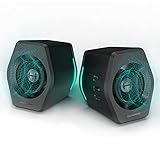
The Edifier G2000 is the strongest all-round choice in this group for a gaming desk where audio quality, connectivity and presentation all matter. It is a 2.0 PC gaming speaker system with a listed 32W total-output class, and it supports USB, Bluetooth and analog connections. That combination makes it more adaptable than a basic USB-powered pair: it can serve a gaming PC, laptop, console-compatible source or phone without requiring the speakers to be replaced when the desk changes.
The G2000 suits listeners who want a more substantial desktop speaker than ultra-compact angled USB speakers provide. Its enclosures occupy more space, but that extra size is useful for producing a fuller near-field presentation. It remains a 2.0 system, so it does not create true surround sound and should not be selected by someone expecting cinema-style low bass from a compact subwoofer-free setup. For games, however, a properly separated stereo pair can make dialogue, music and broad directional cues easier to follow than a single soundbar.
- Format: 2.0 desktop gaming speakers.
- Output class: 32W total output as stated for the model.
- Connections: USB, Bluetooth and analog input options.
- Design: Gaming-oriented enclosures with integrated lighting.
- Best placement: On either side of a monitor, angled toward the listening position.
Strengths
The biggest advantage is flexibility. USB is a convenient option for a computer, Bluetooth handles casual wireless playback and an analog connection can be useful when a device does not expose compatible USB audio. The stereo-pair layout also gives the G2000 a more convincing left-right image than most single-bar alternatives in this list. Its gaming styling and lighting fit an RGB desk without requiring a separate accessory.
Output figures need context. A stated total power number does not tell you how loud the speakers will be in every room, nor does it measure bass quality. At a normal desktop distance, though, the G2000 has a more generous headroom target than the smallest budget pairs. Keeping the computer volume around 70–85 percent and adjusting the speaker level avoids making the operating system perform unnecessary digital attenuation while leaving room for source differences.
Pros
- Most complete input selection in the roundup.
- Higher output class than the smallest USB speakers.
- Separate left and right enclosures support better stereo imaging.
- Strong fit for gaming desks that also play music and video.
Cons
- Costs more than simple USB-powered speakers.
- Uses more desk space than a single soundbar.
- Still lacks the deep low-frequency extension of a dedicated subwoofer.
- Lighting may be unnecessary for a minimalist setup.
The nearest alternative is the Creative Pebble V3. The Pebble V3 is smaller, cheaper in many markets and more convenient when desk depth is limited, but the G2000 offers a more substantial gaming-speaker format and a higher stated output class. Choose the Pebble V3 for compactness and casual listening; choose the G2000 when you want the broadest set of inputs and a more forceful desktop presentation.
2. Creative Pebble V3 – Best for compact USB-C setups
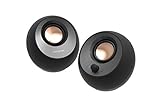
The Creative Pebble V3 is the best choice for a small desk, laptop station or monitor shelf where a normal pair of desktop speakers would feel oversized. It uses the familiar angled Pebble-style enclosure, a 2.0 stereo layout and a compact footprint. The model supports USB-C and Bluetooth 5.0, making it particularly practical for newer laptops and computers that have moved away from older USB-A ports.
Its 45-degree-style upward-facing presentation is useful at a desk because the drivers are aimed toward the listener instead of firing straight across the desktop. That does not replace physical separation, room placement or a larger cabinet, but it can improve perceived clarity when the speakers sit below a monitor. The V3 is most suitable for games, streams, calls and music at moderate near-field levels rather than for high-volume room listening.
- Format: Compact 2.0 desktop speaker pair.
- Connections: USB-C and Bluetooth 5.0, with the exact behavior depending on the host device and connection mode.
- Power approach: USB desktop power and audio class.
- Placement design: Angled enclosures direct sound upward toward the listener.
- Ideal user: Laptop owners, students, small-form-factor PC users and compact gaming desks.
Strengths
Space efficiency is the main reason to buy the Pebble V3. A pair of small speakers can sit beside a 24- or 27-inch monitor without swallowing the mouse area, and the angled cabinets reduce the need for stands. Bluetooth adds a second use case: a phone or tablet can play audio without the computer remaining connected by cable. USB-C also reduces cable clutter on a newer workstation, though users should verify whether their computer’s USB-C port supports the required audio or power behavior.
For games, the separated left and right speakers are preferable to a single low-cost bar when the listener sits centered. Stereo separation helps distinguish broad panning and makes dialogue placement more natural. It is not a competitive-surround replacement and will not deliver subwoofer-level bass, but that is a physical limitation of compact 2.0 speakers rather than a defect unique to this model.
Pros
- Very compact footprint for desks and laptop workstations.
- USB-C and Bluetooth 5.0 improve source flexibility.
- Angled design is well suited to near-field listening.
- Separate cabinets provide genuine left-right separation.
Cons
- Not intended to replace larger speakers for room-filling sound.
- Compact cabinets limit deep bass and maximum output.
- Bluetooth latency can vary by computer, operating system and game.
- Buyers needing multiple wired inputs may prefer another model.
The closest competitor is the Edifier G2000. The G2000 is the better premium gaming choice with a larger design and more connection options, while the Pebble V3 wins when the desk is narrow, the computer is USB-C-equipped or the speakers need to disappear visually. If you sit less than a meter from the display and value compactness more than bass weight, the Pebble V3 is the more rational buy.
3. LENRUE G11 – Best for budget RGB desks

The LENRUE G11 is aimed at buyers who want inexpensive desktop audio with a visible lighting feature. Its listing identifies USB-C/USB power, touch lights and a stereo computer-speaker format. That makes it a sensible match for a basic gaming or study desk where the speakers need to add sound and a little visual character without moving into a larger premium system.
The G11’s most useful trait is not simply that it lights up; it is that the lighting is controlled from the speaker rather than requiring separate software. Touch-style controls can be convenient when the speaker is within reach, although they are less valuable to someone who manages volume and lighting entirely through a keyboard or operating system. As with most USB-powered budget speakers, confirm which cable carries power and which cable carries audio before installation, because USB implementations vary between models.
- Format: Wired stereo desktop speakers.
- Power: USB-C/USB-powered design.
- Controls: Touch lighting control is part of the listed feature set.
- Audio class: Compact computer-speaker stereo output.
- Best environment: Small gaming, school or office desks near the computer.
Strengths
The G11 is easier to recommend than an anonymous generic pair because its intended use is clear: simple computer sound with RGB-style desk presentation. It should work well for game dialogue, browser video, calls and background music at a close listening distance. Its compact format also avoids the width penalty of a full-sized pair, which matters when a gaming monitor, microphone and mouse mat already occupy most of the surface.
Budget speakers benefit from sensible expectations. They are usually tuned for short-range listening, and their small cabinets cannot move the same amount of air as a larger system. Place them at the front edge of the desk rather than behind the monitor, aim them toward your head and avoid covering their drivers with a monitor stand or notebook. Those changes often improve clarity more than changing a software equalizer.
Pros
- Budget-friendly route to desktop stereo and touch lighting.
- USB-C/USB power suits many modern desk setups.
- Compact enough for crowded gaming stations.
- Simple controls are accessible without a separate application.
Cons
- Not the right choice for deep bass or high-volume room listening.
- Exact output and connection behavior should be checked before purchase.
- Lighting adds appearance rather than audio performance.
- May require a separate analog audio connection depending on the computer.
The nearest alternative is the Redragon GS520. The GS520 is the better fit for someone who wants a more traditional separated RGB pair and a stronger gaming aesthetic. The G11 is the more compact, simpler budget option, particularly when touch lighting and USB-C/USB power matter more than cabinet size.
4. Redragon GS520 – Best for traditional RGB stereo speakers

The Redragon GS520 is a wired 2.0 desktop speaker pair for buyers who want their speakers to look like part of a gaming setup rather than an office accessory. The model is identified as having RGB lighting and a desktop stereo format. It is a useful middle-ground option: more visually expressive than a plain pair, but less complex than a premium system with several input methods.
A separated pair is often preferable for games played from a centered desk chair. Put the left and right speakers roughly the same distance from your head, with the tweeter or main driver aimed toward you. Even budget stereo speakers can produce a more stable image when they are symmetrically placed. If one speaker is beside a wall and the other is exposed to open space, the result may sound unbalanced; moving the pair forward and keeping the distances similar is usually the first fix.
- Format: Wired 2.0 stereo desktop pair.
- Power and input: USB power and wired computer-audio class, with the exact cable requirements determined by the included design.
- Visual feature: RGB lighting.
- Best use: Gaming, video and general desktop audio at near-field distance.
- Positioning: Beside the monitor, separated left and right rather than placed together.
Strengths
The GS520’s appeal is balance. It provides a recognizable pair of speakers, gaming-oriented lighting and a relatively uncomplicated setup. Unlike a soundbar, it can create a physical stereo span around the monitor. Unlike the smallest compact speakers, it may fit a buyer who wants a more conventional desktop appearance and has enough width on the desk.
RGB should be judged as a design feature. It can make a dark desk easier to coordinate with a keyboard and mouse, but it does not improve imaging, bass or dialogue intelligibility. If the lights distract you during work, disable them or choose a plain model. If you play games in a dim room and want a coordinated look, the GS520 makes that part of the purchase straightforward.
Pros
- Separated stereo layout is suitable for desk gaming.
- RGB styling complements gaming peripherals.
- Wired operation avoids Bluetooth latency and pairing problems.
- More visually distinctive than plain office speakers.
Cons
- Requires more horizontal desk space than a soundbar.
- Wired design is less convenient for phones and tablets.
- Compact 2.0 cabinets cannot produce true subwoofer bass.
- Lighting may be wasted money for users who prefer a neutral desk.
Its nearest alternative is the Redragon GS560 soundbar. Choose the GS520 if stereo separation and left-right placement are priorities. Choose the GS560 if the monitor stand leaves little room for two speakers and the RGB strip or synchronized lighting is more appealing than a wide stereo image.
5. FUNLOGY Speaker – Best for a compact budget pair

The FUNLOGY Speaker is a compact 14W stereo PC speaker system with USB power, a 30-degree tilt design and a physical volume dial. It is the most practical choice here for someone who wants straightforward controls and does not need Bluetooth, RGB or multiple inputs. The 14W figure places it above the most basic low-output class on paper, though total wattage should not be treated as a direct prediction of loudness or sound quality.
The 30-degree tilt is meaningful on a desk. Small speakers often sit below the monitor’s center line, so a slight upward angle can send more direct sound toward the listener. This is especially useful when the desk is shallow and the speakers must sit close to the keyboard. The front volume dial also beats reaching behind a cabinet or using only an operating-system slider when you frequently switch between quiet work and louder games.
- Format: Compact stereo desktop pair.
- Output class: 14W stereo as listed.
- Power: USB powered.
- Design: 30-degree tilt for desk listening.
- Control: Physical volume dial.
Strengths
The FUNLOGY model focuses on the features that matter during daily use. Tilted cabinets help with directness, a dial is quicker than software volume control and USB power reduces the need for a separate wall adapter. It is well suited to a work-and-play computer where audio consists of meetings, games, streaming video and music at moderate levels.
This pair makes more sense than a soundbar when the listener sits centrally and has enough space to place the speakers on both sides of the monitor. It also avoids wireless issues: there is no Bluetooth pairing to troubleshoot, no codec selection and no possibility of a delayed soundtrack caused by a wireless audio path. The tradeoff is that the computer must remain connected by cable.
Pros
- Useful 30-degree tilt for typical desktop placement.
- Physical volume dial is convenient during games and calls.
- 14W stereo class is suitable for close-range computer listening.
- Simple USB-powered setup.
Cons
- No listed Bluetooth convenience for wireless device switching.
- Compact cabinets have limited low-bass capability.
- Less visually gaming-focused than RGB alternatives.
- USB power does not necessarily mean USB digital audio.
The closest alternative is the LENRUE G11. The G11 is the better style-led purchase with touch lighting and USB-C/USB power, while the FUNLOGY pair is the better functional choice for a buyer who values a dial and tilted cabinets. Select FUNLOGY for daily usability; select G11 when lighting and a more contemporary look are central to the decision.
6. Logitech Z207 – Best for simple Bluetooth stereo

The Logitech Z207 is a 2.0 stereo computer-speaker pair with Bluetooth and a wired desktop format. It is designed for users who want a familiar speaker layout, simple operation and the ability to switch between a computer and a Bluetooth device. The pair is a good match for a home office that doubles as a gaming station, especially when a phone needs to play audio without unplugging the computer.
The Z207 is not a high-output gaming system and does not use a separate subwoofer. Its value is convenience and predictability. Place the two speakers on either side of the display, keep them at equal distance from your chair and use the wired input for games when minimizing latency matters. Bluetooth is better reserved for music, podcasts or casual video unless your computer and operating system maintain acceptable synchronization.
- Format: 2.0 stereo computer speakers.
- Connections: Bluetooth and 3.5mm-style analog computer audio.
- Power: Wired desktop power.
- Best use: Mixed office, streaming and casual gaming setups.
- Placement: Separate left and right cabinets beside a display.
Strengths
Bluetooth makes the Z207 more versatile than a strictly wired budget pair. A phone can connect for music while the PC is asleep, and a laptop can use wireless audio without another cable across the desk. The stereo design remains better suited to a centered desktop than a single bar when the listener wants left-right separation.
The Z207 also has the advantage of a mature product category and uncomplicated controls. The absence of RGB may be positive for an office or shared room. Buyers should still check their computer’s Bluetooth behavior and remember that Bluetooth playback volume may be controlled independently at the source and speaker, creating two volume stages.
Pros
- Bluetooth plus wired audio supports several everyday sources.
- Separate cabinets create a useful stereo spread.
- Suitable for office desks that also handle games and media.
- Less visually aggressive than RGB gaming speakers.
Cons
- Not intended for powerful bass or large-room playback.
- Bluetooth can introduce game-audio latency.
- Costs more than the simplest USB-only speakers in some markets.
- Requires desk width for proper stereo placement.
The nearest alternative is the Creative Pebble V3. The Pebble V3 is smaller and includes Bluetooth 5.0 in a compact angled design, while the Z207 is a conventional pair aimed at uncomplicated mixed-device use. Choose the Z207 for a traditional office-friendly form; choose Pebble V3 if USB-C compatibility and minimal footprint matter more.
7. Nylavee Computer Speakers – Best for a Bluetooth desktop soundbar

The Nylavee Computer Speakers use a soundbar format with Bluetooth and AUX connectivity. This is the right category for a desk where two separate cabinets would compete with a monitor stand, microphone, notebook or wide mouse mat. The horizontal enclosure can sit below a display and leave the sides clear, making it especially attractive for narrow desks and single-monitor workstations.
A soundbar trades physical left-right spacing for convenience. Even if its internal drivers are separated, they are closer together than a pair placed at the edges of a monitor. That can make the stereo image narrower, but it also avoids the common problem of one small speaker being blocked by a monitor arm or pushed too far away. For speech, streams, calls and background music, this compromise is often worthwhile.
- Format: Compact desktop soundbar.
- Connections: Bluetooth and AUX.
- Power: USB-powered soundbar class.
- Best desk: Narrow or cluttered workstations.
- Best content: Dialogue, video, casual games and music at desk distance.
Strengths
The Nylavee design simplifies placement. Instead of measuring two speaker positions, the buyer needs only a clear space below the monitor. Bluetooth provides a convenient secondary source, while AUX offers a direct wired path for a PC or monitor output. That dual-input approach can be useful when a desktop computer and phone share one work area.
It is worth positioning the bar at the front edge of the desk rather than deep behind the monitor. A soundbar that is hidden by a display or aimed into the back of a monitor stand will sound less direct. Keep the bar centered with the screen, and use the wired connection for gaming if wireless delay is noticeable.
Pros
- Uses less side-to-side space than a pair of speakers.
- Bluetooth and AUX suit mixed-device desks.
- Centered placement works well below one monitor.
- USB power helps reduce adapter clutter.
Cons
- Narrower stereo image than properly separated speakers.
- Soundbar format limits cabinet volume and deep bass.
- Bluetooth latency can be unsuitable for some games.
- Exact cable requirements should be confirmed for the computer.
The closest alternative is the Bluedee Computer Speakers. Both occupy the soundbar category and offer Bluetooth/AUX connectivity. Choose Nylavee when its particular enclosure, controls or availability better suit the desk; choose Bluedee when you prefer the competing design or need to compare current dimensions and cable arrangement before buying.
8. Bluedee Computer Speakers – Best for minimalist soundbar desks
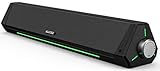
The Bluedee Computer Speakers are a Bluetooth and AUX desktop soundbar for users who want a clean horizontal setup. Instead of placing a left and right cabinet on either side of the monitor, the soundbar sits below or in front of the screen. This approach is particularly useful when the desk is shallow, the display has a large stand or the user wants to preserve maximum mouse space.
Its strengths are practical rather than audiophile-oriented. AUX gives a direct route from a PC, monitor or other analog source, while Bluetooth makes the bar useful for a phone or laptop. For a gaming desk, use AUX when possible: a cable avoids pairing interruptions and reduces the chance of audio delay. Use Bluetooth when convenience matters more than precise timing.
- Format: Desktop computer soundbar.
- Connections: Bluetooth and AUX.
- Power: USB-powered soundbar class.
- Best placement: Centered beneath a monitor or at the desk’s front edge.
- Best buyer: Minimalist users who do not want two speaker cabinets.
Strengths
The single-bar form makes cable management easier. There is no speaker-to-speaker wire crossing the desk, and the sound source remains visually centered with the display. This is valuable for a small desk where the left speaker would otherwise sit beside a notebook and the right speaker would interfere with a mouse arm.
The soundbar can also be a sensible upgrade from built-in monitor speakers. It places the audio closer to the listener and generally offers more enclosure volume than the thin speaker openings found in many displays. It should not be described as surround sound, however. A 2.0-style desktop bar remains a compact stereo source, and its perceived width depends heavily on listening position and room reflections.
Pros
- Minimalist horizontal footprint.
- Bluetooth and AUX provide wired and wireless options.
- Easy to center below a display.
- USB power is convenient for computer desks.
Cons
- Less stereo separation than a properly spaced pair.
- Limited deep bass without a separate subwoofer.
- Wireless gaming delay may vary between devices.
- Sound can be blocked if placed behind a monitor stand.
The nearest alternative is the Nylavee soundbar. Their use cases overlap almost completely, so dimensions, control placement, current price and the included cables should decide between them. If you want a single bar and both models fit the desk, choose the one that leaves the drivers unobstructed and offers the more convenient control position.
9. Redragon GS560 – Best for an RGB gaming soundbar
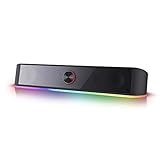
The Redragon GS560 is a 2.0 desktop soundbar with dynamic lighting and an audio-light synchronization feature. It targets gaming desks where a single horizontal speaker is preferred but the user still wants a more visible gaming aesthetic. The GS560 is a better match for a monitor shelf or narrow desk than a wide stereo pair, particularly when lighting coordination matters.
The soundbar format keeps the setup visually tidy, but it changes the audio geometry. A pair of speakers can sit well outside the monitor edges; the GS560 keeps both channels close together. That can make the presentation feel less wide, especially when the listener sits close. In return, it is harder to place one speaker badly or have the two sides become acoustically mismatched.
- Format: 2.0 desktop soundbar.
- Lighting: Dynamic RGB-style lighting with audio-light synchronization listed for the model.
- Power and input: Wired computer-speaker connection class.
- Best use: Gaming desks with limited side space.
- Placement: Centered below the monitor and unobstructed.
Strengths
The GS560 offers a clear visual identity. Audio-reactive lighting can make music and games feel more integrated with the desk, and the bar avoids the separate-cabinet footprint of traditional speakers. For users who already have a Redragon keyboard, mouse or other gaming accessories, the design may fit the rest of the workstation better than a neutral office speaker.
It is also easier to share than a pair that must be repositioned around a monitor stand. Put it in front of the display, keep the controls reachable and use the direct wired connection for games. The lighting should be treated as optional: if it distracts from a competitive game or a work document, turn it down or off rather than allowing it to determine the placement.
Pros
- Single-bar footprint suits narrow desks.
- Dynamic lighting and audio synchronization fit gaming setups.
- 2.0 design is simpler than a surround system.
- Centered placement is easy to maintain.
Cons
- Narrower stereo image than a separated pair.
- Lighting does not improve audio fidelity.
- Compact soundbar cabinets have limited low-bass extension.
- Less suitable for users who prefer a neutral office appearance.
The closest alternative is the Redragon GS520. The GS520 is the better audio-layout choice if you can place speakers on both sides of the monitor. The GS560 is the better desk-layout choice when side space is scarce or synchronized lighting is more important than maximum stereo width.
10. LENRUE USB/USB-C Stereo Speakers – Best for budget convenience

This LENRUE computer-speaker model is a budget wired stereo design with USB/USB-C power, AUX audio, loud-stereo positioning in its listing and a headphone-in feature. It suits a desktop user who wants basic speakers but also wants to connect headphones without reaching behind the computer. The combination of USB power and AUX audio means the connection should be planned as two separate functions: USB provides power, while AUX carries the analog sound unless the particular setup states otherwise.
The headphone-in feature is the most useful differentiator. It makes the speakers a small switching point for a gaming desk: speakers can play normally, then headphones can be connected at the front when other people are nearby. This is more convenient than changing Windows output settings or reaching behind the PC, although users should still verify that the headphone jack behaves as an output and not merely an input on the exact revision.
- Format: Wired stereo computer speakers.
- Power: USB/USB-C-powered class.
- Audio: AUX input.
- Convenience: Headphone-in connection listed for the model.
- Best use: Affordable gaming, work and video desks needing quick headphone access.
Strengths
For many buyers, the headphone connection matters more than Bluetooth. Wireless audio can be convenient, but a front-access headphone jack is immediate and predictable. It also lets the speaker system remain wired to the computer, avoiding pairing prompts and battery concerns. USB-C power may simplify installation on a newer laptop dock, while USB-A compatibility can help with older desktop ports.
Place the speakers at the front corners of the monitor rather than behind it. Keep the volume at a moderate speaker setting and use the computer slider for fine adjustment. If the headphone output is too quiet or sounds different from the PC’s direct output, test both paths before relying on it for a particular headset.
Pros
- USB/USB-C power suits newer and older computers.
- AUX keeps the audio path simple and low-latency.
- Headphone-in feature is useful for shared rooms and gaming.
- Budget stereo format is easy to install.
Cons
- No listed Bluetooth for wireless source switching.
- Small cabinets limit bass and room-filling output.
- USB power and AUX audio may require two cables.
- Exact headphone-output behavior should be confirmed for the model revision.
The nearest alternative is the LENRUE 10W stereo soundbar. Choose this pair if you want left-right separation and headphone access. Choose the LENRUE soundbar if a single horizontal enclosure is more important than a wider stereo presentation.
11. LENRUE 10W Stereo Soundbar – Best for basic soundbar value
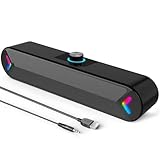
The LENRUE 10W Stereo Soundbar is a budget USB-powered computer soundbar with a listed 10W stereo output class. It is intended for buyers who want a simple horizontal speaker beneath a monitor, not a feature-heavy gaming system. Its compact format reduces desk clutter and makes it a straightforward replacement for weak monitor speakers or a laptop’s built-in audio.
The main decision is whether the user values a centered bar more than separate left and right cabinets. The LENRUE soundbar is easier to fit below one display and produces a consistent result when the listener is not perfectly centered. A pair can create a broader stereo image, but it also requires enough room and careful placement. For office audio, online video, game dialogue and casual listening, the bar’s simplicity may be exactly what the desk needs.
- Format: Horizontal stereo computer soundbar.
- Output class: 10W stereo as listed.
- Power: USB powered.
- Best placement: Directly below or in front of a monitor.
- Best buyer: Budget users who want minimal installation and minimal width.
Strengths
The soundbar removes several placement problems. There is no left speaker to put beside a monitor arm and no right speaker competing with the mouse. The centered format also works well when two people occasionally watch a video from slightly different seats, although every compact stereo bar has a limited listening window compared with room speakers.
USB power is convenient, but buyers should not assume that every USB-powered speaker receives digital audio over USB. If the model uses a separate analog audio lead, connect that lead to the computer or monitor and use USB only for power. If there is no sound, confirm the operating system output device, the physical volume control and the audio cable before concluding that the speaker is defective.
Pros
- Low-cost, compact soundbar format.
- 10W stereo class is appropriate for close-range computer listening.
- Easy to center below one monitor.
- Wired connection avoids Bluetooth delay.
Cons
- Less stereo width than separate speakers.
- No listed Bluetooth for phone or tablet playback.
- Limited bass compared with larger speaker systems.
- May need both USB power and a separate audio connection.
The closest alternative is the FUNLOGY Speaker. The FUNLOGY pair is better if you have space for two cabinets and want a physical volume dial plus a tilted stereo presentation. The LENRUE bar is better when the desk is narrow, the monitor stand leaves a shelf below it or cable simplicity matters more than maximum stereo separation.
12. Amazon Basics Stereo 2.0 – Best for no-frills desktop audio

The Amazon Basics Stereo 2.0 is a basic pair of USB-powered PC or laptop speakers with a 3.5mm AUX input and volume control. It is designed for buyers who want uncomplicated wired audio without RGB, Bluetooth or a soundbar layout. That makes it a sensible office and study choice, and it can also handle casual gaming when the listener is close to the desk.
The appeal is the standard connection arrangement. USB supplies power, while the 3.5mm AUX cable carries sound from a PC, laptop, monitor or dock. This separation is familiar and usually easy to troubleshoot. It also means the speakers do not depend on a particular computer’s Bluetooth stack or USB-audio compatibility. The cost is cable clutter compared with an integrated USB-audio model.
- Format: 2.0 stereo pair.
- Power: USB powered.
- Audio input: 3.5mm AUX.
- Control: Physical volume control.
- Best use: Office, school, video and casual gaming desktops.
Strengths
The Amazon Basics pair is easy to understand. Connect USB to power, connect the analog plug to the computer and adjust volume. A physical control is useful when the speaker sits closer than the PC tower, and the two-cabinet arrangement can produce better left-right separation than similarly priced soundbars when positioned correctly.
Its lack of wireless features is also a benefit for some buyers. There is no Bluetooth pairing to remove from a shared computer, no wireless codec delay and no battery to charge. For a fixed desktop that always plays from one computer, a direct analog cable can be more reliable than adding features that will not be used.
Pros
- Simple USB-power and 3.5mm-audio setup.
- Physical volume control is convenient.
- Separate stereo cabinets support desk-wide placement.
- Good fit for fixed office and school computers.
Cons
- No Bluetooth or USB-C audio feature listed.
- Usually needs two cable connections.
- Not designed for deep bass or high-volume room use.
- Plain appearance may not suit an RGB gaming desk.
The closest alternative is the FUNLOGY Speaker. Both are practical wired budget-oriented pairs, but FUNLOGY adds a 30-degree tilt design and a stated 14W stereo class, while the Amazon Basics model emphasizes a familiar 3.5mm AUX and USB-power arrangement. Choose Amazon Basics for connection simplicity; choose FUNLOGY for angled placement and a more gaming-friendly compact design.
How to Choose
Start with the desk, not the wattage
Measure the usable width beside your monitor and the clear depth between the display and the keyboard. A proper stereo pair needs two locations. As a starting arrangement, place each speaker 20–45 cm from the centerline of the monitor, keep both cabinets at the same distance from your head and angle them inward slightly. If your desk cannot provide that space, a soundbar is not automatically worse; it is simply a different compromise. A centered bar is often better than a pair forced behind the display, where the monitor blocks direct sound.
Near-field listening changes the calculation. At a typical 60–100 cm desk distance, compact speakers need far less acoustic output than speakers intended for a living room. A 10W or 14W stated system can be adequate for games and video at the desk, but the number does not describe amplifier efficiency, distortion, cabinet tuning or maximum clean output. Larger systems such as the Edifier G2000 are more appropriate when you want extra headroom, fuller music or occasional listening from farther across the room.
Choose the connection by your main source
USB-powered speakers are convenient because the computer can provide power, but “USB powered” and “USB audio” are not always the same thing. Some models use USB only for electricity and a separate 3.5mm cable for sound. Others may support USB audio through a compatible port. Read the included-cable description and confirm the required connection before buying, particularly with a laptop dock that has limited ports.
USB-C is most useful when it reduces adapters. A modern laptop may have USB-C ports but no analog headphone jack, while an older desktop may have several USB-A ports and a separate audio output. A USB-C/USB-powered model can be flexible, but a USB-A adapter may still be needed. If the computer is used for competitive games, use a wired audio path where possible. Bluetooth is excellent for music and phone playback, but delay depends on the source, codec, operating system and application. Even a few tens of milliseconds can be noticeable in rhythm games or when a weapon sound must align precisely with an on-screen action.
Understand Bluetooth’s tradeoffs
Bluetooth is valuable when one desk serves several devices. The Edifier G2000, Creative Pebble V3 and Logitech Z207 can make sense when you regularly switch between a PC, laptop and phone. It reduces cable swapping, but it introduces another point of failure: the speaker may connect to the wrong device, the operating system may choose the headset profile or the game may use a different output after a reconnection.
For troubleshooting, disconnect Bluetooth from unused devices, select the speaker explicitly in the operating system and test a video before opening a game. If dialogue and lip movement do not align, change to the wired input. Do not raise every volume control to maximum: set the speaker around 70–80 percent, the computer around 70–90 percent and use the remaining control for comfortable listening. This leaves reasonable adjustment range without forcing digital clipping from an overdriven source.
Pick stereo pair or soundbar deliberately
A pair gives you physical channel separation. If the speakers are 70 cm apart and you sit 70 cm away from their midpoint, you are close to an equilateral listening triangle, a useful starting geometry for stereo. You do not need laboratory precision, but symmetry matters. A soundbar may have internally separated channels, yet the smaller distance between them usually produces a narrower image. It is the better choice when width, cable management and monitor clearance matter more than soundstage.
For story games, strategy games, video and music, stereo separation is usually more valuable than decorative surround modes. For competitive games, clear midrange and consistent positioning are more important than exaggerated bass. If explosions dominate dialogue, reduce low frequencies in the game’s mixer or operating-system equalizer instead of assuming that louder bass means better immersion.
Think about controls and headphones
A physical volume dial is useful if the speakers are within arm’s reach. The FUNLOGY model and Amazon Basics pair emphasize this kind of direct control, while the LENRUE USB/USB-C model lists headphone-in convenience. A headphone output can be more useful than Bluetooth for a shared room because it switches listening privately without pairing or charging.
Check whether connecting headphones mutes the speakers automatically. If it does not, you may still need to change the operating system output. Also consider whether the headphone jack is intended for low-impedance earbuds or can comfortably drive a demanding gaming headset; compact speaker controls do not guarantee the same amplification as a dedicated headphone amplifier. For a high-impedance or audiophile headset, connect directly to the computer or a purpose-built audio interface instead.
Use lighting as a tie-breaker
RGB is a style feature, not a sound-quality specification. The LENRUE G11, Redragon GS520 and Redragon GS560 suit buyers who want lighting integrated into a gaming desk. The GS560’s audio-light synchronization is especially relevant if animated lighting is part of the desired setup, while the GS520 favors a separated pair and the G11 favors a compact budget format.
Ask whether the lights will be visible from your seating position. If the speakers are hidden behind a monitor, you may pay for an effect you rarely see. If you work at night, bright lighting can reflect off a glossy display or distract from dark game scenes. Adjustable brightness or an off mode is more useful than a large number of lighting patterns.
Set realistic bass expectations
None of these products should be treated as a full-range subwoofer system. Deep bass requires driver excursion, cabinet volume and often a dedicated subwoofer. A compact 2.0 speaker can provide enjoyable punch in the upper-bass region while still rolling off substantially at very low frequencies. A listed wattage cannot fix that physical limitation.
Place speakers on stable surfaces rather than hollow shelves that rattle. Keep the rear and side openings clear if the enclosure has any venting. If the sound is boomy, move the speakers a few centimeters forward from the wall and lower the bass setting. If speech is muddy, reduce bass slightly and raise the midrange modestly instead of increasing overall volume. Equalizer changes should be small: a 2–3 dB adjustment is a sensible starting point, while extreme boosts can cause clipping and make cheap drivers work harder.
Budget by the problem you need to solve
Budget models are enough for basic video, calls and desk gaming when you sit close. The LENRUE G11, FUNLOGY Speaker, LENRUE 10W soundbar and Amazon Basics pair each emphasize simplicity in different ways. Choose the G11 for lighting, FUNLOGY for tilt and a dial, the LENRUE soundbar for minimum width and Amazon Basics for a familiar USB-plus-AUX arrangement.
Mid-range choices add a clearer category advantage rather than merely a bigger price tag. Redragon’s GS520 and GS560 add gaming lighting, while the Creative Pebble V3 adds compact USB-C-oriented convenience and Bluetooth. Premium choices make the most sense when you will use their additional connectivity or larger format regularly. The Edifier G2000 is the broadest all-round upgrade, the Logitech Z207 is a traditional Bluetooth pair and the Nylavee and Bluedee models are single-bar solutions for a cleaner desk.
Worked desk-layout example
Suppose a desk is 120 cm wide, the monitor occupies 70 cm, and a microphone stand takes 15 cm on the right. That leaves approximately 35 cm of practical side space, not 50 cm, because the monitor feet and mouse area also need clearance. A wide pair may force one speaker behind the display. A soundbar such as the Nylavee, Bluedee, Redragon GS560 or LENRUE 10W can fit below the monitor and preserve the mouse area. If the monitor is only 55 cm wide and the desk has clear front corners, the Creative Pebble V3, FUNLOGY, GS520 or G2000 can be placed as a stereo pair.
This is the kind of decision that a specification sheet cannot answer. The best computer speakers for desks and gaming are not necessarily the most powerful models; they are the models that can be positioned correctly, connected to the devices you actually use and controlled without disrupting your game or work.
Frequently Asked Questions
Are 2.0 speakers good enough for gaming?
Yes. A properly placed 2.0 pair can deliver clear dialogue, music and useful left-right direction cues without a subwoofer. It will not reproduce deep bass or create true multichannel surround, but stereo is a strong default for desk gaming.
Should I buy a soundbar or two computer speakers?
Buy a soundbar when desk width, cable management or monitor placement is the main constraint. Buy two speakers when you can place them symmetrically and want a wider stereo image. A well-positioned compact pair is usually preferable for music and directional game audio.
Does more wattage mean better computer speakers?
No. Wattage describes an electrical power class, not a complete measure of loudness, clarity or bass. Driver efficiency, cabinet design, distortion and listening distance also matter. Use output figures to identify broad categories, then choose based on placement and connections.
Are USB-powered speakers compatible with every computer?
They generally need a suitable USB port for power, but the audio connection may be USB, 3.5mm AUX or both. Check the cable arrangement before purchase. A speaker that uses USB only for power still needs an analog audio output from the computer.
Is Bluetooth suitable for PC gaming?
It can be suitable for casual gaming, but latency varies by device, codec and operating system. Use a wired connection for rhythm games, competitive play or any situation where sound timing matters. Bluetooth is particularly convenient for music, phones and secondary devices.
How far apart should desktop speakers be?
Start with the speakers about as far apart as the distance from each speaker to your head. At a 70 cm listening distance, roughly 50–70 cm of separation is a useful starting range if the desk allows it. Keep both speakers at equal height and angle them toward your chair.
Why do my computer speakers sound quiet?
Check the speaker control, operating-system volume, application mixer and cable connections first. Confirm that the computer is using the correct output device, and make sure USB is connected to a powered port. Do not assume USB carries audio if the model also requires AUX.
Can these speakers replace a subwoofer?
No compact 2.0 system in this roundup is a substitute for a dedicated subwoofer. They can provide enjoyable near-field bass, but very low frequencies need more driver movement and enclosure volume. Choose a larger system such as the Edifier G2000 for a fuller presentation, while keeping expectations realistic about sub-bass.
Final Recommendations
Choose the Edifier G2000 if you want the best overall combination of gaming presentation, output class and USB, Bluetooth and analog connectivity. Choose the Creative Pebble V3 for a compact USB-C-friendly desk, or the LENRUE G11 for a low-cost setup with touch lighting.
For a soundbar, the Redragon GS560 is the gaming-focused choice, while the Nylavee and Bluedee suit minimalist Bluetooth-and-AUX desks. For a plain wired setup, the FUNLOGY Speaker and Amazon Basics Stereo 2.0 prioritize useful controls and simple installation over extras.


