
The best tower speaker for most rooms and budgets in 2026 is the Polk Audio Monitor XT70: it’s a full-size floorstander with genuine hi-fi driver architecture, enough sensitivity to run happily off a mid-range AV receiver, and a design that scales from a modest stereo setup to a full surround system as you upgrade. If you’re on a tighter budget, the Polk Audio Monitor XT60 and Dayton Audio Classic T65 pair deliver a huge share of that performance for noticeably less, while the Rockville TM150 powered towers are the pick if you want big bass with zero extra equipment — no receiver, no subwoofer, just plug in and play. Below, we break down all ten options by room size, use case, and budget so you can match the right tower to your space in minutes rather than weeks.
Top 3 picks at a glance
Quick Comparison
| Product | Best For | Key Specs | Price Tier |
|---|---|---|---|
| Polk Audio Monitor XT70 | Best overall for medium-to-large rooms | Full-size passive tower, dual woofers + dedicated midrange, Hi-Res certified class, sold individually | Premium |
| Polk Audio Monitor XT60 | Budget hi-fi and starter home theater | Compact passive tower, Dolby Atmos / DTS:X ready class, sold individually | Budget |
| Polk Audio T50 | Small rooms and apartment home theater | 150W peak passive tower, 6.5″ composite driver, twin bass radiators, sold individually | Mid-range |
| Dayton Audio Classic T65 (pair) | Value stereo music listening | Dual 6.5″ woofers, sold as a matched pair, classic hi-fi styling | Mid-range |
| Elimavi Tower Pair | Mid-budget stereo for medium rooms | Dual 6.5″ woofers, 120W handling, sold as a pair | Mid-range |
| Rockville TM150D (Dark Wood) | All-in-one powered bass-heavy listening | Powered tower pair, dual 10″ built-in subs, Bluetooth + multiple inputs | Premium |
| Rockville TM150B (Black) | All-in-one powered tower, black finish | Powered tower pair, dual 10″ built-in subs, Bluetooth + EQ presets | Premium |
| Rockville ONE-Tower BG (Beige) | Single-speaker TV upgrade on a budget | All-in-one Bluetooth tower, HDMI ARC / Optical / RCA inputs | Budget |
| Rockville ONE-Tower Black | Single-speaker TV upgrade, black finish | All-in-one Bluetooth tower, HDMI ARC / Optical / RCA inputs | Budget |
| GOgroove Bluetooth Tower | Dorm rooms, offices, and small spaces | Slim powered tower, built-in subwoofer, Bluetooth streaming | Budget |
How We Chose
Every speaker in this roundup was selected on published specifications, driver architecture, category fit, and the real-world situations each design serves — not on marketing copy. Our criteria came down to five questions. First, driver complement: does the tower have enough cone area and cabinet volume to fill the room sizes buyers actually have, from 100-square-foot bedrooms to 400-square-foot open living rooms? Second, amplification path: passive towers need a receiver or amp, so we weighed whether a model’s sensitivity and impedance suit common mid-range amplifiers, while powered towers were judged on their input flexibility. Third, upgrade path: passive speakers that can later become fronts in a 5.1 or Atmos system scored well, because towers are rarely the last speaker a buyer owns. Fourth, value density: how much acoustic hardware you get per price tier. Finally, format versatility: Bluetooth, HDMI ARC, and optical inputs matter more than ever for TV-first buyers. Where an exact figure isn’t published, we describe the spec class rather than guess.
1. Polk Audio Monitor XT70 — Best Overall Tower Speaker
As an Amazon Associate we earn from qualifying purchases at no extra cost to you.

The Monitor XT70 is the tower we’d point most buyers toward first, because it sits at the intersection of serious hi-fi hardware and real-world practicality. It’s the largest model in Polk’s Monitor XT line, and it’s sold individually — so you buy two for stereo, or start with a pair as fronts and add the matching center and surrounds later. That modularity is a big part of why it’s our overall pick: the speaker you buy today is also the foundation of the home theater you might build in three years.
The XT70 uses a full-size three-way-style array: a 1-inch dome tweeter, a dedicated midrange driver, and dual woofers in a ported cabinet. In practice, that division of labor means the tweeter and midrange handle vocals and detail while the woofers concentrate purely on low-frequency output — the same design philosophy as far more expensive towers. It’s certified for high-resolution audio playback, and Polk rates the line as compatible with Dolby Atmos and DTS:X content, which means it won’t bottleneck a modern AV receiver’s immersive formats.
- Type: Passive floorstanding tower (sold individually)
- Drivers: 1″ dome tweeter, dedicated midrange, dual woofers
- Formats: Hi-Res audio certified class; Dolby Atmos / DTS:X compatible
- Amplification: Needs an AV receiver or stereo amp (typically 25–200W class)
- Room fit: Medium to large rooms, roughly 200–450 sq ft
- Finish: Midnight Black vinyl wrap with removable grille
For home theater buyers, the XT70’s strongest trait is dialogue intelligibility paired with effortless dynamics — the dedicated midrange keeps voices anchored to the screen even when the woofers are working hard on effects. For music, it has the low-end reach that makes a separate subwoofer optional rather than mandatory for stereo listening, though bassheads in large rooms will still benefit from one.
Compared with the XT60 below, the XT70 buys you a larger cabinet, more cone area, and more headroom — in a room under ~200 sq ft the difference is modest, but in a 350 sq ft living room it’s the difference between “plenty loud” and “straining.” Compared with the Rockville powered towers, it requires an extra investment in an amplifier, but it will outlast and outperform them in fidelity terms, and it integrates into a real surround system, which powered towers fundamentally can’t do.
Pros
- Genuine full-size hi-fi driver array with dedicated midrange
- Scales from stereo pair to full Atmos home theater
- Enough sensitivity to work well with mid-range receivers
- Sold individually — easy to buy a matching third for expansion
Cons
- Requires a receiver or amplifier — adds to total cost
- Large footprint; needs breathing room from walls for best bass
- Priced per speaker, so a pair costs more than the sticker suggests
2. Rockville TM150D Dark Wood — Best Powered Tower for Bass Lovers

The Rockville TM150D takes the opposite approach to a passive tower like the XT70: instead of needing a receiver and possibly a subwoofer, it packs everything into the cabinets themselves. This is a powered tower pair — amplification is built in — and each tower houses dual 10-inch subwoofers. That’s more cone area than most standalone budget subwoofers offer, and it’s the reason this system delivers the kind of low-frequency impact that passive towers at twice the price can only match with an added sub.
The dark wood finish gives it a furniture-grade look that suits living rooms better than utilitarian black vinyl. Connectivity is the headline for TV buyers: the TM150 series supports Bluetooth streaming plus wired inputs suited to TVs and media players, so the towers can serve as a complete stereo-plus-TV audio system with no other components. For buyers who want big, room-shaking sound without researching amplifiers, impedance matching, or crossover settings, this is the shortcut.
- Type: Powered (active) tower pair
- Bass: Dual 10″ built-in subwoofers per tower class
- Inputs: Bluetooth plus wired inputs for TV/media sources
- Amplification: Built-in — no receiver required
- Room fit: Medium to large rooms; ideal for bass-heavy music and movie nights
- Finish: Dark Wood
The honest trade-off is upgrade path. A powered all-in-one system is a closed loop: you can’t later reassign these towers as surround channels or drive them from a better amp. What you buy is what you’ll always have. The sonic character also leans toward excitement over neutrality — the built-in subs emphasize impact, which is exactly right for action movies and bass-forward music genres, less ideal if you primarily listen to acoustic jazz or classical and value flat response.
Against the passive Polk XT70 pair at a similar total outlay once you add a receiver, the TM150D wins on convenience and raw bass output, while the Polk wins on refinement and expandability. Against its sibling, the TM150B, the difference is purely finish — pick whichever suits your room.
Pros
- Dual 10″ subs built in — massive bass with no extra equipment
- Complete system: Bluetooth plus TV-friendly wired inputs
- No receiver or amplifier shopping required
- Dark wood finish looks like furniture, not equipment
Cons
- Closed system — no path into a component surround setup
- Bass-forward tuning may be too much for small rooms
- Heavy and space-hungry cabinets
3. Rockville TM150B Black — Best Powered Tower in a Neutral Finish

The TM150B is the black-finished sibling of the TM150D, and functionally it plays the same role in this roundup: a powered tower pair with dual 10-inch built-in subwoofers that delivers theater-scale bass without a receiver, amp, or separate sub. If you’ve decided the powered route is right for you — plug in, pair over Bluetooth, done — the choice between the TM150B and TM150D comes down almost entirely to which finish suits your room. The black cabinet blends into typical TV-stand setups and darker décor, while the dark wood reads warmer and more traditional.
Everything that makes the TM150 series compelling applies here: the sheer cone area of the integrated subwoofers gives these towers a low-frequency floor that passive towers in the same price tier simply cannot reach unaided. Explosions, kick drums, synth bass — the kind of content that makes smaller towers sound thin — comes through with genuine physical weight. For movie-night households and listeners who run hip-hop, EDM, or action-heavy streaming, that character is the point.
- Type: Powered (active) tower pair
- Bass: Dual 10″ built-in subwoofers per tower class
- Inputs: Bluetooth plus TV-friendly wired inputs; EQ presets class
- Amplification: Built-in — plug-and-play
- Room fit: Medium to large rooms
- Finish: Black
The same caveats as the TM150D apply: this is a self-contained system, so there’s no upgrade path into separates, and the tuning favors impact over neutrality. Placement matters more than buyers expect — with this much bass energy, tucking the towers into corners can overemphasize low frequencies; pulling them 12–18 inches off the wall typically tightens things up noticeably.
Within this list, the TM150B’s closest alternative is the TM150D (same product, different finish), and below it, the ONE-Tower models — but those are single-speaker solutions aimed at TV upgrades rather than stereo pairs, so they serve a different buyer entirely.
Pros
- Thunderous built-in bass from dual 10″ subs
- Truly plug-and-play — no extra components needed
- Neutral black finish suits most living rooms
- Strong value for the total hardware delivered
Cons
- No upgrade path into a component system
- Bass emphasis may overwhelm small or reflective rooms
- Stereo imaging depends on proper tower placement
4. GOgroove Bluetooth Tower — Best Ultra-Budget Floor Speaker

The GOgroove Bluetooth tower occupies the entry point of this roundup: a slim, powered floorstanding speaker with a built-in subwoofer and Bluetooth streaming, at the lowest price tier here. It’s designed for the situations where a full stereo pair or a receiver-based system is overkill — dorm rooms, bedrooms, home offices, and secondary spaces where you want better, louder, fuller sound than a TV speaker or tabletop Bluetooth speaker can produce.
The appeal is simplicity and footprint. The cabinet is tall and narrow, so it slips beside a desk or into a corner without dominating the room, and the single-box design means there’s nothing else to buy or wire. Bluetooth pairing handles phones, tablets, and laptops directly, which makes it a natural fit for streaming-first listeners who’ve never owned a receiver and don’t intend to.
- Type: Powered single tower speaker
- Bass: Built-in subwoofer driver class
- Inputs: Bluetooth; auxiliary input class
- Amplification: Built-in
- Room fit: Small rooms — bedrooms, dorms, offices up to ~150 sq ft
- Footprint: Slim; easy corner or desk-side placement
Setting expectations correctly matters here. As a single tower, it doesn’t deliver stereo separation the way a pair does — for music listening where imaging matters, the Dayton Audio T65 pair or the Rockville powered pair will always sound more enveloping. And while the built-in subwoofer adds real warmth versus a tabletop speaker, it isn’t in the same league as the Rockville TM150’s dual 10-inch drivers. Think of it as a dramatic upgrade over built-in TV or laptop speakers, not a substitute for a component system.
Its nearest alternative on this list is the Rockville ONE-Tower, which adds HDMI ARC and optical connectivity — a meaningful step up for TV use. If your use case is primarily music streaming in a small room rather than TV audio, the GOgroove’s lower price tier makes it the smarter buy.
Pros
- Lowest price tier in the roundup
- Slim footprint fits tight spaces
- Bluetooth streaming with no extra components
- Real low-end presence versus tabletop speakers
Cons
- Single speaker — no true stereo separation
- Bass output can’t match powered pairs with dedicated subs
- Fewer TV-friendly inputs than the Rockville ONE-Tower
5. Polk Audio T50 — Best Compact Tower for Small Rooms

The Polk T50 is one of the longest-running value towers on the market, and it earns its place here as the sweet spot for smaller rooms and first-time home theater builds. It’s a passive tower rated at 150W peak power handling, built around a 1-inch silk dome tweeter, a 6.5-inch composite driver, and dual 6.5-inch bass radiators — passive radiators that extend low-frequency response without the port noise that budget ported designs sometimes exhibit.
In real terms, the T50 delivers a fuller, warmer sound than its modest driver count suggests. The bass radiators give it mid-bass presence that makes movies and music feel substantial in rooms up to about 200–250 square feet, which covers most apartments and bedrooms. Pair it with an entry-level AV receiver — anything in the 70–100W per channel class is plenty — and you have the front stage of a surround system that can grow with matching Polk centers and surrounds.
- Type: Passive floorstanding tower (sold individually)
- Drivers: 1″ silk dome tweeter, 6.5″ composite mid/woofer, dual 6.5″ bass radiators
- Power handling: Up to 150W peak class
- Amplification: Needs AV receiver or stereo amp
- Room fit: Small to medium rooms, ~120–250 sq ft
- Finish: Black
The T50’s main limitation is scale: in a 350+ sq ft open-plan space, the single active mid/woofer runs out of air-moving capability, and the Monitor XT60 or XT70 become the better calls. Bass reach is also moderate — the passive radiators emphasize mid-bass warmth rather than sub-40Hz depth, so home theater buyers will want to plan for a subwoofer eventually.
Against the Dayton Audio T65, the T50 trades a bit of driver area (Dayton’s dual active woofers) for Polk’s refined tweeter voicing and a widely matched ecosystem of centers and surrounds. For pure stereo music, the Dayton pair has an edge in value; for a theater build, the T50’s system integration wins.
Pros
- Warm, balanced sound suited to smaller rooms
- Passive radiators deliver clean mid-bass without port chuffing
- Integrates into Polk’s wider home theater ecosystem
- Proven, long-running design
Cons
- Outgunned in large rooms
- Limited deep-bass extension — subwoofer recommended for movies
- Sold individually, so a pair doubles the listed price
6. Rockville ONE-Tower BG (Beige) — Best Single-Tower TV Upgrade
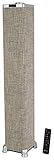
The Rockville ONE-Tower is a different animal from the stereo pairs and passive towers elsewhere in this list: it’s a single all-in-one powered tower designed primarily as a dramatic TV audio upgrade. The connectivity tells you the intended use — HDMI ARC, optical, and RCA inputs mean it hooks directly into a television and can be controlled by the TV’s own remote via ARC, while Bluetooth covers phone and tablet streaming.
That input set is the key differentiator versus the GOgroove. HDMI ARC in particular is the connector that makes a single speaker behave like a soundbar: one cable carries audio from the TV and lets the TV remote handle volume. For buyers who’ve been shopping soundbars but want more low-end presence and a furniture-like footprint, the ONE-Tower fills that niche — often at a similar or lower price than mid-range soundbars, with a cabinet volume no slim bar can match.
- Type: Powered single tower, all-in-one
- Inputs: HDMI ARC, Optical, RCA, Bluetooth
- Amplification: Built-in
- Room fit: Small to medium rooms; TV-first setups
- Finish: Beige (BG)
The beige finish is worth addressing directly: it’s unusual in a category dominated by black, and for rooms with light décor, wood tones, or farmhouse styling, it’s arguably easier to integrate than another black monolith flanking the TV. If your room is darker, the black ONE-Tower variant below is the same product in a different finish.
Limitations mirror the GOgroove’s: as a single speaker, you don’t get stereo separation, and the overall output ceiling is aimed at TV and casual listening rather than party volumes. Within this list, its closest comparison is the GOgroove — the ONE-Tower’s HDMI ARC and optical inputs make it clearly better for TV duty, while the GOgroove undercuts it on price for music-only use.
Pros
- HDMI ARC + optical — proper TV integration with remote passthrough
- All-in-one simplicity, soundbar alternative with a real cabinet
- Distinctive beige finish for lighter décor
- Budget pricing
Cons
- Single speaker — no stereo imaging
- Not designed for large rooms or high-volume listening
- No expansion path
7. Rockville ONE-Tower Black — Best Single-Tower TV Upgrade in Black
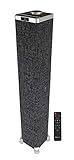
The black ONE-Tower is the same all-in-one concept as the beige version — a single powered tower with HDMI ARC, optical, RCA, and Bluetooth connectivity — finished in the standard black that disappears beside most TVs and entertainment furniture. Everything written about the beige variant applies here; the decision between them is purely aesthetic.
That sameness is worth emphasizing, because it means buyers can choose on décor alone without giving anything up. You get the same soundbar-alternative functionality: one HDMI cable to the TV’s ARC port, volume controlled by the existing TV remote, and Bluetooth on top for streaming audio from phones when the TV’s off. For renters, dorm residents, or anyone furnishing a first apartment, it’s a complete audio solution that fits in a car and sets up in five minutes.
- Type: Powered single tower, all-in-one
- Inputs: HDMI ARC, Optical, RCA, Bluetooth
- Amplification: Built-in
- Room fit: Small to medium rooms; TV-first setups
- Finish: Black
The placement flexibility of a tower over a soundbar is a quiet advantage: a soundbar needs shelf space under the TV or wall-mounting, while the ONE-Tower stands beside the entertainment unit — useful for wall-mounted TVs with no furniture below. The trade-off versus a true stereo pair remains imaging; for dialogue-driven TV, sports, and streaming shows, a single full-range cabinet is perfectly adequate, but music-focused listeners will notice the missing soundstage width.
Against the TM150 powered pair, the ONE-Tower is the budget, minimal-footprint option — roughly half the concept for buyers who don’t need dual towers and dual 10-inch subs. Against the GOgroove, it wins on TV inputs at a modest price premium.
Pros
- HDMI ARC/optical make it a genuine soundbar replacement
- Free-standing placement works with wall-mounted TVs
- Bluetooth included for music streaming
- Budget-friendly complete solution
Cons
- Mono/single-cabinet presentation
- Output suited to small-medium rooms only
- Dead-end for future component upgrades
8. Dayton Audio Classic T65 — Best Value Stereo Pair

The Dayton Audio Classic T65 is the pick for buyers who want the most stereo hardware per dollar: it’s sold as a matched pair of passive towers, each with dual 6.5-inch woofers, at a mid-range price tier that often undercuts a single tower from bigger-name brands. Dayton Audio has a long-standing reputation in the DIY and value-audio community for engineering-driven, no-frills products, and the T65 follows that pattern — money goes into drivers and cabinets rather than marketing.
Dual 6.5-inch woofers per tower give the T65 real low-end authority for music. In a stereo pair properly spaced — roughly 7–9 feet apart with slight toe-in — these towers produce the wide soundstage and imaging that single powered towers can’t approach. For dedicated music listening rooms, that’s the fundamental argument for a passive pair: two full-range cabinets creating a believable acoustic space between them.
- Type: Passive floorstanding towers (sold as a pair)
- Drivers: Dual 6.5″ woofers per tower plus tweeter class
- Amplification: Needs stereo amp or AV receiver
- Room fit: Small to medium-large rooms, ~150–350 sq ft
- Finish: Black, classic styling
The catch is that “pair” economics plus amplifier requirement. Budget $100–$200 for a capable stereo amp or entry receiver if you don’t own one — even so, the total often lands below a pair of XT70s plus amp. The other trade-off is ecosystem: Dayton doesn’t offer the broad matching center/surround lineup Polk does, so theater expanders are better served by the Polk T50 or XT60.
Against the Elimavi pair (also dual 6.5″, sold as a pair), the T65 leans on Dayton’s deeper track record in driver design and the classic aesthetic. Against the Polk XT60, it delivers more bass cone area per dollar but a smaller upgrade ecosystem.
Pros
- Outstanding hardware-per-dollar — a full pair at mid-range pricing
- Dual 6.5″ woofers deliver genuine stereo bass
- Wide soundstage for dedicated music listening
- Brand with strong value-audio reputation
Cons
- Amplifier required — extra cost
- Smaller matching-speaker ecosystem for theater expansion
- Utilitarian styling won’t suit every room
9. Polk Audio Monitor XT60 — Best Budget Hi-Fi Tower
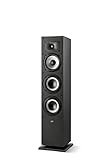
The Monitor XT60 is the XT70’s smaller sibling, and it’s the tower we recommend when budget leads but you still want a real component system. It shares the Monitor XT line’s design DNA — 1-inch dome tweeter, Polk’s proprietary woofer cones, Hi-Res certification class, and Dolby Atmos/DTS:X compatibility — in a more compact, more affordable cabinet. Sold individually, a pair plus a modest receiver lands at a total price that undercuts most powered premium systems while offering far better upgrade options.
The XT60 is the right size for the rooms most people actually have. In 150–300 square feet, it reaches satisfying volumes with authority, and its smaller woofers relative to the XT70 are rarely the limiting factor at sane listening levels. Where the XT70 earns its premium is large rooms and higher output demands; everywhere else, the XT60 delivers a strikingly similar character for less money.
- Type: Passive floorstanding tower (sold individually)
- Drivers: 1″ dome tweeter with woofer array class
- Formats: Hi-Res audio class; Dolby Atmos / DTS:X compatible
- Amplification: Needs receiver or amp; friendly to entry-level units
- Room fit: Small to medium rooms, ~120–300 sq ft
- Finish: Midnight Black
As a home theater foundation, the XT60 integrates with the entire Monitor XT family — matching centers, bookshelves, and height modules — making it the most future-proof budget pick here. For music-only buyers, the Dayton T65 pair offers more low-end per dollar; for anyone who might add surround channels later, the XT60 is the safer investment.
Pros
- Real hi-fi architecture at budget pricing
- Full Monitor XT ecosystem for expansion
- Right-sized for typical rooms
- Sold individually for flexible purchasing
Cons
- Needs an amplifier
- Less bass and headroom than the XT70 in large rooms
- Pair cost adds up versus all-in-one options
10. Elimavi Tower Pair — Best Mid-Range Stereo Alternative

The Elimavi floor-standing pair rounds out the list as a mid-range stereo option built around the classic dual-6.5-inch formula: two woofers per tower, 120W power handling, sold as a matched pair in black. It competes directly with the Dayton Audio T65 on concept — maximum stereo hardware per dollar — and the choice between them comes down to styling preference and current pricing, since they occupy the same spec class and price tier.
The use case is the same as the Dayton’s: a music-first stereo system in a small-to-medium room where soundstage and imaging matter more than connectivity features. Two towers spaced properly, driven by an entry-level stereo amp or receiver, produce the kind of enveloping presentation that single powered towers and soundbars physically cannot replicate.
- Type: Passive floorstanding towers (sold as a pair)
- Drivers: Dual 6.5″ woofers per tower
- Power handling: 120W class
- Amplification: Needs stereo amp or AV receiver
- Room fit: Small to medium rooms, ~150–300 sq ft
- Finish: Black
The honest caveat is brand track record: Elimavi is a newer name than Polk or Dayton Audio, so long-term reliability data and matching ecosystem accessories are thinner. Buyers prioritizing proven longevity should lean Dayton or Polk; buyers who find the Elimavi at a meaningfully better price get equivalent-spec hardware for the money.
Pros
- Dual 6.5″ woofers per tower — real stereo bass
- Complete pair in the box
- Mid-range pricing for full-size hardware
Cons
- Newer brand with shorter track record
- Amplifier required
- No matching surround/center ecosystem
How to Choose
Tower speakers split into two fundamentally different product types, and deciding which camp you’re in resolves most of the confusion in this category.
Passive vs. powered: the first decision. Passive towers (Polk XT70, XT60, T50, Dayton T65, Elimavi) contain no amplifier — they need a receiver or stereo amp between them and your sources. Powered towers (Rockville TM150, ONE-Tower, GOgroove) contain amplification and accept sources directly. If you already own or plan to buy an AV receiver, go passive — you’ll get better fidelity per dollar and a real upgrade path. If you want to connect a TV or phone and be done, go powered — but understand you’re buying a closed system.
The amplifier math nobody shows you. For passive towers, amplifier matching worries buyers unnecessarily. Here’s the actual budget: typical listening happens at 1–5 watts of continuous power. Peaks in music and movies might demand 20–50 watts momentarily. A tower rated for “150W” isn’t demanding a 150W amp — that figure is a ceiling, not a requirement. Any AV receiver in the 70–100W-per-channel class drives every passive tower on this list comfortably. The real matching concern is impedance: most towers are 6–8 ohms, which every mainstream receiver handles. Where buyers go wrong is buying an underpowered source for huge rooms — a 45W mini-amp feeding big towers in a 400 sq ft space will run out of headroom before the speakers do.
Room size determines driver requirements. Use this mapping as a starting point:
| Room Size | Minimum Recommended Setup | Best Picks From This List |
|---|---|---|
| Under 150 sq ft (bedroom, office, dorm) | Single powered tower or compact passive pair | GOgroove, ONE-Tower, Polk T50 |
| 150–250 sq ft (typical living room) | Passive pair w/ dual woofers or powered pair | XT60, Dayton T65, Elimavi, TM150 |
| 250–400 sq ft (large/open-plan) | Full-size passive pair; powered pair w/ subs | XT70, TM150B/D |
| 400+ sq ft | Full-size passive pair + dedicated subwoofer | XT70 pair + sub |
Placement costs nothing and changes everything. Towers pressed against the back wall get boomy, bloated bass because the wall reinforces low frequencies. Pulling them 12–24 inches out typically tightens bass dramatically — free “upgrade” most buyers never claim. For stereo imaging, space the towers roughly as far apart as your listening distance (an equilateral triangle between you and the speakers), and angle them inward 15–30 degrees if the soundstage feels vague. Keep towers at least 2 feet from side walls to avoid smearing the stereo image.
Stereo vs. single tower. A single powered tower (GOgroove, ONE-Tower) produces sound; a stereo pair produces a soundstage — instruments and voices positioned across an apparent space. For TV dialogue, sports, and casual background listening, a single good tower beats two bad ones. For music you actually sit and listen to, stereo separation is the entire experience — prioritize the pair.
Do you need built-in subwoofers? The Rockville TM150’s dual 10-inch drivers answer “yes” for bass-heavy music and action movies without a separate sub box. But integrated subs fix your bass output permanently — a separate subwoofer can be upgraded, repositioned (bass is non-directional, so placement is flexible), and tuned via crossover controls. Home theater buyers building toward a 5.1 system should usually buy passive towers now and add a dedicated sub later rather than buying powered bass.
Connectivity checklist for TV use. If a tower will serve your television, verify the input path before buying: HDMI ARC (single cable, TV remote controls volume — best), optical (reliable, no remote passthrough), or RCA/analog (universal but basic). Passive towers connect to TVs only through a receiver — factor that into total cost.
Total cost of ownership. Compare complete systems, not sticker prices. A “budget” passive tower pair plus a $150–$250 receiver may cost more than a powered pair — but the receiver also powers future surround speakers, handles multiple HDMI sources, and retains resale value. Powered systems are cheaper day one and dead-ended forever. Neither is wrong; they’re different products wearing the same shape.
Frequently Asked Questions
Do tower speakers need a separate amplifier?
Passive towers (Polk, Dayton, Elimavi models here) do — they need an AV receiver or stereo amplifier to function. Powered towers (Rockville, GOgroove) have amplification built in and connect directly to TVs and phones. Check which type you’re buying before assuming a single purchase covers everything.
Are tower speakers better than a soundbar?
For pure sound quality per dollar, usually yes — larger cabinets and drivers produce fuller sound and real stereo separation that slim bars can’t match. Soundbars win on simplicity, footprint, and features like wireless subwoofers at low prices. A single powered tower like the ONE-Tower splits the difference: soundbar-easy setup with speaker-grade cabinet volume.
What size room do tower speakers need?
Compact towers work in rooms from ~120 sq ft up; full-size towers like the XT70 make sense from ~200 sq ft upward. In very small rooms under 100 sq ft, towers can produce excessive bass buildup — bookshelves on stands often fit better there.
Do I need a subwoofer with tower speakers?
For music, often not — dual-woofer towers like the T65 or XT70 reach low enough for most genres. For home theater, yes eventually: movie soundtracks contain sub-30Hz effects that only dedicated subs reproduce. The Rockville TM150’s built-in 10-inch subs cover middle ground without a separate box.
Why are some tower speakers sold individually?
Per-speaker pricing lets buyers build custom configurations — three for a front stage, or mixing sizes across positions. Always check whether a listing is per-unit or per-pair; the Polk XT and T series are individual, while Dayton and Elimavi sell pairs.
Can I mix tower speakers with different brands for surround sound?
Yes, with a caveat: the three front speakers (left, center, right) should ideally share a brand family so dialogue pans sound consistent. Surrounds and subwoofers can be any brand — those channels are far less sensitive to tonal matching.
How much should I spend on a receiver for passive towers?
Entry-level AV receivers in the $250–$450 range drive any passive tower on this list properly — look for 70W+ per channel and the HDMI connectivity your TV needs. Spending more buys features (more channels, room correction), not louder sound.
Are powered towers obsolete if I later buy a receiver?
They can’t integrate as passive speakers, but they’re not wasted — a powered tower works as a standalone system in another room. Passive towers, by contrast, fold directly into whatever system the receiver powers. That’s the core trade-off between the two types.
Bottom line: Buy the Polk Monitor XT70 if you want the best long-term system foundation and have (or will get) a receiver. Choose the Rockville TM150B or TM150D if you want maximum bass with zero additional equipment. Grab the Dayton Audio T65 pair for the best pure stereo value, the Polk T50 or XT60 for small rooms and starter theaters, and the Rockville ONE-Tower or GOgroove when a simple single-speaker upgrade is all the room actually needs.


