
The best DJ speakers for most home setups and small-to-medium events are powered 12-inch speakers: choose a compact 10-inch model for practice rooms, a 12-inch cabinet for general event use, and a pair of high-output 12- or 15-inch speakers when you need wider coverage or deeper bass.
As an Amazon Associate we earn from qualifying purchases at no extra cost to you.
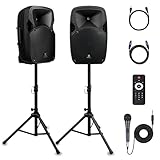


Top 3 picks at a glance
Quick recommendations
- Best all-around choice: Yamaha DXR12mkII, QSC K12.2, or RCF ART 912-A for strong output, clear vocals, and reliable event coverage.
- Best for home practice: a powered 10-inch speaker such as the QSC CP8 or Yamaha DBR10. They take up less space and are easier to keep at a sensible listening level.
- Best value for small events: Yamaha DBR12, Electro-Voice ZLX-12P G2, or JBL EON715.
- Best for larger rooms: a matched pair of 12-inch speakers, preferably with a subwoofer if dance music bass is important.
- Best club-style setup: two high-output 12-inch tops with one or two 15- or 18-inch powered subwoofers, rather than relying on large full-range tops alone.
What matters when choosing DJ speakers
Powered output: compare usable headroom, not just watts
Powered speakers include an amplifier, crossover, protection circuitry, and drivers in one cabinet. This is usually the simplest arrangement for a DJ because you connect the mixer or controller directly to the speakers and avoid matching a separate amplifier.
Watt figures are difficult to compare because manufacturers may quote peak, program, or continuous power. Maximum SPL, measured in decibels, is more useful for estimating loudness, while DSP limiters and distortion determine how pleasant the speaker remains near its limit. A cabinet rated around 125–132 dB maximum SPL generally offers adequate headroom for small and medium events, but the real result depends on room size, audience absorption, music style, and speaker placement.
Do not run a speaker at its limiter continuously. A speaker with 3–6 dB of unused headroom will sound cleaner and handle sudden kick-drum peaks better than a smaller speaker operated at full output.
Woofer size: bass extension versus portability
- 8-inch: compact and suitable for desktop practice, speech, and low-volume monitoring. It usually needs a subwoofer for convincing dance music.
- 10-inch: a good home-practice and small-room size. It is lighter and often clearer in the midrange than a larger cabinet, but has less low-end authority.
- 12-inch: the most flexible size for DJs. It provides useful bass output, enough volume for many private events, and remains manageable for one person.
- 15-inch: can produce more low-mid energy, but it is not automatically deeper or clearer. A 15-inch top may be heavier and slower to deploy, and a 12-inch top paired with a dedicated subwoofer is often the better live system.
Dispersion determines room coverage
Most DJ tops use a horn with approximately 90-degree horizontal coverage and 50–60-degree vertical coverage. A wider pattern helps cover a broad audience from a short distance, while a narrower pattern can project farther and reduce sound hitting side walls.
Place the horns above head height—typically with the horn about 30–60 cm above the tallest audience member—and angle the speakers slightly downward. If the speakers are on the floor, people close to the cabinet may hear excessive bass while those farther away hear a dull, quieter mix. Stand-mounted speakers also reduce the risk of blocking the high frequencies with the crowd.
Inputs and control features
For a basic DJ system, look for balanced XLR/TRS combination inputs, an XLR mix output, a gain control, and selectable line or microphone sensitivity. Two independent inputs are useful if you want to connect a controller and microphone without an additional mixer.
Bluetooth is convenient for background music but should not be the primary connection for a performance. Wireless links can introduce latency, pairing problems, or unwanted volume changes. DSP presets, high-pass filters, input sensitivity switches, and pole-mount sockets are more important for dependable event use. Some models also offer app control or digital mixing, which is useful when the speaker is mounted out of reach.
Head-to-head comparison of popular powered DJ speakers
| Model | Woofer | Published maximum SPL | Dispersion | Useful strengths | Typical market range |
|---|---|---|---|---|---|
| Yamaha DBR10 | 10-inch | 129 dB | 90° × 60° | Lightweight, simple controls, good for practice and small rooms | Usually $350–$500 |
| Electro-Voice ZLX-12P G2 | 12-inch | 127 dB | 90° × 60° | DSP features, useful input options, strong general-purpose value | Usually $500–$700 |
| Yamaha DBR12 | 12-inch | 131 dB | 90° × 60° | Good output-to-weight balance and straightforward operation | Usually $550–$750 |
| JBL EON715 | 15-inch | 128 dB | 100° × 60° | Broad coverage, app control, larger low-mid presentation | Usually $650–$900 |
| QSC K12.2 | 12-inch | 132 dB | 75° conical | High headroom, detailed DSP, suitable for demanding event work | Usually $900–$1,200 |
| Yamaha DXR12mkII | 12-inch | 134 dB | 90° × 60° | Very strong output and projection for a full-range top | Usually $1,000–$1,300 |
| RCF ART 912-A | 12-inch | 130 dB | 100° × 60° | Powerful output, wide coverage, compact professional enclosure | Usually $900–$1,200 |
Published SPL figures are not measured under one universal standard, so use them as a guide rather than a laboratory ranking. The DBR12, ZLX-12P G2, and EON715 are sensible choices for mobile DJs working within modest budgets. The K12.2, DXR12mkII, and ART 912-A provide more headroom for louder events and larger spaces, though their higher cost and weight may be unnecessary in a bedroom or small studio.
Match the speaker to your room and event
| Situation | Recommended setup | Why it works | What to avoid |
|---|---|---|---|
| Bedroom or office practice | One 8- or 10-inch powered speaker, or headphones | Enough level without overwhelming the room; easy placement | Large 15-inch tops run close to the wall |
| Small house party, up to about 40 people | One or two 10-inch speakers | Portable and capable of clear vocals and moderate dance volume | Expecting deep sub-bass from tops alone |
| Private event, about 40–100 people | Pair of 12-inch powered speakers | Better stereo width, coverage, and headroom | Using one speaker in a wide room with people behind it |
| 100–200-person dance event | Pair of high-output 12-inch tops plus one or two powered subs | Separates vocal/high-frequency projection from bass duty | Boosting bass heavily on full-range tops |
| Club or regular professional work | Matched 12-inch tops with 15- or 18-inch subs | More headroom, controlled crossover, and less strain on the tops | Mixing unrelated speakers with different tonal balance |
A practical power and coverage calculation
Suppose a small event has 80 guests in a rectangular room 12 metres deep. You want an average level of about 95 dB at the audience, with approximately 6 dB of headroom for kick and bass transients. That means the system should reach about 101 dB at the farthest listening position without operating at its limit.
Sound level falls by roughly 6 dB every time the distance doubles in free field. If a speaker produces 126 dB at 1 metre, the theoretical level is about 108 dB at 8 metres: 126 minus 18 dB for three distance doublings. Room reflections change this result, but the calculation shows why a speaker rated around 126 dB can cover a modest event with useful headroom, while a low-output practice monitor may run out of capacity.
For this room, a pair of 12-inch speakers is preferable to one 15-inch cabinet because two positions improve left-to-right coverage and let each speaker work less hard. If the audience expects strong bass, add a subwoofer and engage the tops’ high-pass filter around 90–110 Hz, depending on the manufacturer’s recommended crossover. This gives the tops more headroom instead of asking their woofer to reproduce the deepest bass and the vocal range simultaneously.
Setup settings that improve results
- Start the speaker gain near unity or the marked line-level position. This preserves input headroom and reduces the temptation to run a noisy controller output at its maximum.
- Set the controller master around -6 dB. Leave room for sudden track changes and microphone peaks.
- High-pass the microphone around 80–120 Hz. This removes handling noise and stage rumble without thinning normal speech.
- Use a high-pass filter on tops at roughly 90–110 Hz when a subwoofer is connected. The exact value should match the subwoofer’s crossover setting.
- Keep bass EQ boosts modest. A 6 dB boost requires roughly four times the amplifier power in that frequency band, quickly consuming headroom.
- Walk the room before the audience arrives. Check the front, middle, rear, and side walls. If the front is painfully loud while the rear is quiet, raise and re-aim the speakers rather than simply increasing volume.
Which size should you buy?
Choose 10-inch speakers if your priority is home practice, bedroom production, mobile convenience, or small acoustic spaces. Choose 12-inch speakers if you want one pair to handle practice, parties, speeches, and regular small events. Choose 15-inch speakers only when their extra low-mid output and broad cabinet format suit your venue; they are not a substitute for a subwoofer when deep club bass is the goal.
For the broadest buying decision, a pair of 12-inch powered speakers with balanced inputs, pole mounts, DSP protection, and a maximum SPL around 127–134 dB is the safest starting point. Add a matched subwoofer later if your events demand sustained low-frequency impact.
Frequently asked questions
Can I use Bluetooth as the main connection for DJing?
Bluetooth is better suited to background music than to a performance connection. The article notes that wireless links can introduce latency, pairing problems, or unwanted volume changes. For a basic DJ system, a wired balanced XLR/TRS connection from the controller or mixer is more dependable. Bluetooth can still be useful when convenience matters more than precise timing.
Should I buy one speaker or a pair for an event?
A pair is usually preferable for private events involving about 40–100 people because it improves stereo width, coverage, and headroom. For a small house party with up to about 40 people, one or two 10-inch speakers may be sufficient. In a wide room, avoid relying on one speaker because some people may be positioned behind it.
Do I need a subwoofer with powered DJ speakers?
You need a subwoofer when strong or convincing dance-music bass is important, especially in a larger event or club-style setup. A pair of 12-inch tops with one or two powered 15- or 18-inch subs can reduce strain on the tops. Without a subwoofer, avoid expecting deep sub-bass from compact full-range speakers.
Where should powered DJ speakers be positioned?
Place the speakers on stands with the horns about 30–60 cm above the tallest audience member, then angle them slightly downward. This helps prevent the crowd from blocking high frequencies and provides more even coverage. Floor placement can make nearby listeners hear excessive bass while people farther away hear a duller, quieter mix.
How much headroom should I leave when operating DJ speakers?
Leave about 3–6 dB of unused headroom rather than running the speaker continuously at its limiter. Headroom helps the system handle sudden kick-drum and bass peaks with less distortion. The article also recommends setting the controller master around -6 dB and starting the speaker gain near unity or its marked line-level position.


