
Top 3 picks at a glance
Best Karaoke Speakers for Clear, Powerful Vocals
The best karaoke speakers for most home setups are powered PA speakers with a 10- or 12-inch woofer, a dedicated microphone input, and separate controls for mic level and echo; choose a 10-inch model for a small room and a 12-inch model when you need more bass or headroom. For vocals that stay clear at higher volume, prioritize feedback-resistant positioning and usable microphone connections over headline wattage.
What to measure before choosing
Speaker specifications rarely describe how a karaoke system will sound in your room. Use these practical checks to match the speaker to your singers, microphone, and audience:
As an Amazon Associate we earn from qualifying purchases at no extra cost to you.


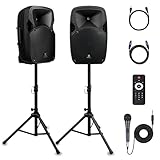

- Vocal clarity: Look for a powered PA speaker with a vocal-friendly sound mode or equalizer. A 10- or 12-inch woofer paired with a high-frequency driver is a useful starting point; the crossover and tuning matter more than woofer size alone. You want consonants to remain distinct when music is playing, not merely a loud vocal.
- Bass output: A larger woofer generally has more low-frequency authority, but room placement and cabinet design also matter. A 12-inch speaker is usually the better fit for dance tracks and fuller backing music. Avoid turning up bass to compensate for a weak mix: it can mask vocals and trigger limiting.
- Maximum volume: A published peak-watt figure does not tell you how loud the speaker can play cleanly. Compare maximum SPL ratings when available, and leave headroom. A speaker that sounds strained, harsh, or heavily compressed is already past a useful karaoke level.
- Microphone compatibility: Check whether the speaker has an XLR or quarter-inch mic input, phantom power if you plan to use a condenser microphone, and independent microphone and music controls. A wireless microphone system may require its receiver’s line output to connect to the speaker.
- Feedback resistance: This depends as much on placement and microphone technique as on the speaker. Feedback can occur when a microphone picks up amplified sound and sends it through the system again. A feedback-suppression feature may help, but it cannot fix a microphone pointed straight at a speaker.
- Room-size suitability: For a small living room, one well-positioned speaker is often enough. Larger rooms, outdoor gatherings, or audiences spread across a wide area may need a second speaker or a more capable PA system.
Match the setup to the room
| Use case | Good starting point | Volume target | Connection to prioritize |
|---|---|---|---|
| Bedroom or small living room, up to about 20 m² | One powered 8- or 10-inch PA speaker | About 75–90 dB at the audience | Mic input with separate mic and music level |
| Living room or party room, about 20–45 m² | One powered 10- or 12-inch PA speaker | About 85–95 dB at the audience | Two mic inputs or a small mixer |
| Large room, roughly 45–90 m² | Pair of powered 10- or 12-inch PA speakers | About 90–100 dB, with headroom | Balanced XLR or line connections between components |
| Outdoor gathering | Pair of PA speakers; consider a subwoofer for bass-heavy music | Depends on crowd size and distance | Reliable power, protected cabling, and wireless-mic receiver compatibility |
These are planning ranges, not guaranteed coverage figures. Room shape, background noise, speaker placement, and how far listeners stand from the speaker all change the result. Outdoors, sound disperses without walls to reflect it, so a setup that feels ample indoors may seem weak outside.
Power and placement: a practical example
Suppose a party is in a 30 m² room and the audience is roughly 4 meters from the speaker. Aiming for around 90 dB at the audience is a reasonable starting target for lively karaoke, though it may be too loud for some homes. Sound level drops by about 6 dB each time the distance doubles in an open field. Going from 1 meter to 4 meters is two doublings, so the speaker needs about 12 dB more output at 1 meter than the level you want at the audience: approximately 102 dB at 1 meter.
This estimate is not a substitute for a speaker’s measured maximum SPL: rooms reflect sound, while music peaks and speaker compression complicate the calculation. It does explain why choosing solely by amplifier wattage is unreliable. Pick a powered speaker with comfortable SPL headroom, then run it below its harsh or distorted limit.
Place the speaker in front of the singers and point it toward the audience. Keep microphones behind the speaker’s front face, aimed away from it. Raising the speaker so the high-frequency driver is near ear level can improve clarity for listeners without forcing you to increase the volume.
Product types worth considering
Portable PA speakers with built-in mixing
These are the most convenient choice for a typical home karaoke setup. Models such as the JBL EON710 and Yamaha DBR10 are real powered PA speakers in the 10-inch class; verify the exact input and processing features on the version you are considering. A built-in mixer or mic input reduces extra equipment, while a separate wireless-microphone receiver gives you more flexibility in microphone choice. Expect roughly $300–$700 for many capable single-speaker options, depending on features and configuration.
Compact speakers for small rooms
An 8- or 10-inch powered speaker can be a better buy than a larger cabinet if the audience is close and the room is modest. Smaller speakers are easier to place and can sound clear at conversational party levels. Their limitation is headroom: bass-heavy backing tracks and a loud group may push them toward distortion sooner. Prices commonly range from about $200–$500 for this class.
Pairs of PA speakers for wider coverage
A matched pair can spread vocals and music more evenly across a wide room than one speaker turned up very loud. Connect them using the manufacturer’s recommended outputs or a mixer, and avoid placing them so close together that the coverage overlaps unpredictably. A pair of 10- or 12-inch speakers typically costs more and takes up more space, but is a stronger fit for large gatherings.
PA speaker plus subwoofer
Add a subwoofer when low-end impact is a priority and the main speakers have suitable high-pass filtering or crossover support. It is usually unnecessary for casual singing in a small room. Poorly balanced bass can make lyrics harder to understand, so set the subwoofer level conservatively and reduce it if vocals lose definition.
Microphone compatibility and feedback
For the simplest setup, connect a dynamic microphone directly to a speaker’s mic input. If you need two or more microphones, use a mixer or a speaker with enough independent mic channels. Wireless systems connect through their receiver; check whether its output is mic-level or line-level and use the corresponding input to avoid a signal that is too quiet or too hot. Phantom power is needed for many condenser mics, but not for typical dynamic karaoke mics.
If you hear a sustained ringing or howl, lower the mic or master level first. Then move the microphone behind the speaker, turn its capsule away from the speaker, and ask singers to avoid cupping the grille. If the system has an equalizer, make small cuts in the frequency band that rings rather than boosting other bands. Feedback suppression can reduce problem frequencies, but aggressive processing may make vocals sound unnatural.
A quick buying decision
- Choose one 8- or 10-inch powered speaker for a small room, one or two microphones, and moderate volume.
- Choose a 10- or 12-inch powered speaker for a typical living-room party where vocals must compete with backing tracks.
- Choose two matched PA speakers if listeners are spread across a large room or you need even coverage without pushing one cabinet to its limit.
- Add a subwoofer for bass-heavy music or an outdoor event, not simply because a larger system seems more powerful.
- Choose a mixer or multi-channel speaker when you need several microphones, independent singer levels, or more control over tone and effects.
Before buying, confirm the microphone inputs, wireless receiver connection, and control layout—not just the speaker’s advertised wattage. A properly placed powered PA speaker with enough clean headroom will usually deliver clearer karaoke vocals than an oversized system run with the microphone too close to the speaker or the bass turned up too high.
Frequently asked questions
Do I need a mixer for a home karaoke setup?
You do not necessarily need a mixer for a simple home setup. A dynamic microphone can connect directly to a speaker’s microphone input, while a built-in mixer or independent microphone controls may provide enough adjustment. Use a mixer when you need several microphones, independent singer levels, or more control over tone and effects.
Can I use wireless microphones with a powered PA speaker?
Yes, a wireless microphone system can work with a powered PA speaker through its receiver. Check whether the receiver’s output is mic-level or line-level, then use the corresponding speaker input. A separate receiver also gives you more flexibility in microphone choice, but the speaker must have a compatible connection.
Where should I place the speaker to make vocals clearer?
Place the speaker in front of the singers and aim it toward the audience. Keep the microphones behind the speaker’s front face and pointed away from it. Raising the speaker so its high-frequency driver is near ear level can improve clarity, while avoiding a microphone pointed directly at the speaker helps reduce feedback.
Is a subwoofer necessary for karaoke?
A subwoofer is usually unnecessary for casual singing in a small room. Consider one when low-end impact is a priority, for bass-heavy music, or for an outdoor event. The main speakers should support suitable high-pass filtering or crossover control, and the subwoofer level should remain conservative so bass does not mask the lyrics.
Why is advertised wattage not enough to choose a karaoke speaker?
Advertised wattage does not show how loudly a speaker can play cleanly. Maximum SPL ratings, when available, are more useful, along with the speaker’s headroom and behavior at higher volume. A speaker that sounds strained, harsh, or heavily compressed has passed a useful karaoke level, regardless of its headline amplifier rating.


