
The best powered mixers for live sound and small venues are the Yamaha EMX7 for dependable general-purpose work, the Yamaha EMX5 for compact two-speaker systems, and the Behringer Europower PMP6000 when you need many channels and more routing flexibility.
As an Amazon Associate we earn from qualifying purchases at no extra cost to you.

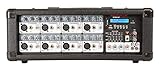

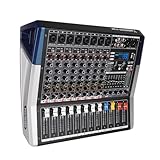
Top 3 picks at a glance
Best powered mixers at a glance
| Model | Amplifier output | Inputs and channels | Best use | Main limitation |
|---|---|---|---|---|
| Yamaha EMX2 | 500 W + 500 W at 4 ohms | 10 input channels | Small acoustic acts, speech, rehearsals | Basic effects and limited routing |
| Yamaha EMX5 | 630 W + 630 W at 4 ohms | 12 input channels | Small bands and mobile PA systems | Fewer advanced control options than a larger console |
| Yamaha EMX7 | 710 W + 710 W at 4 ohms | 12 input channels | Versatile live sound and small venues | Costs more than entry-level powered mixers |
| Behringer Europower PMP6000 | Up to 1,600 W per channel at 4 ohms, shared system limits apply | 16 input channels | Large input lists, monitors, and budget installations | More complicated gain and routing workflow |
| Peavey XR8600D | Up to 600 W per channel at 4 ohms | Eight input channels | Rugged speech, bands, and straightforward PA setups | Less flexible than newer digital mixers |
Published output figures are maximum amplifier ratings, not a promise of clean volume in every installation. Speaker impedance, power supply limits, heat, crest factor, and the mixer’s total power budget all affect usable output.
How to choose the right powered mixer
1. Count channels with future expansion included
Count every microphone, instrument, playback source, and monitor-related input before choosing a mixer. A four-piece band might need four vocal microphones, kick drum, snare, stereo keyboard, guitar, bass DI, and playback. That is already 11 sources, before adding a spare microphone or a second keyboard.
For that setup, a compact six- or eight-channel mixer is too small even if the current show can be made to work. Choose at least 12 input channels, and preferably 16 if the mixer will serve different acts. The EMX5 and EMX7 suit modest bands, while the PMP6000 is the better fit for larger input lists.
- Speech or solo performer: 4–6 input channels is usually enough.
- Duo, trio, or acoustic group: 6–10 channels gives useful headroom.
- Four-piece band: 10–14 channels is a practical target.
- Small venue with several acts: 16 channels reduces repatching between sets.
2. Match amplifier power to the speakers
Most powered mixers drive two passive speakers, commonly at 8 ohms each. Connecting one 8-ohm speaker to each output normally gives less power than connecting one 4-ohm load to each channel. Adding a second 8-ohm speaker in parallel changes the load to 4 ohms, but it also increases the demand on the amplifier and cables.
As a practical example, suppose a powered mixer produces 500 watts per channel into 4 ohms. With one 8-ohm speaker connected to each channel, the available rating may be closer to 300–350 watts per channel. If each speaker is rated for 400 watts continuous, that is a sensible pairing: the mixer can provide useful headroom without requiring the speakers to absorb the full maximum figure continuously.
Avoid treating “1,000 watts” on the front panel as a complete system specification. Check whether it means total output, peak output, or power shared between channels. Also check the speaker’s continuous or program rating rather than matching only its peak rating.
3. Confirm speaker impedance and connectors
Before buying, verify that the mixer supports the speaker impedance you intend to use. Many powered mixers use speakON outputs; some use 1/4-inch speaker outputs, and some provide both. Do not use ordinary instrument or unbalanced patch cables to carry high-power speaker output. Use proper speaker cable with the correct connector.
Passive speakers are the normal match. Do not connect powered speakers to an amplifier output, because the powered speaker already contains an amplifier. Use a line-level output, monitor output, or suitable signal output instead, and confirm its level before connecting.
Head-to-head: the leading choices
Yamaha EMX7: best all-rounder
The EMX7 is a strong choice when reliability, simple operation, and enough power for small venues matter more than extensive digital features. Its two-channel amplifier can deliver up to 710 watts per channel into 4-ohm loads, and it provides a useful collection of microphone and line inputs for bands, presenters, and community venues.
Its onboard effects are appropriate for vocals and announcements, while the graphic equalizer helps control room boom or feedback. The workflow is easy to understand: set input gain, adjust channel levels, shape the overall mix, and use the powered outputs for passive speakers.
Choose the EMX7 when one operator needs to get a show running quickly and the system will not require elaborate monitor mixes or complex signal routing.
Yamaha EMX5: best for compact bands
The EMX5 provides up to 630 watts per channel into 4 ohms and keeps the control layout relatively uncomplicated. It is a good middle ground for a duo, trio, acoustic band, or small function room that needs more than a basic karaoke-style mixer.
It is preferable to the EMX2 when additional inputs and greater output headroom are important, but the larger EMX7’s extra flexibility is unnecessary. Its main trade-off is that you should not expect the same number of routing and control options found on larger mixers.
Yamaha EMX2: best for simple portable systems
The EMX2 is suited to speech, solo performers, small acoustic groups, and rehearsal spaces. Its two-channel amplifier is rated at up to 500 watts per channel into 4 ohms, but its real advantage is low setup complexity rather than maximum output.
Choose it when the system has only a few sources and you value fast setup. Do not choose it for a fully miked drum kit, multiple monitor mixes, or several simultaneous performers.
Behringer Europower PMP6000: best for channel count
The PMP6000 is designed for users who need many inputs, more extensive routing, and a larger feature set at a comparatively modest market cost. Its amplifier section is powerful enough for demanding small-venue systems, but that power makes speaker matching and gain structure especially important.
It is a better fit than the Yamaha models for a venue that regularly handles multiple microphones, keyboards, playback devices, monitors, or several performers. The trade-off is a denser control panel and a greater chance of routing mistakes during a rushed setup.
Peavey XR8600D: best for straightforward installed or mobile use
The XR8600D offers a simple two-channel powered-mixer approach with up to 600 watts per channel into 4-ohm loads. It suits speech systems and small bands that want conventional controls and substantial output without relying on a touchscreen or computer.
Its simpler signal architecture can be an advantage for volunteers and community venues. However, buyers needing detailed feedback tools, multiple independent monitor mixes, or modern recording and USB features should consider a newer mixer design.
EQ, effects, and feedback control
Channel EQ is more useful than an impressive effects list. At minimum, look for a high-pass filter on vocal channels, a midrange control, and a main graphic equalizer. A high-pass filter around 80–120 Hz can remove stage rumble and microphone-handling noise from speech and vocals. For a thin vocal, reduce the filter frequency or leave it bypassed rather than boosting excessive low end.
Use effects sparingly in small rooms. Start with a short vocal reverb around 1.2–1.8 seconds and keep the effects return low enough that the words remain clear. Long reverb times can make a reflective room sound louder while reducing intelligibility.
Feedback is usually fixed more effectively by placement and narrow cuts than by turning down the entire system:
- Move the main speakers in front of the microphones and aim them away from the rear of the microphone capsules.
- Set channel gain so normal speech or singing peaks around the mixer’s nominal level, leaving several decibels of headroom.
- Raise the master level until the system approaches feedback.
- Use the graphic EQ to cut the narrow frequency band that rings, often by 2–4 dB at a time.
- Reduce monitor level or reposition the monitor before applying deep EQ cuts.
Do not solve feedback by boosting every frequency that sounds quiet. Large boosts consume amplifier headroom and make the next feedback frequency more likely.
Decision matrix
| Your situation | Recommended class | Why |
|---|---|---|
| Two microphones and background music | Compact 4–6 channel unit, such as EMX2 | Lower setup complexity and enough input capacity |
| Acoustic trio using two passive 8-ohm speakers | 500–700 W per channel at 4 ohms | Provides practical headroom without excessive size |
| Four-piece band with 10 or more sources | 12–16 channel powered mixer, such as EMX7 or PMP6000 | Prevents input shortages and repeated repatching |
| Separate vocal and instrument monitor mixes | Model with dedicated monitor or auxiliary outputs | Main speaker power alone does not create independent monitor control |
| Powered speakers already in use | Unpowered mixer instead of a powered mixer | Avoids sending amplified output into an active speaker input |
Setup checklist for a small venue
- Confirm speaker impedance and connect only compatible passive speakers to the power outputs.
- Put speakers ahead of microphones and keep microphones behind the main speaker coverage.
- Turn channel gains down before connecting sources.
- Enable high-pass filtering on vocals and speech where low-frequency noise is not needed.
- Set the main EQ flat first; make small cuts only after listening from the audience area.
- Test the loudest expected vocal or instrument before the audience arrives.
- Leave amplifier and mixer ventilation unobstructed, especially when operating near the published load limit.
Price and value
Compact powered mixers generally fall around $300–$600, midrange 12-channel models commonly sit around $500–$900, and higher-output or larger-channel systems can reach roughly $900–$1,500. Prices vary by region and included accessories. Spending more for extra wattage is less valuable than buying enough channels, appropriate speaker compatibility, and the monitor outputs your venue actually needs.
For most small live systems, the Yamaha EMX7 is the safest balanced recommendation. Choose the EMX5 or EMX2 when simplicity and portability take priority, and choose the Behringer PMP6000 when channel count and routing flexibility matter more than an uncluttered control panel.
Frequently asked questions
Can I connect powered speakers to a powered mixer?
No, do not connect powered speakers to an amplifier output. Powered speakers already contain an amplifier, so use a line-level output, monitor output, or another suitable signal output from the mixer instead. Confirm the output level before connecting, and use the mixer’s powered outputs only with compatible passive speakers.
How many channels do I need for a four-piece band?
A four-piece band usually needs 10–14 input channels, depending on the instruments and microphones involved. Four vocal microphones, kick drum, snare, stereo keyboard, guitar, bass DI, and playback already total 11 sources. Include a spare microphone or another keyboard when choosing a mixer for different acts or future expansion.
What type of cable should connect a powered mixer to passive speakers?
Use proper speaker cable with the correct connector, such as speakON or 1/4-inch speaker connections when supported by the mixer. Do not use ordinary instrument or unbalanced patch cables for high-power speaker output. Also verify that the mixer supports the speaker impedance you intend to use before connecting the system.
What happens when I connect two 8-ohm speakers to one amplifier channel?
Connecting two 8-ohm speakers in parallel changes the load to 4 ohms. This can allow the amplifier to deliver more power, but it also increases demand on the amplifier and cables. Check the mixer’s supported impedance and total power limits, and do not treat the maximum front-panel wattage as guaranteed clean output.
Is onboard reverb important for a small venue?
Onboard reverb can be useful for vocals and announcements, but channel EQ and feedback control are more important than an impressive effects list. Start with a short vocal reverb around 1.2–1.8 seconds and keep the effects return low enough for clear words. Long reverb times can reduce intelligibility in reflective rooms.


