
Top 3 picks at a glance

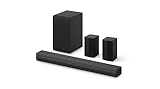
Best Surround Sound Speakers for Immersive Home Theater
The best surround sound speakers depend on your room more than on any single brand: use compact, wall-friendly speakers in small rooms, a matched center channel for clear dialogue, and a properly integrated subwoofer before spending more on flagship towers.
Choose the layout before choosing the speakers
Most home theaters fall into one of three practical layouts. The numbers describe the main speaker channels, followed by subwoofers where applicable.
As an Amazon Associate we earn from qualifying purchases at no extra cost to you.

| Room and seating situation | Recommended layout | Speaker design | Why it works |
|---|---|---|---|
| Small room, sofa against or near the rear wall | 5.1 | Compact bookshelf or satellite speakers | Fewer channels avoid cramped rear placement and keep setup manageable |
| Medium room, seating at least 1 m from the rear wall | 5.1.2 or 7.1 | Bookshelf speakers, a dedicated center, and either height or rear channels | Provides a larger soundstage without demanding a full cinema installation |
| Large room, multiple rows or open-plan space | 7.1.4 or 5.1.4 | Matched floorstanders or high-output bookshelf speakers with multiple subwoofers | Improves coverage, bass consistency, and overhead movement across the seating area |
A 5.1 system has left, center, right, surround-left, surround-right, and one subwoofer. A 5.1.2 system adds two height channels. Dolby Atmos can use more channels, but additional speakers help only when their positions are practical. Installing four height speakers in a low-ceiling room with poor separation may produce less convincing overhead effects than two correctly placed speakers.
Best speaker types for each room size
Small rooms: compact bookshelf or satellite speakers
For rooms below roughly 15 square meters, large floorstanding speakers can dominate the space and make placement difficult. Compact models such as the Q Acoustics 3010i, Polk Audio Signature Elite ES15, ELAC Debut 2.0 B6.2, or KEF Q350 are more appropriate choices, depending on the available width and amplifier power.
Use a dedicated center channel whenever possible. A speaker such as the Q Acoustics 3090Ci, Polk Audio Signature Elite ES35, or KEF Q650c can improve dialogue substantially, but the center should be from the same product family as the left and right speakers. Matching the front three reduces changes in vocal tone as a sound moves across the screen.
In a small room, place the surround speakers slightly behind the listening position and approximately 30–60 cm above seated ear level. If the sofa touches the back wall, use low-profile wall-mounted speakers or move the sofa forward if possible. A speaker directly beside a listener can sound distracting even when its specifications look impressive.
Medium rooms: bookshelf speakers or slim floorstanders
Rooms of approximately 15–30 square meters benefit from speakers with greater output and a little more bass extension. The KEF Q Series, Polk Audio Reserve range, ELAC Debut 2.0 range, and Klipsch Reference Premiere range include suitable bookshelf, center, and surround options.
Floorstanding speakers are useful when the front left and right speakers must play louder or cover a larger listening area. They are not automatically better for movies, however. A well-positioned bookshelf pair crossed to a capable subwoofer can deliver cleaner dialogue and more consistent bass than oversized towers placed too close to a wall.
For a 5.1.2 system, place the two height speakers in or just in front of the listening position rather than directly above the front speakers. In-ceiling speakers provide the most convincing vertical image. Up-firing modules are easier to install, but they need a reasonably flat, reflective ceiling and a clear path between the module and ceiling.
Large rooms: high-output speakers and two subwoofers
In rooms above about 30 square meters, prioritize output capability, controlled directivity, and bass distribution. Floorstanders such as models from the Klipsch Reference Premiere, Polk Reserve, or KEF Q ranges can provide useful headroom, while matching bookshelf speakers may be preferable for side and rear channels.
A second subwoofer is often a better upgrade than replacing good main speakers. Room modes create peaks and nulls: one seat may have excessive bass while another has almost none. Two subs placed on opposing walls, or at the front and rear of the room, can smooth those differences when calibrated properly.
Dialogue clarity, surround imaging, and bass integration
Dialogue clarity
The center channel handles most movie and television dialogue, so its position matters as much as its model. Place it directly below or above the display, aimed toward ear height, with the front edge flush with the cabinet. Do not hide it inside a deep shelf, where reflections can make voices sound muffled or hollow.
If speech is difficult to understand, first check the center level and listening mode. A useful starting point is to raise the center channel by 1–2 dB, then enable a moderate dialogue-enhancement setting if your receiver provides one. Excessive enhancement can make voices thin and can reveal compression artifacts.
Surround imaging
Surround imaging depends on placement, dispersion, and level matching. Wide-dispersion bookshelf speakers can make the rear field feel more enveloping, while controlled-directivity speakers can reduce reflections in a bright room. Bipolar or dipolar surround designs can create a diffuse field, but direct-radiating speakers are generally easier to position and more predictable with modern object-based formats.
Keep the left and right speakers symmetrical around the screen and angle them toward the main seat. Aim the surround speakers across the room rather than directly at the listener if effects sound too sharp. Set every speaker to “Small” in the receiver, even if the front speakers are floorstanders, unless you have a specific reason to run them full range.
Subwoofer integration
Set the crossover around 80 Hz as a starting point. Smaller satellites may work better at 100–120 Hz, while larger bookshelf speakers can sometimes use 60–80 Hz. The correct value is the point where the subwoofer supports the main speakers without sounding localizable.
Here is a practical power calculation. Suppose a receiver is rated at 100 watts per channel into eight ohms, but the system uses five channels simultaneously. If shared power supply limitations reduce real multichannel output to about 65 watts per channel, the available amplifier power is approximately:
5 × 65 W = 325 W total
That is usually ample for compact or medium-efficiency speakers in a medium room, especially because the subwoofer handles the deepest bass. In a large room, speakers rated around 90 dB sensitivity will need less amplifier power for the same volume than speakers rated around 84 dB. Avoid choosing an amplifier solely by its two-channel headline rating; check its multichannel performance and impedance compatibility.
Wired, wireless, and installation-focused choices
A traditional AV receiver with passive speakers gives the most flexibility. Receivers from Denon, Yamaha, Onkyo, and Sony commonly provide room correction, HDMI eARC, subwoofer management, and support for Dolby Atmos. This approach requires speaker cable, an equipment cabinet, and time to configure distances, levels, and crossover points.
Powered systems are simpler. The Sonos Arc Ultra with Era 300 surround speakers and Sub 4 is a compact wireless-oriented option for people who want minimal cabling and a unified app. It is especially attractive when running cable to rear speakers is difficult. Its trade-offs include dependence on the platform, fewer conventional upgrade paths, and less receiver-level control than a separates system.
Soundbars with wireless surrounds suit apartments and rented spaces, but a separate center channel and wider front speakers generally create a more stable dialogue image. If you cannot place speakers beside or behind the seating position, a soundbar may be the more coherent choice rather than an incorrectly positioned 5.1 package.
Decision matrix: match the system to your situation
| Your priority | Best-fit system | What to buy first | Main compromise |
|---|---|---|---|
| Small room and low visual impact | Compact 5.1 system | Matched center, compact fronts, and an 8–10 inch subwoofer | Less maximum output and smaller front soundstage |
| Clear voices for television and films | Receiver-based 5.1 | Center speaker and correct placement | More cabling and configuration |
| Immersive overhead effects | 5.1.2 or 5.1.4 Atmos | Ceiling or correctly placed height speakers | Installation difficulty and ceiling constraints |
| Large open-plan room | High-sensitivity 5.1.4 or 7.1.4 | Two subwoofers and an AV receiver with sufficient processing | Higher cost, more cable, and greater placement demands |
| Minimal installation | Wireless surround platform | Soundbar, compatible surrounds, and subwoofer | Less component-level flexibility |
A reliable setup sequence
- Place the screen and seating first. Speaker positions should follow the viewing position, not the room’s unused corners.
- Align the front three speakers. Keep the center close to the display and the left and right speakers at similar distances from the main seat.
- Add the subwoofer before final calibration. Try the front wall, a front corner, and the midpoint of a side wall; choose the position with the smoothest bass at the seating area.
- Set speakers to Small and choose an initial 80 Hz crossover. Adjust upward for tiny speakers or downward only when the mains remain clean and the bass does not become directional.
- Run room correction, then verify it manually. Confirm that distances are plausible, speaker sizes are correct, and the subwoofer phase has not been set incorrectly.
- Check real content at moderate volume. Listen for voices moving between the center and front speakers, bass notes that disappear at one seat, and surround effects that pull attention toward a single speaker.
For most buyers, the strongest all-around route is a matched 5.1 system with a dedicated center and a capable subwoofer. Add two height channels when the room permits it, and consider a second subwoofer before replacing speakers that already produce clean, balanced sound. That combination delivers more audible immersion than paying for oversized speakers that cannot be positioned correctly.
Frequently asked questions
Should the left, center, and right speakers come from the same product family?
Yes, the front three should ideally come from the same product family. Matching them reduces changes in vocal tone as sound moves across the screen. Use a dedicated center channel whenever possible, and place it directly below or above the display, aimed toward ear height, with its front edge flush with the cabinet. Do not hide it inside a deep shelf.
Are floorstanding speakers always better than bookshelf speakers for movies?
No, floorstanding speakers are not automatically better for movies. They are useful when the front left and right speakers must play louder or cover a larger listening area. However, a well-positioned bookshelf pair crossed to a capable subwoofer can provide cleaner dialogue and more consistent bass than oversized towers placed too close to a wall.
Where should surround speakers go if the sofa is against the rear wall?
Place the surround speakers slightly behind the listening position and approximately 30–60 cm above seated ear level, but move the sofa forward if possible. If it touches the back wall, use low-profile wall-mounted speakers. A speaker directly beside a listener can sound distracting, even when its specifications look impressive. Fewer channels may also be more practical in this situation.
What should I adjust first if movie dialogue is difficult to understand?
First check the center-channel level and listening mode. A useful starting point is to raise the center channel by 1–2 dB, then enable a moderate dialogue-enhancement setting if the receiver provides one. Excessive enhancement can make voices thin and reveal compression artifacts. Also confirm that the center speaker is directly below or above the display and is not hidden inside a deep shelf.
Do I need four height speakers for convincing Dolby Atmos effects?
No, four height speakers are not always necessary for convincing Dolby Atmos effects. Additional speakers help only when their positions are practical. In a low-ceiling room with poor separation, four height speakers may produce less convincing overhead effects than two correctly placed speakers. For a 5.1.2 system, place the two height speakers in or just in front of the listening position.


