
The best wireless home sound systems for most people are a soundbar-and-subwoofer package for simple TV upgrades, a modular Sonos setup for flexible whole-home audio, or a dedicated wireless surround system such as Sony BRAVIA Theater Quad when movie immersion matters more than minimal hardware.
As an Amazon Associate we earn from qualifying purchases at no extra cost to you.


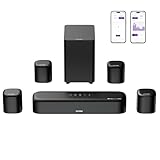
Top 3 picks at a glance
Quick recommendations by room and priority
| Your situation | Best layout | Suitable system class | Typical budget |
|---|---|---|---|
| Small bedroom or apartment | Soundbar alone, or soundbar plus compact subwoofer | Compact Dolby Atmos soundbar | Usually $250–$700 |
| Medium living room, easy installation | Soundbar, wireless subwoofer, optional rear speakers | Premium all-in-one surround package | Usually $600–$1,500 |
| Large open-plan room | Separate front, center, subwoofer, and rear channels | Modular wireless surround system | Usually $1,500–$3,000+ |
| Music across several rooms | Networked speakers in zones | Multiroom platform such as Sonos | Usually $400–$2,500+, depending on zones |
| Maximum movie immersion | Four or more discrete wireless speakers plus subwoofer | Spatial-audio system such as Sony BRAVIA Theater Quad | Usually $2,000–$3,500+ |
Choose the layout before choosing the brand
1. Soundbar only: the simplest option
A soundbar-only system is the right choice when the TV is in a small room, the sofa is close to a wall, or you do not want rear speakers and extra power cables. Models such as the Sonos Arc Ultra, Bose Smart Ultra Soundbar, and Sony BRAVIA Theater Bar 9 can create a wide virtual or reflected surround field while keeping installation simple.
This layout is less convincing when the room is very wide, the ceiling is unusually high, or the seating is far from the soundbar. Dolby Atmos height effects also depend on ceiling reflections, so a flat, moderately low ceiling generally works better than a vaulted or absorbent one.
2. Soundbar plus subwoofer: the best general-purpose layout
Adding a wireless subwoofer usually produces a larger improvement than moving from one premium soundbar to another. It handles bass that a slim bar cannot reproduce efficiently, giving explosions, orchestral music, and electronic tracks more physical weight without forcing the soundbar to work as hard.
The Sonos Arc Ultra with Sub 4 is a flexible example, while Bose systems can be expanded with a compatible Bass Module. Check compatibility by product generation: wireless subwoofers are not universally interchangeable, even when they use the same brand.
3. Soundbar, subwoofer, and rear speakers: the strongest value for movies
Rear speakers create a real change in sound placement. Effects can move behind the seating position rather than being simulated from the front wall. This layout is particularly effective for action films, live concerts, and games with directional audio.
Samsung’s Q-series surround packages, Bose systems with compatible Surround Speakers, and Sonos systems expanded with Era 100 or Era 300 speakers all fit this category. The trade-off is that each rear speaker still needs a nearby power outlet, despite receiving audio wirelessly.
4. Discrete wireless speakers: the premium option
Sony BRAVIA Theater Quad uses four separate speakers rather than placing every channel in one bar. That gives it more freedom to establish front width, side movement, and rear ambience, but it requires careful positioning and more visible hardware.
This layout is worth considering for a large dedicated viewing room. It is less suitable if furniture is frequently rearranged or if the television sits in an open-plan space where speaker placement is inconsistent.
Head-to-head: the main wireless system approaches
| Approach | Wireless connection | Strengths | Limitations | Upgrade flexibility |
|---|---|---|---|---|
| Soundbar package | Wi-Fi or proprietary link for subwoofer and rears | Fast setup, strong TV compatibility, compact footprint | Less precise than separate speakers; power still needed at every speaker | Low to medium |
| Sonos multiroom | Wi-Fi, with optional wired network connection | Excellent room-to-room control, easy expansion, broad music support | Limited to the Sonos ecosystem; TV audio depends on HDMI ARC/eARC | High within the platform |
| Dedicated wireless surround | Manufacturer-specific wireless network | More discrete channels and stronger cinematic placement | More setup, more outlets, fewer cross-brand combinations | Medium |
| Bluetooth speaker pair | Bluetooth, sometimes Wi-Fi | Affordable and convenient for music | Usually weak for lip-sync, surround formats, and TV control | Low |
Wireless does not mean cable-free
In most home theater systems, “wireless” means that audio travels between components without a long signal cable. The soundbar, subwoofer, and rear speakers still need electrical power. Before buying, mark the nearest outlet to each proposed speaker position.
For television compatibility, HDMI eARC is preferable to optical audio. eARC can carry higher-bandwidth formats and allows the TV remote to control volume more reliably. A television with only optical output can still work with many soundbars, but it may lose Dolby Atmos formats, advanced control features, or automatic audio switching.
Wi-Fi is usually better than Bluetooth for a home system. Wi-Fi supports multiroom playback, higher-quality streams, stable synchronization, and control from several devices. Bluetooth remains useful for a guest’s phone, but it can introduce latency and normally does not create a true surround system.
Room-size matching that actually matters
Room volume is more useful than floor area alone. A 20-square-metre room with a 2.4-metre ceiling is about 48 cubic metres, while the same floor area with a 4-metre ceiling is 80 cubic metres. The taller room needs more acoustic output and may deliver weaker reflected height effects.
| Approximate room volume | Recommended layout | Subwoofer guidance | Placement priority |
|---|---|---|---|
| Up to 35 m³ | Compact soundbar or soundbar plus small subwoofer | Compact sub is normally sufficient | Keep the bar centered and near the TV |
| 35–70 m³ | Soundbar, subwoofer, and optional rear speakers | Use a full-size subwoofer if you watch action films | Place rears slightly behind and beside the sofa |
| Over 70 m³ | Separate surround speakers or a larger premium package | Consider a more powerful subwoofer or dual-sub solution where supported | Prioritize speaker spacing and listening-position calibration |
These are practical starting points, not strict engineering limits. Heavy curtains, rugs, bookshelves, and open doorways change how the system sounds. A highly reflective room can sound bright and echo-prone even with modest equipment, while a heavily furnished room may need more volume.
Setup steps for better results
-
Connect the main speaker through HDMI eARC. On the TV, set digital audio output to “pass-through” or “bitstream” when available. This prevents the television from unnecessarily decoding and re-encoding surround audio.
-
Place the soundbar at ear level or just below the screen. Do not hide it inside a cabinet. Leave the upward-firing drivers unobstructed if the unit supports Atmos height channels.
-
Position the subwoofer by listening, not appearance. Start beside the TV, then try a front corner and the side wall. Keep the position that produces even bass rather than the loudest single bass note.
-
Place rear speakers about 0.5–1 metre behind the main seating row. Aim them toward the listening area, but avoid putting them directly against a wall if the manufacturer recommends clearance.
-
Run the supplied room-calibration process. Perform it after placing furniture, because sofas and curtains affect reflections. Re-run it if you move the sofa or add a large rug.
-
Set the subwoofer level conservatively. Start at the calibration result or the middle setting. Raising bass by 2–3 dB is often enough; excessive bass can mask dialogue and make music tiring.
How much bandwidth does wireless audio need?
Audio consumes far less network bandwidth than video, but several rooms playing simultaneously can expose a weak network. As a planning example, suppose a system streams four rooms at 1 Mbps each. The audio payload is only 4 Mbps, yet Wi-Fi overhead, retransmissions, control traffic, and other household devices can multiply the practical requirement. Reserving roughly 10–20 Mbps of reliable capacity for a multiroom system gives useful headroom.
For a stable setup, place the main system and frequently used zones within strong 5 GHz or 6 GHz Wi-Fi coverage, or connect one main component by Ethernet when the platform supports it. A crowded wireless channel can cause dropouts even when an internet speed test reports excellent download performance, because the issue is local airtime rather than broadband speed.
Best choices by budget
Usually under $500
Choose a compact soundbar with HDMI ARC/eARC and a dedicated dialogue mode. A subwoofer is optional at this price, but avoid buying a cheap bar with many simulated channels if your priority is clear speech. This tier suits bedrooms, small apartments, and secondary televisions.
Usually $500–$1,200
This is the sweet spot for a soundbar, wireless subwoofer, and optional rear speakers. Look for room calibration, a real center-channel design, HDMI eARC, and support for Dolby Atmos. The Sonos Beam with compatible speakers, Bose Smart Ultra-based systems, and midrange Samsung Q-series packages illustrate the different ecosystem approaches.
Usually $1,200–$2,500
At this level, compare channel separation and expansion options rather than counting virtual channels. Sonos Arc Ultra-based systems offer a strong multiroom path; premium Samsung packages emphasize a complete surround bundle; and Sony’s BRAVIA Theater Quad targets listeners who want separate wireless speakers without running signal cables through the room.
Final buying decision
Buy a soundbar-only system if convenience and clear TV dialogue are your priorities. Add a subwoofer when you want more cinematic scale. Choose rear speakers when surround placement matters. Choose a modular multiroom platform if you expect to add speakers in other rooms, and choose discrete wireless speakers when the room is large enough to benefit from real separation.
Before ordering, verify four details: the TV’s HDMI ARC or eARC capability, the number and location of power outlets, the wireless network coverage at every speaker position, and whether future speakers belong to the same ecosystem. Those checks usually matter more than a larger channel-number printed on the box.
Frequently asked questions
Can I use a wireless sound system with a TV that only has optical audio output?
Yes, many soundbars can work with a television that has only optical output, but some Dolby Atmos formats, advanced control features, or automatic audio switching may be unavailable. HDMI eARC is preferable because it carries higher-bandwidth formats and usually lets the TV remote control volume more reliably. Check the soundbar’s supported connections before choosing a system.
Do wireless rear speakers still need power cables?
Yes, wireless rear speakers still need nearby electrical outlets. “Wireless” usually means that audio travels between components without a long signal cable; it does not mean that the speakers operate without power. Before buying, mark the nearest outlet for every proposed speaker position, including the subwoofer and each rear speaker.
Where should I place the rear speakers relative to the sofa?
Place the rear speakers slightly behind and beside the sofa, generally about 0.5–1 metre behind the main seating row. Aim them toward the listening area, but avoid putting them directly against a wall when the manufacturer recommends clearance. Their placement helps create effects that move behind the seating position rather than appearing only from the front.
Will a soundbar create convincing Dolby Atmos height effects in every room?
No, Dolby Atmos height effects depend partly on ceiling reflections. A flat, moderately low ceiling generally works better than a vaulted or absorbent one. A soundbar-only system can also be less convincing when the room is very wide, the ceiling is unusually high, or the seating is far from the soundbar. Room furnishings and reflections also affect the result.
Should I choose Wi-Fi or Bluetooth for connecting audio devices?
Wi-Fi is usually the better choice for a home system because it supports multiroom playback, higher-quality streams, stable synchronization, and control from several devices. Bluetooth remains useful when a guest wants to play music from a phone, but it can introduce latency and normally does not create a true surround system. A Bluetooth speaker pair is mainly suited to convenient music playback.


