
Top 3 picks at a glance
Best audiophile speakers for every room
The best audiophile speakers depend on room size, listening distance, and how much amplifier power you can provide: compact standmounts suit small rooms, efficient floorstanders can fill larger ones, and powered speakers are a practical choice when you want to avoid a separate amplifier. Match the speaker’s sensitivity and impedance to your amp, then check bass extension and placement before choosing by price or cabinet size.
Choose by room and listening distance
Room volume is only part of the decision. A small room with a sofa far from the speakers can need more output than a larger room where you sit close. The matrix below is a useful starting point, not a guarantee: speaker design, room absorption, music level, and bass preferences all affect the result.
As an Amazon Associate we earn from qualifying purchases at no extra cost to you.


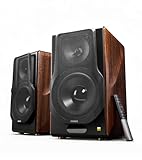
| Room and listening setup | Good starting type | Useful spec range | Placement starting point |
|---|---|---|---|
| Small room, up to about 150 sq ft; seat within 7 ft | Compact passive standmount or powered bookshelf speaker | 85–90 dB sensitivity; roughly 50–100 W per channel for passive models; bass extension around 50–65 Hz | Keep speakers 1–2 ft from the front wall; use stands to place tweeters near ear height |
| Medium room, about 150–300 sq ft; seat 7–10 ft away | Larger standmount or slim floorstander | 87–92 dB sensitivity; roughly 75–150 W per channel; bass extension around 35–55 Hz | Start 2–3 ft from the front wall and adjust distance to control bass |
| Large room, over about 300 sq ft; seat 10 ft or more away | High-sensitivity floorstander or large powered speaker | 90 dB or higher is helpful; roughly 100–200 W per channel for passive speakers; bass extension around 25–40 Hz | Allow space behind and beside the speakers; consider a subwoofer for deep bass at higher levels |
| Desk or nearfield setup | Powered monitors or compact standmounts | Prioritize low noise and clear nearfield response over maximum bass extension | Form an even-sided triangle with the listening position; point tweeters toward your ears |
Compare speaker types before comparing models
Standmount speakers
Standmounts—often called bookshelf speakers, though they usually perform better on proper stands—are easier to place in compact rooms. They can deliver detailed stereo imaging without taking up much floor space. Their main trade-off is limited deep bass and maximum output compared with larger cabinets. If you listen to bass-heavy music or want cinema-like impact, plan for a subwoofer or choose a larger speaker.
Floorstanding speakers
Floorstanders can move more air and often reach lower frequencies than similarly priced compact speakers. That does not automatically make them better for a small room: a speaker with strong bass output can excite room modes and sound boomy when placed too close to a wall. Check whether the design is front-ported, rear-ported, or sealed, but treat that as a clue rather than a placement rule. The room and listening position still matter more.
Powered speakers
Powered speakers contain amplification, so you do not need to match a separate amp’s power rating or minimum load. They are especially convenient for desktops, televisions, and simpler stereo setups. Check the inputs you need—such as USB, optical, or analog—and whether the model supports a subwoofer connection. Powered designs can be excellent value, but they are less flexible if you later want to change the amplifier.
Passive speakers
Passive speakers require an external amplifier or receiver. This adds a matching decision, but gives you room to upgrade components independently. For most listeners, a well-matched, competent integrated amplifier matters more than chasing an unusually high wattage figure.
Read the specifications that affect the match
- Sensitivity: Usually stated in decibels at 1 watt and 1 meter, sensitivity estimates how loudly a speaker plays for a given input. A speaker rated at 90 dB is typically easier to drive to a given level than one rated at 84 dB. Measurement methods vary, so compare figures cautiously.
- Impedance: A nominal 8-ohm speaker is generally an easier load than a 4-ohm model, but nominal impedance hides frequency-dependent dips. If choosing a difficult-to-drive speaker, check that the amplifier is specified to handle its load, especially if you listen loudly.
- Bass extension: A quoted low-frequency limit does not say how much output remains at that frequency. Look for the tolerance attached to the figure, such as “-3 dB,” when available. For music with substantial sub-bass, a subwoofer may be more effective than buying a much larger speaker.
- Amplifier power: More watts provide headroom, but they do not guarantee better sound. Avoid driving an underpowered amp into audible clipping; also avoid assuming that a high-power amp makes every speaker safe at any volume.
A useful amplifier power calculation
Here is a rough way to estimate whether a passive speaker has enough headroom. Suppose a speaker is rated at 87 dB sensitivity, you sit 3 meters away, and you want peaks near 95 dB. In a free-field estimate, doubling distance from 1 meter to about 2 meters costs roughly 6 dB, and moving to 3 meters costs about 9.5 dB. That puts the speaker’s output at roughly 77.5 dB at your seat with 1 watt. Reaching 95 dB peaks would therefore require around 56 times the power, or about 56 watts per channel.
This is an approximation, not a safe-volume target. Room reflections can increase average level, while music peaks, impedance dips, and desired headroom can raise the practical requirement. A clean 100-watt-per-channel amplifier would provide more margin in this example than a 60-watt model, but the speaker’s actual load and the amplifier’s performance into it still matter.
Place speakers before adding more equipment
- Start with symmetry. Put the left and right speakers similar distances from the side walls, with the listening seat centered between them. Unequal placement can pull vocals to one side.
- Set the listening triangle. For a typical stereo setup, begin with speaker spacing close to the distance from each speaker to your seat. Adjust by ear: too wide can weaken the center image; too narrow can make the soundstage feel cramped.
- Move speakers in small increments. Try 2–4 inches at a time. Moving closer to a wall often increases bass, while moving farther away may reduce bass buildup and improve depth. The exact result depends on the room.
- Test toe-in. Pointing the speakers more toward the seat can sharpen imaging and reduce side-wall reflections. Less toe-in can broaden the presentation. Start with the speaker axes crossing just behind your head, then adjust.
- Use stands and isolation sensibly. Place standmount tweeters near seated ear height and keep cabinets stable. On a desk or resonant surface, isolation pads can reduce unwanted vibration, though they cannot fix poor room acoustics.
Shortlist by situation
- Small room, no subwoofer: Choose a compact speaker with useful mid-bass extension and moderate sensitivity. Don’t expect a small cabinet to reproduce the lowest bass loudly.
- Small room, strong bass preference: Use compact speakers with a subwoofer, then set the crossover around 70–90 Hz as a starting point. Adjust by listening and, if available, measurement; the best crossover depends on how the speakers behave in the room.
- Medium room, one-box simplicity: Consider a powered bookshelf pair with the connections your sources require. This avoids the separate amplifier-matching step.
- Large room or distant seat: Favor higher sensitivity and an amplifier that can handle the speaker’s impedance. A subwoofer can add deep bass without requiring the main speakers to work as hard.
- Desk listening: Prioritize low background noise, input compatibility, and controllable bass. Nearfield placement can make imaging convincing even with modest-sized speakers.
Final buying check
Before choosing among the best audiophile speakers for your budget, confirm three things: the speaker fits your room and listening distance, your amplifier can handle its impedance and provide enough clean headroom, and the published bass figure matches your expectations. For general market context, compact passive pairs commonly span a few hundred dollars to well over $1,000, while premium floorstanders can cost several thousand dollars or more. Prices vary widely by brand, finish, and region, so prioritize the system match over a particular price tier.
Frequently asked questions
Do bookshelf speakers need stands?
Bookshelf speakers usually perform better on proper stands, especially when you want the tweeters near seated ear height. Stands also keep the cabinets stable and make placement easier in a stereo setup. On a desk or resonant surface, isolation pads can reduce unwanted vibration, but they cannot correct poor room acoustics or create deep bass.
How far should speakers be from the wall?
Begin with compact speakers about 1–2 ft from the front wall in a small room, or 2–3 ft away in a medium room. Move them in small increments, such as 2–4 inches, because distance affects bass buildup and depth. The best position depends on the room, speaker design, and listening seat.
When should I add a subwoofer?
Add a subwoofer when compact speakers do not provide enough deep bass, particularly for bass-heavy music or cinema-like impact. In a small room with a strong bass preference, set the crossover around 70–90 Hz as a starting point. A subwoofer can also add deep bass in a large room without making the main speakers work as hard.
Are powered speakers better for a simple setup?
Powered speakers can be better for a simple setup because they contain amplification and do not require a separate amplifier. They suit desktops, televisions, and simpler stereo systems. Before choosing one, check whether it has the inputs you need, such as USB, optical, or analog, and whether it supports a subwoofer connection.
How does toe-in change the sound?
Toe-in can change both imaging and presentation. Pointing the speakers more toward the listening seat can sharpen imaging and reduce side-wall reflections, while less toe-in can broaden the presentation. A useful starting point is to aim the speaker axes so they cross just behind your head, then adjust by listening.


