Top 3 picks at a glance
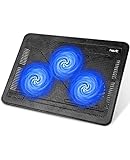
Best gaming laptop cooling pads in 2026
The best gaming laptop cooling pad for most people is the IETS GT500: its sealed foam-and-high-speed-fan design can deliver stronger airflow to a laptop’s underside than open-frame pads, but it is loud at full speed. Choose the Cooler Master Notepal X-Slim II for a quieter, simpler setup, or the Thermaltake Massive 20 RGB if you need a broad platform for a large laptop. A pad helps most when your laptop draws air through bottom vents; it cannot fix blocked vents, dried thermal paste, or an overly aggressive performance profile.
Cooling-pad results depend on the laptop, the position of its intake vents, room temperature, and fan settings. A lower CPU or GPU temperature is useful, but the more important gaming outcome is whether the laptop holds its clocks without thermal throttling. The comparisons below focus on those trade-offs rather than treating fan count or maximum airflow as a guarantee.
As an Amazon Associate we earn from qualifying purchases at no extra cost to you.


Quick comparison
| Model | Cooling approach | Noise and airflow control | Size and ergonomics | Best fit |
|---|---|---|---|---|
| IETS GT500 | One high-speed fan, foam seal around the laptop | Strong airflow; can be loud at high settings | Designed for laptops up to about 17 inches; angled stand | Maximum cooling priority |
| Thermaltake Massive 20 RGB | Large 200 mm fan | Adjustable airflow; generally less high-pitched than small, fast fans | Broad platform for laptops up to about 19 inches; adjustable height | Large laptops and lower-frequency fan noise |
| Cooler Master Notepal X-Slim II | Single 160 mm fan in an open mesh pad | Simple, relatively low-speed airflow | Supports laptops up to 17 inches; slim, slightly raised platform | Lightweight, uncomplicated desk use |
| KLIM Wind | Four fans beneath an open mesh surface | Multiple fans spread airflow; fan-speed control is limited | Commonly listed for laptops up to 17 inches; fixed-angle stand | Budget multi-fan cooling and extra USB ports |
These are design and size comparisons, not a promise of a specific temperature drop. Manufacturers’ laptop-size limits describe platform fit, not guaranteed alignment with every intake vent. Check the pad’s actual surface dimensions and your laptop’s underside before buying.
Which pad fits your gaming setup?
| Your situation | Shortlist | Why | Check before buying |
|---|---|---|---|
| Your laptop heats up during long gaming sessions and has large bottom intakes | IETS GT500 | A seal directs fan air toward the laptop instead of letting much of it escape around the edges. | Confirm that the foam can sit around, rather than cover, the intake and exhaust openings. |
| You use a 17–19-inch laptop or want a roomy platform | Thermaltake Massive 20 RGB | Its large fan and wide surface suit a bigger chassis better than compact pads. | Compare the laptop’s footprint with the pad surface; a stated maximum screen size is only a guide. |
| You want a basic pad that is easy to move | Cooler Master Notepal X-Slim II | It is a slim, open design without the bulk or sealing foam of a high-pressure pad. | Its open airflow is less targeted, so results depend heavily on vent placement. |
| You want a budget pad with several fan positions | KLIM Wind | Four fans can cover a wider underside area than one small fan. | Make sure the fans line up with the laptop’s intake vents and that the fixed tilt suits your desk. |
| Your laptop intakes air mainly from the sides or rear | Try a stable stand first | Raising the chassis may improve clearance without adding fan noise or another powered device. | Do not aim a pad’s airflow at exhaust vents; it can disrupt the laptop’s airflow path. |
How the leading options differ in practice
IETS GT500: strongest airflow, with a noise trade-off
The GT500 is the clearest choice when cooling is the priority and your laptop has underside intakes that can sit inside its foam seal. The seal is the important design difference: it reduces air escaping around the laptop, making the fan’s airflow more directed. That can be more useful than simply adding several fans beneath a large open mesh.
The drawback is sound. A high-speed fan can become distracting during quiet scenes, voice chat, or late-night play. Start at a lower speed and increase it only until temperatures or clock stability improve. The foam also makes fit and vent placement especially important: never let it obstruct a laptop’s exhaust, and avoid forcing a chassis onto a surface that does not fit it securely.
Thermaltake Massive 20 RGB: room for larger machines
A large 200 mm fan spreads airflow across a wider area and tends to produce a lower-pitched sound than a small fan running very fast, though the result still depends on the chosen speed and the room. The broad surface and adjustable stand make this a more natural match for a large gaming laptop than a compact pad.
Its open design is less focused than a sealed pad. If your laptop’s intakes are clustered in one small section, a large fan does not automatically send more air to those vents. Position the laptop so the fan sits beneath the intake area, not beneath a solid panel or the laptop’s exhaust.
Cooler Master Notepal X-Slim II: simple and portable
The Notepal X-Slim II uses an open mesh platform and a single 160 mm fan. It is a sensible choice when you want modest airflow, a raised typing angle, and a pad that is easier to carry or store than a bulky high-pressure model. It has fewer moving parts and less elaborate fan control than premium cooling designs.
That simplicity also sets a ceiling on what it can do. If the laptop’s intake vents do not line up with the fan, the main gain may come from lifting the base and improving clearance rather than from the fan itself. Consider it an ergonomic and airflow aid, not a dependable cure for severe thermal throttling.
KLIM Wind: multiple fans, but check the layout
The KLIM Wind places four fans under an open surface and includes USB pass-through ports. Spreading fans across the pad can help when a laptop has several intake zones, but fan count alone does not establish cooling performance. A group of fans that misses the vents can be less effective than one well-aligned fan.
Its fixed stand angle may work well for desk gaming but is less flexible if you switch between a low keyboard position and a steeper display angle. Treat the USB ports as convenience features, not as a powered hub for demanding devices unless the product specifications explicitly support their power requirements.
Will a cooling pad improve sustained gaming temperatures?
It can, especially when a laptop’s underside intakes are close to the desk or when dust has partly restricted airflow. Raising the rear of the laptop increases the space available for air to reach those vents. A powered pad adds airflow, while a sealed model can direct more of it toward the base. The amount of improvement varies: some laptops benefit noticeably, while others are limited by internal cooling capacity, room temperature, or firmware power limits.
Judge a pad over a full gaming session rather than by a brief temperature dip. A short run may not warm the laptop’s heatsink or surrounding components enough to reveal throttling. If you can, compare the same game scene, graphics settings, room conditions, and laptop power profile before and after adding the pad. Watch for sustained CPU/GPU clocks and frame-time stability alongside temperature. A few degrees lower without improved clocks or smoother performance may not justify more fan noise.
Get a useful result without adding unnecessary noise
- Check the vent map first. Look at the underside and rear edges of your laptop. Match pad fans to intake vents; keep the exhaust path clear.
- Test elevation before buying a powered pad. Raise the rear slightly with a stable stand. If temperatures or fan behavior improve, better clearance may be the main thing your setup needs.
- Use the quietest effective fan speed. Increase pad speed in small steps during a repeatable game session. Stop when additional airflow brings little improvement; that last increment may cost more in noise than it saves in temperature.
- Keep the laptop’s own cooling profile consistent. Switching between quiet and turbo modes changes laptop fan speed and power limits, making a before-and-after comparison unreliable.
- Recheck over time. Dust buildup can reduce airflow from both the pad and laptop. Clean vents according to the laptop maker’s guidance; a cooling pad is not a substitute for internal maintenance.
USB, fit, and ergonomics: details worth checking
Many pads draw power through USB and provide one or more pass-through ports. That can be handy for a mouse or keyboard, but the pad’s USB connection may occupy a laptop port, and pass-through ports do not necessarily supply the current or data speed of a dedicated powered hub. Check the exact model’s port specifications if you plan to attach storage, a headset, or other power-hungry devices.
For fit, measure your laptop’s width and depth, then compare those dimensions with the usable pad surface—not just the advertised maximum screen size. A 17-inch display tells you little about chassis shape, vent location, or how far a laptop overhangs the platform. For ergonomics, choose a stand angle that lets your wrists stay neutral and the display sit comfortably; the tallest setting is not automatically the most comfortable.
Frequently asked questions
How can I tell whether my laptop’s vents will work with a cooling pad?
Check the laptop’s underside and rear edges to locate its intake and exhaust vents. Compare those locations with the pad’s fan positions and surface dimensions. The pad should not cover intake or exhaust openings, and its stated laptop-size limit does not guarantee that the fans will align with your vents.
Could raising my laptop help without using a powered cooling pad?
Yes. Raising the rear with a stable stand can improve clearance and give air more room to reach bottom intakes. If temperatures or fan behavior improve, better clearance may be the main thing your setup needs; a powered pad may not be necessary.
How should I compare temperatures with and without a cooling pad?
Use the same game scene, graphics settings, room conditions, and laptop power profile, and compare over a full gaming session. Look at sustained CPU and GPU clocks and frame-time stability as well as temperature. A brief temperature dip alone may not reveal throttling or indicate a useful performance improvement.
Can a cooling pad fix severe thermal throttling?
Not reliably. Results depend on vent placement, room temperature, and the laptop’s internal cooling capacity and firmware power limits. A pad cannot fix blocked vents, dried thermal paste, or an overly aggressive performance profile, so severe throttling may need attention beyond added airflow.
Can I use a cooling pad’s USB ports to power other devices?
Treat USB pass-through ports as convenience features, not as a powered hub for demanding devices. Use them for demanding devices only if the product specifications explicitly support their power requirements.
Bottom line
Choose the IETS GT500 if your gaming laptop’s bottom vents match its sealed airflow area and you can tolerate higher fan noise. Pick the Thermaltake Massive 20 RGB for a broad platform and a large-fan design, or the Cooler Master Notepal X-Slim II for a simpler, more portable lift. The KLIM Wind is a budget-friendly multi-fan option when its fan positions line up with your vents. In every case, the best gaming laptop cooling pads are the ones that fit the airflow layout and improve sustained clocks at a noise level you can live with.