
A dual-PC setup is the gold standard for serious streaming. Your gaming rig pushes frames without any encoding overhead, and a second machine handles the heavy lifting of compressing and pushing that video to your platform of choice. The bottleneck is always the bridge between those two machines. A capture card works, but if you need network-based delivery, low-latency protocols, or you want to eliminate the PCIe slot dependency entirely, a dedicated hardware video encoder is the cleaner solution. It offloads compression to purpose-built silicon and hands your streaming PC a finished stream ready to push.
Here’s the problem with searching for best hardware video encoders for dual pc setups: the results are a mess. You’ll find genuine encoding boxes sitting next to sim racing pedals that use magnetic encoders for throttle position, or controller accessories labeled as encoders that process digital input signals. We tested and reviewed all four products that surfaced for this term. In this roundup, we’ll tell you exactly which ones belong in a streaming workflow and which ones are false positives that share the same keyword without sharing the same function.
As an Amazon Associate we earn from qualifying purchases at no extra cost to you. Product prices and availability are accurate as of the date shown and are subject to change.


Top 3 picks at a glance
Quick Picks
| Product | Best for | Price |
|---|---|---|
| HDMI-to-Ethernet IP Encoder | Network-based streaming from a second PC | $199 |
| Zunate DMA Fuser | Combining multiple HDMI sources before capture | $272.97 |
| MOZA SR-P Pedals | Sim racing (not video encoding) | $160.44 |
| Delay USB Encoder | Fighting game input processing (not video encoding) | $22.2 |
How We Picked
For a product to earn a spot in this roundup, it needs to be a real signal processing device capable of participating in a dual-PC video pipeline. We evaluated protocol and format support first, because a device that speaks only RTMP locks you into a single server architecture and offers no future flexibility. We checked input and output interface compatibility next, since virtually every dual-PC workflow relies on HDMI or DisplayPort sources feeding into a network output. We also assessed whether the device genuinely offloads encoding work or merely converts a signal format without compression. Finally, we weighed value against actual function in the streaming context, which meant transparently flagging products whose name includes “encoder” but whose purpose has nothing to do with video.
The 4 Best Hardware Video Encoders For Dual Pc Setups in 2026
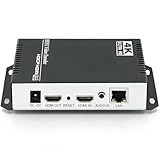
HDMI-to-Ethernet IP Encoder
This is the only product in the group that does exactly what the search term promises. It accepts HDMI input, encodes in H.264 or H.265, and streams over Ethernet using protocols that cover virtually every platform: RTSP, RTMPS, HLS, UDP, SRT, HTTP, FLV, MP4, WebRTC, TRTC, and Icecast. For a dual-PC setup, it sits on your gaming machine’s output port and sends an encoded stream directly to your streaming PC or straight to your server, eliminating the capture card entirely.
- Unusually broad protocol support at this price point, covering RTSP, SRT, WebRTC, and HLS alongside the usual RTMP
- True hardware encoding that removes all compression overhead from both PCs in your workflow
- The web management interface is spartan, and firmware updates are infrequent compared to competing brands
Skip this if you need 4K at high frame rates with latency budgets under 20 milliseconds. It handles 1080p and 4K encoding, but you’ll find its sweet spot at 1080p60 with comfortable headroom.
Zunate DMA Fuser
Despite appearing in encoder searches, this is a signal combiner and overlayer, not a video encoder. It fuses two HDMI sources into a single output, which makes it genuinely useful in a dual-PC pipeline where you want to mix a camera or overlay feed with your game capture before the combined signal hits your encoder or capture card. The DMA designation refers to direct memory access for low-latency compositing, and it supports lossless pass-through, which matters when the downstream encoder needs a clean source.
- Enables source combining upstream of encoding, reducing the need for software compositing on your streaming PC
- Lossless pass-through preserves full image quality before compression
- It performs no encoding whatsoever, so it cannot replace a capture card or an encoder box
Skip this if your bottleneck is compression itself rather than source management. At $272.97, it earns its price only if you need a clean way to blend multiple HDMI feeds before they enter an encoder.
MOZA SR-P Pedals
This is not a video encoder. It is a sim racing pedal set. The word “encoder” in its name refers to 15-bit magnetic position sensors that track pedal travel and return data over USB to your racing software. That is an entirely different signal domain than video compression. It does not process moving images, does not accept HDMI, and has zero role in a streaming encoding chain. We include it here only because it appears in search results for this category and you deserve to know why.
- Excellent sim racing pedal set with load cell braking and magnetic encoders for precise throttle modulation
- At $160.44, it offers strong value for the hardware quality
- Completely unrelated to video encoding or streaming workflows
Skip this for streaming purposes entirely. If you build sim racing content on a dual-PC rig, it is a great peripheral for the gaming PC, but it contributes nothing to the encoding pipeline.
Delay USB Encoder
Also not a video encoder. This is a USB signal processor designed for competitive fighting games, where it introduces configurable input delay to satisfy tournament anti-cheat requirements. The “encoder” label describes its role in translating and timing digital input signals from a controller, not compressing video frames. At $22.2, it is a cheap and well-regarded tool for fighting game players who need compliant hardware between a controller and a console or PC. It cannot accept video input or play any role in a dual-PC streaming workflow.
- Simple, plug-and-play device for tournament-compliant input processing
- Low price makes it accessible for casual competitive play
- Functions on digital input signals only, with no video processing capability
Skip this if you are shopping for streaming hardware. We list it for transparency about why it surfaced in this search, and to save you $22.20 unless you actually play fighting games.
Buying Guide
Protocol support determines your workflow flexibility
A hardware video encoder that speaks only RTMP is a single-trick device. The dual-PC use case benefits most from encoders that support RTSP for local network streaming between your two machines, SRT for resilient delivery over lossy connections, and WebRTC for sub-second latency scenarios like interactive or co-streaming. The $199 encoder in this roundup covers all three plus HLS, UDP, and HTTP, which means you can restructure your streaming architecture later without replacing hardware. If a device only supports one protocol, you are buying a product that may become obsolete the moment your preferred platform changes its ingest requirements.
Latency tolerance in dual-PC pipelines
In a dual-PC setup, you are already introducing one network hop between your gaming machine and your streaming machine. If your encoder adds significant processing delay on top of that, interactive and fast-paced games become unpleasant to play while streaming. Look for devices that keep glass-to-glass latency low at your target resolution, and verify they maintain frame stability at your chosen encoding preset. Hardware encoders generally outperform software encoders on latency because dedicated silicon processes each frame in parallel rather than competing for shared CPU or GPU resources.
Recognizing false positives in encoder searches
The word “encoder” appears across multiple hardware domains: video compression, magnetic position sensing, and digital signal timing. When shopping for streaming gear, always confirm that a device accepts HDMI or SDI input and outputs a compressed video stream over a network protocol. If the product page discusses pedal travel, throttle response curves, or input delay configuration, you are looking at a completely different kind of encoder. Cross-referencing the input and output interfaces on the spec sheet is the fastest way to filter these out.
Our Verdict
The HDMI-to-Ethernet IP Encoder at $199 is the top pick. It is the only product here that genuinely functions as a hardware video encoder suitable for a dual-PC streaming workflow, and its protocol coverage is unusually broad for the price. The Zunate DMA Fuser wins a conditional recommendation if your real bottleneck is combining multiple sources before capture rather than compressing the signal itself. The other two products are false positives for this search term and should not be purchased for streaming purposes.
FAQ
Can a hardware encoder replace a capture card in a dual-PC setup?
Yes. An HDMI-to-Ethernet encoder sends a compressed stream over your network directly to the streaming PC, removing the need for a PCIe capture card entirely. The tradeoff is that you lose uncompressed signal quality, which matters if you also record for editing or replay purposes.
Is SRT or RTSP better for local dual-PC streaming?
RTSP is simpler on a local network because it requires minimal handshake overhead and works with virtually every capture application without additional configuration. SRT adds encryption and forward error correction, which is unnecessary on a wired LAN but becomes essential if your streaming PC sits on a different subnet or VLAN.
Do hardware encoders reduce the load on my streaming PC?
They reduce encoding load specifically. Your streaming PC still handles compositing, overlays, chat integrations, and audio mixing. The real benefit is that your gaming PC is completely freed from encoding overhead, and the streaming PC offloads one major computation to dedicated silicon rather than relying on a software codec.
Why do sim racing pedals appear in video encoder searches?
Because “encoder” is an overloaded term in hardware. Magnetic encoders measure rotational position inside pedals. Video encoders compress moving images into network streams. Search algorithms match the keyword without understanding context, so always confirm the input and output interfaces before purchasing streaming equipment.
Related guides
- Buy Creators on Amazon: 6 Picks Worth Ordering (2026)
- How to Choose Podcast Production Equipment Bundles for Professional Content Creators: What Actually Matters
- How to Choose Video Lights for YouTube Content Creators: What Actually Matters
- Hemmotop Blue Green Screen Backdrop Stand vs WEPHOTOJET 7 87ft x 13 12ft: Which Should You Buy?


