Low-end punch is the one thing a small wireless speaker has the hardest time delivering. Physics works against a compact enclosure: moving enough air to make a kick drum feel real takes either a large driver, a passive radiator, a dedicated subwoofer element, or a lot of amplifier power. When a buyer searches for Bluetooth speakers with bass, the real decision is how much low-end authority they want and how much bulk, weight, and battery drain they will accept to get it. A pocket-size speaker with a bass-boost mode and a boombox-size unit with dual subwoofers both claim “deep bass,” yet they serve very different listeners.
This guide is for people who care about the weight of the music more than about the lightest possible pack. Think backyard cookouts where a drum-heavy playlist has to carry across a patio, garage workouts, pool days, or a bedroom setup where a compact speaker needs to sound fuller than a phone ever could. The seven models below all advertise bass-oriented features in their listings, from subwoofer elements to dedicated bass modes, and they range from palm-friendly designs to loud outdoor boomboxes. As we head through 2026, battery life, waterproofing, and pairing features matter nearly as much as the bass claim itself, so the comparison below covers those too.
Top 3 picks at a glance
Quick Picks
As an Amazon Associate we earn from qualifying purchases at no extra cost to you.



| Product | Best for | Key spec from the title |
|---|---|---|
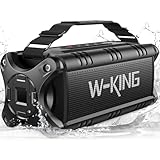
| W-KING 90W Boombox | Loud outdoor parties | 90W max, 50W deep bass with two subwoofers, 40H, IPX7 |
| Anker soundcore 2 | Everyday portable use | 12W stereo, BassUp, 24-hour playtime, IPX7 |
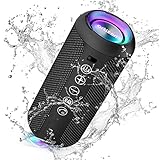
| Ortizan X10 | Long-lasting home and party use | Deep bass, 30 hours playtime, TWS pairing, IPX7 |
| ANCOON Jobsite Speaker | Workshops and rough environments | 80W peak, rugged build, 20H, IPX6 |
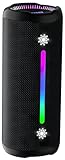
| BassBloom ROAR 3 | Lights plus bass on a budget | 20W, JIKE Bass, Bluetooth 5.4, RGB lights, IPX6 |
| W-KING 90W Floatable | Poolside and lakeside listening | 90W max, floatable, custom EQ, 40H, IPX6 |
| OHAYO 35W | Wired-quality feel over USB-C | 35W, active bass, USB-C lossless audio, Bluetooth 5.3, IPX7 |
How to Choose
Read the wattage number the right way
Wattage on a listing is not a loudness guarantee, and “max” or “peak” wording means the figure describes a brief burst, not continuous output. A 90W max rating with two 50W bass elements describes a much bigger system than a 12W or 20W speaker, but the sound pressure rating, where listed, is a better hint at real volume. One listing here cites 105dB, which tells you far more about outdoor loudness than the headline wattage. As a rough guide, 10W to 20W suits a bedroom or desk, 30W to 40W fills a living room or small patio, and anything at 60W or more is built for open-air gatherings. Do not pay for headroom you will never use: the loudest speakers are also the heaviest and the hungriest on battery.
Look for the mechanism, not just the word “bass”
Every speaker in this list uses the word, but the mechanisms differ. Dual subwoofers, a named bass-enhancement circuit, an active bass mode, and a custom EQ app all behave differently. Dedicated subwoofer or passive-radiator hardware moves real air and tends to extend lower than a pure software boost. Software modes such as BassUp-style processing reshape the tone and are most useful at moderate volume in small rooms. If the listing offers an adjustable EQ, you can trim bass when the speaker sits against a wall, which matters because corners and shelves exaggerate low frequencies and can turn music muddy.
Match battery life and water rating to where you will listen
Playtime claims in the titles run from 20 hours to 40 hours, and they are usually quoted at moderate volume with bass effects off. Driving a bass-forward speaker loudly can shorten that dramatically, so choose a number that comfortably exceeds your longest session. For water, IPX7 means the speaker is rated for temporary immersion, IPX6 covers powerful water jets such as heavy rain or a hose, and neither rating promises protection from sand, dust, or salt. Floating designs help when the speaker lives near a pool. If the speaker will mostly sit on a dry shelf, a water rating is a bonus rather than a priority.
Check pairing, inputs, and Bluetooth version
True wireless stereo (TWS) or dual pairing lets you link two identical speakers for a wider soundstage, which is the cheapest way to double your bass output without buying a bigger unit. Ports matter if you want to play from a memory card, a flash drive, or a cable: some listings mention TF card, AUX, and U-disk support, while others lean on USB-C input. Newer Bluetooth versions such as 5.3 or 5.4 improve connection stability and efficiency, but codec support, not version number, determines audio fidelity, so do not overpay for a version bump alone. Budget models usually cut corners on the app, the quality of included cables, and the consistency of bass at maximum volume, where cheaper amplifiers can distort.
The 7 Best Options
W-KING 90W Boombox Speaker
This is the heavyweight of the group on paper. The title lists 90W max output, two 50W deep bass subwoofer elements, a 105dB rating, 40 hours of playtime, and an IPX7 rating. It also supports TF card, AUX, and U-disk playback along with EQ settings. It suits anyone hosting outdoor gatherings who wants low-end energy that carries across a yard.
- Strength: dual subwoofer elements and a 105dB figure point to serious outdoor output.
- Strength: TF, AUX, and U-disk inputs mean playback does not depend on a phone connection.
- Trade-off: the large boombox format is less pocketable than any other speaker here.
Skip it if you want something to toss in a small bag or if you mainly listen at low volume in a bedroom, where this much hardware is unnecessary.
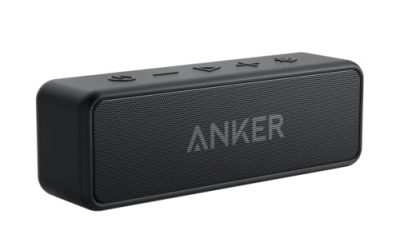
Anker soundcore 2
The most compact and restrained option in the roundup, this speaker lists 12W stereo sound, BassUp processing, 24 hours of playtime, an IPX7 rating, and wireless stereo pairing. It is a sensible fit for dorm rooms, kitchens, and bathrooms, and for buyers who want a bass boost without moving up to a boombox.
- Strength: 24-hour playtime and an IPX7 rating cover a full day of casual use and wet environments.
- Strength: wireless stereo pairing lets you add a second unit later for wider sound.
- Trade-off: at 12W, it will not fill an open yard, and the bass is processed rather than driven by oversized hardware.
Skip it if your main use is outdoor parties or if you expect floor-shaking low end from a small body.
Ortizan X10
The X10 listing promises big sound and deep bass, TWS pairing, IPX7 waterproofing, and 30 hours of playtime. It is aimed at home and party use, which makes it a middle path between the small soundcore and the larger W-KING units. Buyers who want a long battery and the option of a stereo pair will find it appealing.
- Strength: 30 hours of listed playtime is among the longest in this group outside the 40-hour models.
- Strength: TWS pairing allows a two-speaker setup for stereo separation.
- Trade-off: the title gives no wattage figure, so judging real loudness against the other options takes extra research.
Skip it if you need a published power rating to compare against a specific volume target.
ANCOON Jobsite Speaker
Built for rough environments, this model lists 80W peak output, a rugged body, 20 hours of playback, and an IPX6 rating. The “large jobsite speaker” wording points to workshops, garages, and construction sites where noise competes with the music and drops are a risk. Buyers who need a durable speaker that still delivers bass will find its pitch sensible.
- Strength: rugged construction suits dusty, busy work areas.
- Strength: 80W peak output gives plenty of headroom over machinery noise.
- Trade-off: peak wattage is a burst figure, and 20 hours is the shortest battery claim in the group.
Skip it if you want a polished living-room look or if long unplugged sessions across several days matter most.
BassBloom ROAR 3
The ROAR 3 lists 20W output, JIKE Bass technology, IPX6 protection, 24 hours of playtime, Bluetooth 5.4, RGB lights, and wireless TWS pairing. It sits at the budget end of the bass-focused field and adds a visual element through lighting. It fits teens, dorm parties, and anyone who likes a light show with the beat.
- Strength: Bluetooth 5.4 is the newest version cited in this group, helping connection stability.
- Strength: RGB lights and TWS pairing add party appeal at a modest wattage.
- Trade-off: 20W will not carry far outdoors, and lighting effects can shorten real-world battery life.
Skip it if you dislike flashing lights or want a speaker for large open spaces.
W-KING 90W Floatable Speaker
This second W-KING model shares the 90W max rating and 40-hour playtime, adding floatability, an IPX6 rating, custom EQ, dual pairing, and subwoofer-backed deep bass. Floating makes it the clear choice for pool, boat, and lake days, where a dropped speaker would otherwise be a problem.
- Strength: floatable design is a safety net around water.
- Strength: custom EQ lets you tame bass when the speaker sits against a wall or on a hard surface.
- Trade-off: IPX6 is rated for jets of water, not full immersion like IPX7, so floating on the surface suits it better than submerging.
Skip it if you want the highest immersion rating or a lightweight carry-anywhere speaker.
OHAYO 35W Portable Speaker
The OHAYO lists 35W output, an IPX7 rating, 24 hours of playtime, USB-C lossless audio, active bass, Bluetooth 5.3, and LED lighting. The USB-C lossless input is its standout: it allows a wired connection to a laptop or phone for steadier audio than wireless streaming. It suits desk setups and mid-size room listening.
- Strength: USB-C lossless audio gives a wired option when you want to avoid wireless compression.
- Strength: 35W with active bass sits in a useful middle range for rooms and small patios.
- Trade-off: it lacks the dual subwoofer hardware cited by the W-KING units, so the bass depth claim is more modest.
Skip it if you plan to host outdoor events for large crowds.
Which One Fits Your Situation
Backyard parties and large patios
The W-KING 90W Boombox Speaker is the logical starting point. Its two subwoofer elements, 105dB rating, and 40-hour playtime are tuned for open spaces where music has to compete with conversation and wind.
Poolside, lakeside, or boat days
The W-KING 90W Floatable Speaker fits better because it floats and offers custom EQ to adjust bass for open-air acoustics. Pair two units if you want the sound to wrap around a larger deck.
Small apartment or dorm room
The Anker soundcore 2 gives sensible volume and a BassUp mode without overwhelming neighbors. Buy a second unit later if you want stereo pairing. If you want visual flair too, the BassBloom ROAR 3 adds RGB lighting at a modest wattage.
Workshop, garage, or jobsite
The ANCOON Jobsite Speaker is built for tough spaces, with 80W peak output over machinery noise and a rugged body. Plan for recharging more often, since its battery claim is the shortest here.
Common Mistakes
- Treating peak or max wattage as continuous output. Those numbers describe short bursts, so compare decibel ratings and driver hardware when listed.
- Buying more speaker than the room needs. A boombox in a small bedroom causes distortion in corners and annoys neighbors without improving the sound.
- Ignoring the water rating details. IPX6 and IPX7 are not interchangeable, and neither covers sand, salt, or dust.
- Assuming the longest battery claim applies at full volume. Bass-heavy playback at high levels drains cells faster than the quoted hours suggest.
- Skipping the second speaker option. Two small TWS-capable units often deliver wider, fuller sound than one slightly larger speaker.
Related guides
- When I Turn On Record Game In Background On Gamebar. Gamebar Crashes, What Do I Do?
- How To Reduce Background Noise On A Streaming Microphone
- Poly Computer Accessories Company Streaming Evaluation
Frequently Asked Questions
Does a higher wattage always mean better bass?
No. Wattage tells you about amplifier capacity, but bass depth also depends on driver size, enclosure design, and whether there are subwoofer or passive radiator elements. A well-built 20W speaker can sound more balanced than a distorted 90W one at maximum volume.
Is IPX7 or IPX6 better for outdoor use?
IPX7 covers temporary immersion in water, while IPX6 covers strong water jets. For rain, splashes, and pool edges either works, but if the speaker might fall into water, IPX7 offers a safer margin.
Can I pair two speakers to get more bass?
Models that list TWS or dual pairing can link with a matching unit for stereo output and extra volume. Both speakers need to be the same model, and low-frequency output improves because the work is split across two sets of drivers.
Why does bass sound muddy on a shelf or near a wall?
Walls and corners reinforce low frequencies, which can make bass boomy. Move the speaker a few inches away from the wall or use a custom EQ, where available, to lower the bass setting.