Choosing an 8-inch monitor for video editing is really a decision about how much low end your room can honestly support. Dialogue lives in the midrange, but trailers, title sequences and sound design reach below 100 Hz, and a smaller speaker cannot reproduce that region at working levels. The trade is physical: bigger cabinets demand deeper desks, more distance from your chair, and clearance from the wall behind them.
This guide is for editors working in spare rooms, garage conversions and small suites rather than desktop corners, and for anyone cutting bass-heavy material who keeps reaching for a subwoofer. Every model below is a powered two-way design with an 8-inch woofer, picked from its Amazon listing name and published specifications, with single and pair listings flagged so the count is never a surprise.
Top 3 picks at a glance


Quick Picks
As an Amazon Associate we earn from qualifying purchases.
| Product | Best for | Key spec from title |
|---|---|---|
| Yamaha HS8 | Dialogue-first edits that must translate | 38 Hz to 30 kHz response, 120 W bi-amp |
| KRK ROKIT 8 G5 | Untreated larger rooms needing DSP tuning | 203 W total, three voicing modes |
| ADAM Audio T8V | Trailers and sound design needing deep lows | Bass extension down to 33 Hz |
| JBL 308P MkII | Two-editor desks and client seating | Sold as a pair, Image Control Waveguide |
How to Choose
Low-End Extension Decides Whether You Need a Sub
An 8-inch woofer moves enough air to cover the region where trailer hits, engine rumble and score swells actually sit, roughly 35 to 80 Hz. Check the lowest figure each listing publishes and note the tolerance attached to it, because a response quoted at minus 10 dB is not directly comparable with one quoted at plus or minus 3 dB. If your work is mostly dialogue and social cuts, deep extension matters less. If you mix theatrical-style pieces, it decides whether a separate subwoofer joins the shopping list later.
Listening Distance and Desk Depth Come First
These cabinets run about 12 to 13 inches deep and 15 to 16 inches tall, so they belong on stands behind the desk or on a genuinely deep worktop, not squeezed beside a keyboard. Plan on sitting roughly four to six feet from each speaker so the woofer and tweeter blend before the sound reaches you. Measure the gap between your chair, the desk edge and the rear wall before ordering. If that triangle cannot open up, a smaller monitor will serve the room better than an 8-inch pair crammed into it.
Boundary Controls Matter More Than Extra Wattage
A large woofer near a wall excites room modes and piles up bass that is not in your mix, which is why the rear-panel controls deserve more attention than headline power figures. Look for a room or boundary control that shelves the low end down when the speaker sits close to a wall, a high trim for bright or dull rooms, or DSP voicing with several EQ combinations. In an untreated edit room, those adjustments change what you hear every day; another fifty watts mostly changes how loud an already uneven response can get.
Match the Inputs to Your Interface or Mixer
Most editors feed monitors from an audio interface or a small mixer, and nearly every model here accepts balanced XLR or quarter-inch TRS connections, which reject hum over longer cable runs. One model below adds an unbalanced RCA input, handy for a consumer switcher or a laptop dock without balanced outputs. Confirm what your source device actually provides before choosing, and plan cable lengths around stands placed behind the desk. Also check the level control on each rear panel, since matching left and right output by ear alone is unreliable.
The 4 Best Options
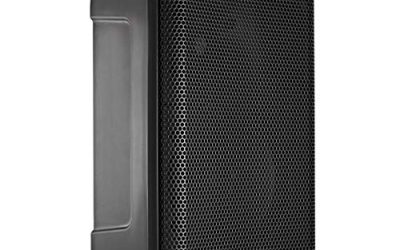
Yamaha HS8
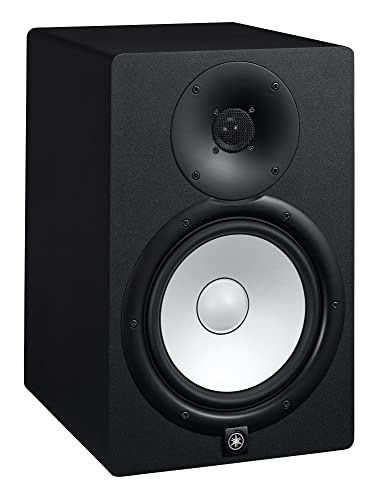
The HS8 is the reference point in this size class, voiced flat and unflattering so dialogue edits made on it tend to hold up on televisions and laptops. Its Room Control switch cuts output below 500 Hz in steps, which helps when stands push the cabinets toward a wall, and the High Trim switch adjusts the top end by two decibels either way. For a mid-size edit room where spoken word carries the project and bass is supporting rather than leading, this is the straightforward pick. The listing sells one monitor, so a stereo setup means ordering two.
Specs
- Woofer: 8-inch cone; tweeter: 1-inch dome
- Amplification: 120 W bi-amp system (75 W LF plus 45 W HF)
- Frequency response: 38 Hz to 30 kHz (-10 dB)
- Inputs: XLR and TRS phone jack, balanced or unbalanced
- Controls: LEVEL knob, ROOM CONTROL (0, -2, -4 dB under 500 Hz), HIGH TRIM (plus or minus 2 dB)
- Dimensions: 9.8 x 15.4 x 13.1 inches; weight 22.5 lb
- Sold as: single monitor
Best for: Editors in mid-size rooms who want a flat reference for dialogue-led work.
Watch out for: The listing is for one speaker only; budget and desk space for two.
ASIN: B00DCYMVB2
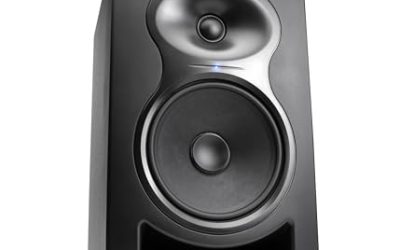
KRK ROKIT 8 G5
KRK builds the ROKIT 8 G5 around tuning flexibility, which suits edit rooms that double as offices and cannot be treated properly. An LCD screen and knob on the back select three DSP voicing modes, including a flat Mix mode and a midrange-focused Focus mode, alongside 25 boundary and tuning EQ combinations. With the highest total power in this group, it keeps headroom for loud trailer passes in a bigger room. One caution from the listing itself: its title describes a single monitor while a product field suggests a different count, so confirm the quantity on the page before ordering.
Specs
- Woofer: 8-inch woven Kevlar; tweeter: 1-inch silk dome
- Amplification: 203 W total Class D bi-amp (312 W dynamic)
- Frequency response: 42 Hz to 36 kHz (plus or minus 3 dB); max SPL 111 dB
- DSP: three voicing modes (Mix, Create, Focus), 25 boundary and tuning EQ combinations, LCD display
- Input: balanced XLR and quarter-inch TRS combo jack
- Dimensions: 15.75 x 10.47 x 12.56 inches (H x W x D); weight 23.04 lb
- Model: RP8G5-NA
Best for: Larger, untreated edit rooms where DSP voicing has to compensate for placement.
Watch out for: The listing’s title and item-count field disagree; verify whether the offer is one monitor or two.
ASIN: B0CVZXK3PY
ADAM Audio T8V
The T8V reaches lowest on paper here, with bass response extending to 33 Hz, which matters when a trailer mix or a sound-design pass has content a smaller monitor would simply hide. Its U-ART ribbon tweeter extends to 25 kHz through a dispersion waveguide, a combination aimed at long sessions where harsh top end wears you down. It is also the only model in this group with an RCA input alongside balanced XLR, useful if a consumer-level source feeds the desk. The listing sells a single monitor, and the cabinet is tall, so check stand height before committing.
Specs
- Woofer: 8-inch; tweeter: U-ART accelerated ribbon with HPS waveguide
- Frequency response: bass extension to 33 Hz; tweeter extends to 25 kHz
- Amplification: 70 W Class D woofer amplifier, 20 W Class D tweeter amplifier
- Output: up to 118 dB SPL per pair
- Inputs: XLR (balanced) and RCA (unbalanced)
- Model: AMS-T8V
- Sold as: single monitor
Best for: Bass-heavy editing, trailers and sound design in rooms with space behind the desk.
Watch out for: Sold singly, and at nearly 16 inches tall it needs stands set lower than usual for tweeter height.
ASIN: B087NC73NZ
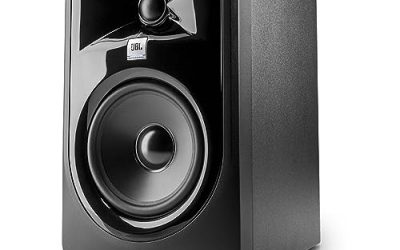
JBL 308P MkII

This listing is the convenient one for a shared edit bay because it sells the 308P MkII as a pair, two monitors with two power cords in one box. JBL’s Image Control Waveguide keeps imaging stable across a wider seating area, which helps when a director or client sits beside you and still needs to judge dialogue balance. Boundary EQ shelves the low end for placement on a desk or near a wall, and the rear Slip Stream port is tuned to avoid chuffing at higher levels. Output is moderate rather than huge, so it fits a controlled suite better than a cavernous room.
Specs
- Woofer: 8-inch; tweeter: 1-inch soft dome
- Amplification: 112 W per speaker (56 W LF plus 56 W HF, Class D, bi-amplified)
- Frequency response: 45 Hz to 20 kHz (plus or minus 3 dB); range 37 Hz to 24 kHz (-10 dB)
- Maximum SPL: 112 dB peak
- Features: Image Control Waveguide, Boundary EQ (LF shelf at 50 Hz), ported 15 mm MDF enclosure
- Inputs: XLR and TRS
- Weight: 17.87 lb per speaker
- Sold as: pair of two monitors
Best for: Edit bays with a second seat, where a wide sweet spot matters more than maximum output.
Watch out for: Continuous output is modest for very large rooms; check the seller is supplying new units.
ASIN: B07C54DPBD
Which One Fits Your Situation
You Cut Trailers and Sound-Design-Heavy Pieces
Start with the ADAM Audio T8V, whose 33 Hz extension shows you low content the others roll off, or the KRK ROKIT 8 G5 if the room is untreated and its DSP voicing will earn its keep. Either way, give the cabinets stands, distance from the rear wall, and enough listening space for that bass to develop honestly.
You Mostly Edit Dialogue-Driven Content
The Yamaha HS8 fits this work best. Its flat voicing keeps voices consistent from project to project, the Room Control switch handles stands placed near a wall, and its moderate extension is honest rather than flattering. Order two, since the listing covers a single monitor, and set levels with the rear knob rather than your interface alone.
A Client or Director Sits Next to You
Choose the JBL 308P MkII pair. The waveguide holds imaging together when two people share the listening area instead of one chair parked in the sweet spot, and buying the pair in a single listing removes any count confusion. Boundary EQ keeps the low end civil when the desk pushes them toward the wall.
Your Room Is Large but Bare and Echoing
The KRK ROKIT 8 G5 gives you the most tools here: three voicing modes and 25 EQ combinations to tame placement problems you cannot fix with panels. Pair that flexibility with sensible placement first, stands behind the desk and distance from corners, because DSP can trim excess bass but cannot repair a bad position.
Common Mistakes
- Buying 8-inch monitors for a small untreated room, then fighting boomy bass that smaller speakers would never have excited.
- Assuming a listing is a pair, or a single, without reading the title and box contents; the four listings here split both ways.
- Parking the cabinets flat on the desk at keyboard depth instead of on stands at a proper listening distance.
- Comparing frequency figures across brands without checking whether each is quoted at minus 10 dB or plus or minus 3 dB.
- Ignoring the rear-panel room controls and judging the speakers before those settings match the placement.
Frequently Asked Questions
Do I Still Need a Subwoofer With 8-Inch Monitors?
For dialogue, corporate work and most online video, no: the models here reach between 33 and 45 Hz depending on the figure quoted, which covers the audible weight of voices and music beds. A subwoofer only becomes necessary when you must judge content below that range, such as theatrical trailer hits or dedicated low-frequency effects channels.
How Far Away Should I Sit From 8-Inch Monitors?
Plan on roughly four to six feet between each speaker and your ears, with the tweeters near ear height and the pair forming a triangle with your chair. Closer than that, the woofer and tweeter stop blending into one image. If your room cannot fit that triangle, a smaller monitor will judge mixes more honestly.
Are These Monitors Sold Singly or in Pairs?
It depends on the listing, which is exactly why each entry above flags it. The Yamaha HS8, KRK ROKIT 8 G5 and ADAM Audio T8V listings each cover one monitor, so stereo means two units. The JBL 308P MkII listing used here is a pair. Always confirm the count in the title and box contents before ordering.
Can I Run These From a Laptop Without an Interface?
You can feed them from a headphone output with the right adapter cables, and the T8V even accepts unbalanced RCA, but a proper interface or mixer gives balanced connections, a physical volume knob and matched left and right levels. For daily editing work, balanced XLR or TRS runs from an interface are the cleaner and quieter route.
Related guides
More from Amazon
Programs that pair well with the guide above. Offers and eligibility are set by Amazon and may change.
Free shipping on eligible items, Prime Video and more. Eligible new members can start with a free trial.
Start a Prime free trialAd-free music streaming. Eligible new subscribers can start with a free trial.
Try Music Unlimited freeA Prime membership for ages 18-24 with a trial period. Eligibility is set by Amazon.
See Prime for Young AdultsAudiobooks and podcasts to listen to on the go. Eligible new members can start with a free trial.
Try Audible freeAs an Amazon Associate we earn from qualifying purchases.