
The best TV antennas for most homes are an amplified indoor flat antenna when broadcast towers are nearby, a multidirectional outdoor antenna when signals arrive from several directions, and a directional roof or attic antenna when you live farther from the transmitters or have obstructions.
“Best” depends less on the antenna’s advertised mile rating than on your local terrain, tower direction, building materials, and whether your stations broadcast on VHF or UHF. The comparisons below focus on reception stability, practical range, amplifier behavior, and installation effort rather than headline specifications.
As an Amazon Associate we earn from qualifying purchases at no extra cost to you.
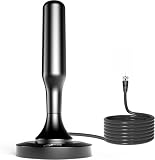


Top 3 picks at a glance
Quick comparison: indoor versus outdoor antennas
| Design | Representative models or class | Practical reception range* | Signal stability | Amplifier performance | Installation effort | Best situation |
|---|---|---|---|---|---|---|
| Passive indoor flat | Mohu Leaf 30, similar 30-mile class | 10–25 miles | Good near towers; sensitive to walls | None; avoids overload | Very low | Apartment or home with strong local signals |
| Amplified indoor flat | Mohu Leaf 50, Winegard FlatWave Amped | 15–35 miles | Good to fair, depending on interference | Can offset cable loss; may overload near towers | Low | Indoor installation with moderate cable distance |
| Compact outdoor multidirectional | Antennas Direct ClearStream 2MAX | 25–45 miles | Better than indoor designs through walls | Optional; useful for splitters and long cable runs | Moderate | Suburban areas with stations in more than one direction |
| Larger outdoor multidirectional | Antennas Direct ClearStream 4MAX | 35–60 miles | Strong when towers are spread across a broad arc | Useful after the antenna, not necessarily at the antenna | Moderate to high | Weak-to-moderate signals and multiple tower directions |
| Outdoor directional Yagi or high-gain array | VHF/UHF directional class | 40–70+ miles in favorable terrain | Best for a clear path to one tower group | Helpful with long coax runs; not a substitute for aiming | High | Rural locations or distant transmitters |
*These are practical planning ranges, not guarantees. Hills, trees, buildings, and station power can reduce them substantially.
Best indoor antenna approach: start simple
Passive flat antennas for strong local signals
A passive antenna such as the Mohu Leaf 30 is often the right first choice within roughly 10 to 20 miles of the broadcast towers. It has no power adapter and no amplifier to introduce noise or overload. Place it high on a wall, ideally facing the tower direction, rather than behind a television or inside a cabinet.
Passive designs are particularly suitable when the coaxial cable is short and the television receives a strong signal already. They are also a sensible choice in dense urban areas, where a strong nearby signal can overload an amplifier and create pixelation that looks like weak reception.
Amplified indoor antennas for cable loss, not magic range
The Mohu Leaf 50 and Winegard FlatWave Amped are examples of amplified indoor designs. Their main advantage is compensating for losses from longer coaxial cable, a wall outlet location, or a passive splitter feeding multiple televisions. An amplifier cannot recover a broadcast signal blocked by a concrete wall or corrupted by multipath reflections.
Use the amplifier’s power injector close to the television or splitter, and try both powered and unpowered modes if the antenna supports that option. If all channels become unstable immediately after enabling amplification, overload is more likely than insufficient gain. Turn the amplifier off, move the antenna farther from the television, and rescan.
Best outdoor antenna approach: get above the obstacles
Multidirectional antennas for mixed tower locations
The ClearStream 2MAX is a practical choice when stations are located in different directions but are not extremely distant. Its bow-tie style elements are designed for UHF reception, the band used by many digital television services. A compact outdoor antenna generally outperforms a larger indoor antenna simply because the roof, attic, or mast position has fewer obstructions.
For weaker suburban or rural signals, the ClearStream 4MAX provides more collecting area and is better suited to a wider range of signal levels. A multidirectional antenna avoids constant repositioning, but it may receive more reflected signals than a directional model. If one channel breaks up while nearby channels remain perfect, a directional antenna may be the better upgrade.
Directional antennas for distance
A directional VHF/UHF antenna is usually the strongest option when most desired stations come from one transmitter site. It concentrates reception in one direction and rejects some interference from the sides and rear. This makes it useful beyond roughly 40 miles, especially in open rural terrain.
Directional designs require accurate aiming. A 10-degree change can matter when a station is already near the reception threshold. Use a signal map to identify the compass bearing of each station, then aim toward the main group rather than relying on the antenna’s printed “miles” rating.
How local broadcast conditions change the choice
| Your situation | Recommended starting point | Why | First adjustment |
|---|---|---|---|
| Apartment, towers within 15 miles | Passive indoor flat antenna | Strong signals and short cable runs do not need amplification | Place it near an exterior-facing window |
| Home, 15–30 miles, moderate trees | Amplified indoor or compact attic antenna | Height and modest gain help overcome indoor losses | Compare powered and unpowered operation |
| Stations spread across different bearings | Outdoor multidirectional antenna | It avoids frequent re-aiming | Mount above the roofline if possible |
| Most stations in one direction, 40+ miles away | Directional outdoor VHF/UHF antenna | Forward gain and rejection of side signals improve margin | Aim precisely and verify both VHF and UHF support |
| Several TVs on one antenna | Outdoor antenna with distribution amplifier | Splitting divides available signal power | Use a low-noise amplifier before long cable runs |
A useful power-budget calculation for multiple TVs
Every passive two-way splitter introduces roughly 3.5 dB of loss, and real systems also lose signal through coaxial cable and connectors. Suppose an outdoor antenna feeds four televisions through a four-way splitter. The splitter may cost about 7 dB, while 75 feet of coaxial cable might add approximately 3 dB at higher UHF frequencies. The system therefore loses about 10 dB before connector losses.
A distribution amplifier with around 15–20 dB of gain can restore that loss while leaving several decibels of margin. However, placing a powerful amplifier directly on a very strong antenna signal can cause tuner overload. The better sequence is antenna first, then short coax, then amplifier, then the splitter—unless the antenna is already receiving an overloaded signal, in which case amplification will make matters worse.
Installation details that matter more than the label
- Height: An outdoor antenna mounted above the roofline usually has a clearer path than one attached near the ground. In an attic, keep it away from foil-backed insulation, metal ductwork, and large wiring bundles.
- Direction: Start with the antenna aimed at the largest cluster of towers. Rotate it in small increments and rescan after each change.
- VHF support: Do not assume a “digital” antenna receives every station. Digital broadcasts can use VHF or UHF. Check the actual RF channel of missing stations and choose an antenna designed for the required band.
- Cable: Use intact RG6 coaxial cable. Avoid unnecessary couplers and very thin, damaged cable, especially for runs longer than 50 feet.
- Grounding: Outdoor installations should use an appropriate coaxial grounding block and follow local electrical and building requirements. Grounding protects the wiring system; it does not increase reception.
- Rescanning: Run a channel scan after every significant position change. A television does not always discover a newly available station automatically.
Fixes for common reception problems
Pixelation on only one or two channels
Check whether those stations use a different band or tower bearing. If the missing stations are VHF while the others are UHF, the antenna may be the wrong type. If they share a direction, rotate the antenna toward that group and rescan.
All channels fail after adding an amplifier
Disconnect amplifier power and scan again. If reception improves, the local signal is probably already strong or the amplifier is defective. Try a lower-gain distribution amplifier farther down the cable instead of a high-gain preamplifier.
Reception changes when someone walks past the antenna
This is typical of marginal indoor reception and multipath. Move the antenna higher, nearer an exterior wall or window, and farther from the television, router, and other electronics. If the problem remains, an attic or outdoor position usually provides a larger improvement than another indoor model.
Frequently asked questions
How should I choose between a VHF/UHF antenna and a UHF-only antenna?
Choose an antenna that supports the actual RF bands used by your missing stations. Digital broadcasts can use either VHF or UHF, and a UHF-focused antenna may not receive every station. Check the actual RF channel of stations you cannot receive, then select an antenna designed for the required band rather than relying on the word “digital” in the product description.
Where should I place an indoor antenna for the best chance of reception?
Place the indoor antenna high on a wall, preferably near an exterior-facing window and toward the tower direction. Avoid putting it behind the television, inside a cabinet, or near obstructions. Concrete walls, building materials, and reflected signals can reduce stability, so moving the antenna can help more than choosing a model with a larger advertised range.
Do I need an amplifier when splitting one antenna among several televisions?
You may need a distribution amplifier because splitting divides the available signal power. A four-way splitter may introduce about seven dB of loss, while cable and connectors add more. The usual sequence is antenna, short coax, amplifier, and then splitter. However, a strong incoming signal can overload a powerful amplifier, so amplification is not automatically beneficial.
Why should I rescan channels after moving the antenna?
Rescan after every significant antenna position change because a television may not automatically discover a newly available station. Rotate the antenna in small increments, scan after each adjustment, and compare reception. This is especially useful when aiming toward a different tower group or changing an indoor antenna’s location near a wall or exterior-facing window.
What should I do to protect an outdoor antenna installation?
Use intact RG6 coaxial cable and an appropriate coaxial grounding block, while following local electrical and building requirements. Avoid unnecessary couplers and very thin or damaged cable, particularly on longer runs. Grounding protects the wiring system but does not increase reception, so it should be treated as an installation-safety measure rather than a performance upgrade.
Bottom line
Choose a passive indoor antenna for strong nearby stations, an amplified indoor model when cable loss is the main problem, an outdoor multidirectional antenna for several tower directions, and a directional VHF/UHF antenna for distant transmitters in one clear direction. Before buying, map the local towers, confirm the required broadcast bands, and prioritize mounting height and cable quality. Those decisions usually determine reliable free channels more than a larger number printed on the package.


