
Setting up a software stream deck alternative means installing a companion app like Touch Portal or Bitfocus Companion on your PC, installing the matching interface app on a phone or tablet, connecting both to the same network, then mapping buttons on the touchscreen interface to actions in OBS or other software through a websocket or plugin connection. The result is a customizable button panel without buying dedicated hardware.
Top 3 picks at a glance
![DeskFX Free Audio Effects & Audio Enhancer Software [PC Download]](https://m.media-amazon.com/images/I/41fXbDohyuS._SL160_.jpg)

Quick answer
Install Touch Portal or Bitfocus Companion on your PC, install the corresponding app on a phone or tablet, connect both devices to the same Wi-Fi network, then configure buttons to trigger OBS scene changes, source toggles, or other actions through each tool’s connection method.
As an Amazon Associate we earn from qualifying purchases at no extra cost to you.
![MixPad Multitrack Recording Software for Sound Mixing and Music Production Free [Mac Download]](https://m.media-amazon.com/images/I/51kaO82jYOL._SL160_.jpg)
![WavePad Audio Editing Software - Professional Audio and Music Editor for Anyone [Download]](https://m.media-amazon.com/images/I/B1fcLEGCs6S._SL160_.png)

![Free Fling File Transfer Software for Windows [PC Download]](https://m.media-amazon.com/images/I/41Vq6ZqHfjL._SL160_.jpg)

| Tool | Cost | Best for |
|---|---|---|
| Touch Portal | Free tier, paid upgrades | Custom-designed touch layouts |
| Bitfocus Companion | Free, open source | Broad software/hardware integration support |
What a software stream deck alternative actually does
A dedicated hardware macro deck is essentially a small screen with programmable buttons that send commands to your PC when pressed. A software alternative replicates this same function using a phone or tablet’s touchscreen as the button interface instead of dedicated hardware, communicating with your PC over your local network rather than a direct USB connection.
This approach removes the upfront hardware cost and lets you resize or redesign your button layout freely, since you’re working within an app rather than a fixed physical grid of buttons. It also scales naturally as your needs grow, since adding more buttons or pages within a software app is simply a configuration change rather than a hardware purchase, which matters for streamers whose control needs evolve significantly as their setup and workflow mature. The tradeoff is losing the tactile feedback of physical buttons, which some streamers rely on to trigger actions without looking away from their game.
Both major software options covered here connect to streaming software like OBS through a websocket connection, similar in concept to how other remote-control integrations work, letting button presses on your second device translate into scene switches, source toggles, or other actions on your PC.
Because this connection method is built on an open, documented standard rather than a proprietary protocol tied to specific hardware, it also tends to be more future-proof: if you later switch which app you use for this purpose, the underlying OBS integration approach carries over conceptually even if the specific interface and setup steps differ between tools.
If you’re weighing this against buying dedicated hardware instead, our guide to stream deck alternatives covers physical hardware options for comparison.
Touch Portal
Touch Portal is an app that turns a phone or tablet into a customizable touch-button interface, communicating with a companion app running on your PC. It supports a range of plugins for integrating with different software and services, including OBS, letting you build a layout of buttons mapped to whatever actions you use most often.
Its interface design tools let you customize button appearance, including icons and labels, which makes it easier to build a layout you can navigate quickly by sight, partially compensating for the lack of physical tactile feedback compared to hardware.
Touch Portal also supports importing community-shared layout templates for common streaming setups, which can shortcut the initial design process considerably if someone has already built and shared a layout close to what you’re trying to achieve. Starting from a solid template and customizing it to your specific needs is often faster than designing an entire layout from a blank canvas.
The free tier covers core functionality adequately for many streamers, with paid tiers unlocking additional plugins and features for more advanced or specialized integrations beyond the basics.
Bitfocus Companion
Bitfocus Companion is a free, open-source tool originally built to bridge software commands to physical macro controllers, but it also includes its own web-based interface that can be accessed from a phone or tablet’s browser, functioning as a software alternative without needing dedicated hardware at all.
Companion supports an especially broad range of software and hardware integrations beyond streaming specifically, since it was built with professional live production environments in mind, covering everything from streaming software to broadcast equipment and beyond. For streamers whose setup already touches professional-grade production tools, this broader integration support can be valuable.
Because it’s open source and community maintained, updates and new integrations depend on contributor activity rather than a company’s release schedule, similar to other open-source tools covered elsewhere on this site, but its use in professional live production environments has kept it well maintained over time.
Connecting to OBS via websocket
Both Touch Portal and Bitfocus Companion connect to OBS through OBS’s websocket remote-control capability, which recent versions of OBS Studio include built in. This is the same underlying connection method that powers many other third-party OBS integrations, not something specific to either app individually.
Setup generally involves confirming OBS’s websocket server is enabled and noting its connection details, then entering those details into Touch Portal’s or Companion’s OBS integration settings so the two applications can communicate. Once connected, available OBS actions, like scene switching or source visibility toggles, become available to map to buttons in your chosen app.
Test each mapped button individually after setup to confirm it triggers the correct action in OBS, rather than assuming a whole layout works correctly after only testing a couple of buttons, since a misconfigured action is easy to miss until you actually need it live.
Setting up buttons for common streaming tasks
Start with the handful of actions you actually use most often during a typical stream — switching between your main gameplay scene and a “starting soon” or “be right back” scene, toggling your microphone, or starting and stopping a recording — rather than trying to map every possible action at once. A smaller, well-organized set of buttons is more useful in practice than an overwhelming full-featured layout you don’t fully remember.
Group related buttons together visually and use clear labels or icons, since you’ll often be glancing at this quickly during an active stream rather than studying it carefully. Consistent layout and color coding across pages, if your chosen app supports multiple pages, makes muscle memory develop faster over repeated use.
Consider adding buttons for actions beyond OBS if your chosen tool supports it, like triggering alerts, adjusting audio levels through a connected tool, or launching frequently used applications, once you’re comfortable with the basic OBS integration.
Some streamers also build in confirmation steps for higher-consequence actions, like ending a stream or switching to a scene that reveals something not meant for the audience, either through a two-step button sequence or by placing these specific actions on a less easily reached page. This small extra bit of friction can prevent an accidental tap from causing an awkward on-stream moment, which is a real risk with any touchscreen interface where buttons are closer together than physical keys would be.
Building multi-page layouts for complex setups
As your button needs grow beyond a handful of core actions, both Touch Portal and Bitfocus Companion support organizing buttons across multiple pages rather than cramming everything onto a single crowded screen. A common approach is a home page with your most-used actions, then dedicated pages for less frequent tasks like specific scene layouts, audio adjustments, or alert testing.
Use a folder or page-navigation button to move between pages, and keep that navigation button in a consistent location across every page, so switching between pages becomes second nature rather than requiring conscious thought each time. Inconsistent navigation placement is a common reason a multi-page layout ends up feeling more confusing than a single crowded page would have been.
Color coding by function, rather than by page, helps you recognize action types at a glance regardless of which page you’re on. For example, keeping all scene-switching buttons one color and all audio-related buttons another color, consistently across every page, builds faster recognition than relying purely on text labels read in the moment.
Revisit and prune your layout periodically as your workflow evolves. Buttons for actions you set up early on but rarely use anymore just add visual clutter and slow down finding the ones you actually reach for regularly. A layout that’s actively maintained rather than only ever added to tends to stay genuinely useful longer.
Network and device considerations
Your phone or tablet and your PC generally need to be on the same local network for these tools to communicate reliably, so confirm both are connected to the same Wi-Fi network rather than, for example, your phone being on cellular data. A stable Wi-Fi connection reduces the chance of a button press failing to register during a live moment.
A dedicated older phone or a basic tablet mounted near your setup works well for this purpose, freeing up your primary phone for other uses during a stream. Mounting the device within easy reach, ideally without needing to look far from your main screen, improves how naturally you’ll actually use it during play.
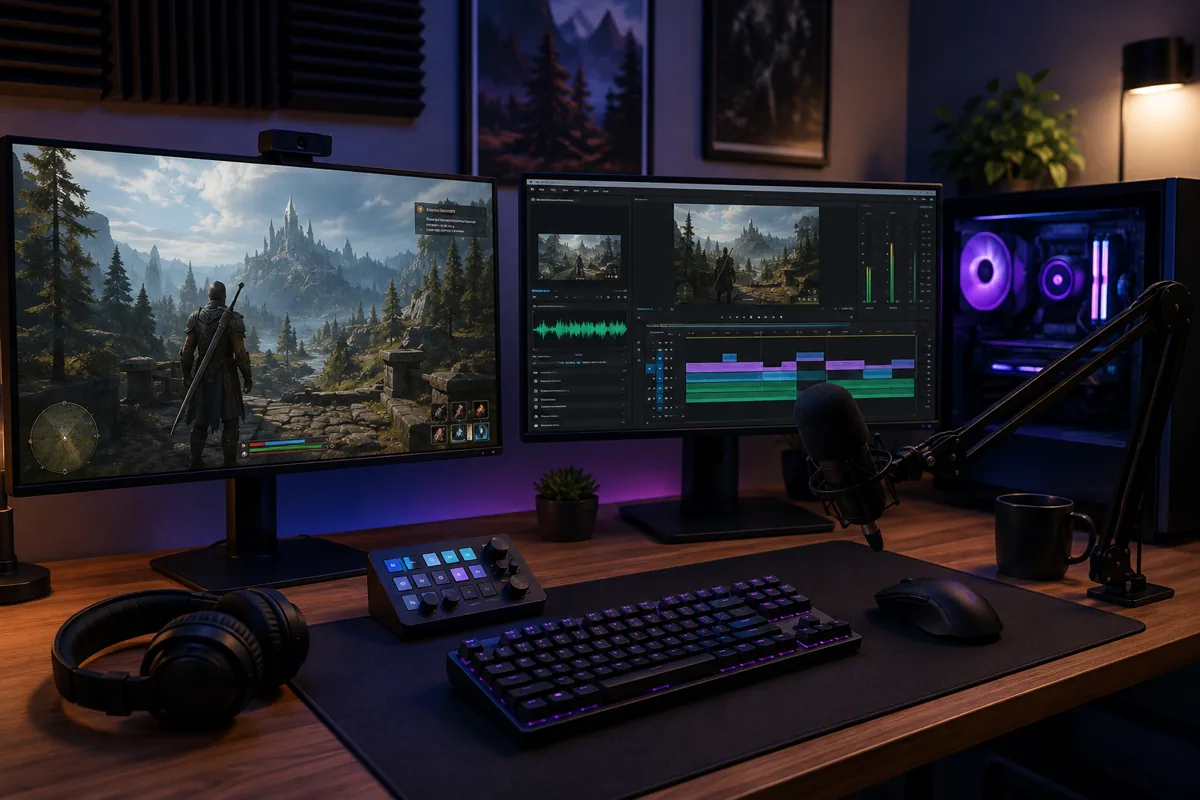
If your streaming rig already includes a second monitor for chat and alerts, consider whether a corner of that existing screen could serve a similar purpose to a dedicated phone or tablet, reducing the number of separate devices you need to manage. This works best for a smaller, less frequently used set of buttons rather than your full primary control layout, since a shared screen means splitting attention between your controls and whatever else that monitor is displaying. For streamers building out a broader second-screen setup, our guide to monitors for content creation covers considerations for dedicating screen space to tools like this alongside chat and alerts.
Step-by-step setup
- Choose Touch Portal or Bitfocus Companion based on which integrations and cost model fit your setup best.
- Install the companion app on your PC and the matching interface app on your phone or tablet.
- Connect both devices to the same Wi-Fi network.
- Confirm OBS’s websocket server is enabled and note its connection details.
- Enter those connection details into your chosen app to link it with OBS.
- Map a small set of frequently used actions to buttons first, testing each one individually before adding more.
- Mount or position your phone or tablet within easy reach of your streaming setup.
When a software alternative isn’t enough
If you rely heavily on being able to hit a button without looking, particularly during fast-paced competitive games, a physical device’s tactile feedback genuinely outperforms a touchscreen for that specific need, and no software solution fully replicates that without looking down at a screen.
If your streaming setup already has limited desk space and adding another mounted device isn’t practical, this may tip the balance back toward integrating fewer separate devices rather than adding a phone or tablet mount to an already crowded setup.
If you need extremely low-latency, guaranteed button response for a professional broadcast environment, a direct USB-connected physical device removes the network dependency entirely, which a Wi-Fi-based software solution can’t fully match under all conditions. For the vast majority of home streaming setups this level of guaranteed response isn’t strictly necessary, but it’s worth being honest with yourself about whether your specific production needs actually require it before dismissing a software alternative on theoretical grounds alone.
Troubleshooting software deck alternative issues
App can’t find or connect to the PC: confirm both devices are on the same Wi-Fi network, and check that your PC’s firewall isn’t blocking the companion app’s connection.
Buttons work but with a noticeable delay: check your Wi-Fi signal strength on both devices, since network congestion or a weak signal is the most common cause of delayed button response in either tool.
OBS actions aren’t available to map: confirm OBS’s websocket server is enabled and that you’ve entered the correct connection details in your chosen app, since a mismatch here is the most common setup mistake.
Layout resets or buttons disappear after an update: check for a backup or export of your button configuration, which both tools generally support, before rebuilding a layout from scratch after a significant update.
Phone or tablet screen turns off during a stream: adjust your device’s screen timeout settings, since a default short timeout is a common and easily overlooked cause of the interface appearing unresponsive mid-stream.
Companion or Touch Portal loses connection whenever the PC goes idle: check your PC’s sleep and power-saving settings, since a PC that suspends its network adapter during idle periods will drop the connection even if the PC itself doesn’t fully sleep; adjusting network adapter power settings specifically, separate from general PC sleep settings, often resolves this.
Frequently asked questions
Do software stream deck alternatives work as well as a physical device?
For most common streaming tasks, yes, functionally they can trigger the same actions. The main difference is tactile feedback: a physical device lets you feel for a button without looking, while a touchscreen app requires glancing at the screen, which matters more during fast-paced gameplay than during calmer segments.
Do I need a second device to use a software stream deck alternative?
You need a phone, tablet, or second screen to display the button interface, since running it on the same screen as your game isn’t practical. Most players use an old phone or a basic tablet dedicated to this purpose.
Does a software stream deck alternative need to be on the same network as my PC?
Yes, in most setups the controlling device and your PC communicate over your local network, so both need to be connected to the same Wi-Fi network for the connection to work reliably.
Can I control more than just OBS with these tools?
Yes, both Touch Portal and Bitfocus Companion support integrations beyond OBS, including other streaming and production software, system commands, and various third-party app integrations, though the specific list of supported integrations varies between the two tools.
Is there a cost to using these software alternatives?
Touch Portal offers a free tier with paid upgrades for additional features and plugins. Bitfocus Companion is free and open source. Both let you try the core functionality without a mandatory upfront purchase, unlike a physical hardware device. Elena Marchetti, our Streaming & Creator Editor, tested both on her dual-PC streaming rig and found either a reasonable starting point before deciding whether a dedicated physical device, covered in our stream deck alternatives guide, is worth the added cost for your setup.


