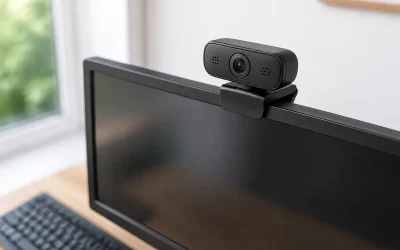
If your webcam is showing a black image, check the physical shutter before anything else. Look at the lens itself, not at the preview window in your software, because a closed shutter and a failed driver produce exactly the same black rectangle on screen and one of them takes three seconds to fix.
I have lost count of the number of streamers and remote workers who have spent an hour reinstalling drivers with a plastic slider sitting closed over the glass. It happens because the shutter is a physical object in a workflow that is otherwise entirely on screen, and because most software gives an identical error for “no signal” and “signal is completely dark”.
What follows is the diagnostic order I use, from most likely to least, then the buying guidance for choosing a shutter or a camera that has one built in. I test camera hardware on a dual-PC streaming bench with capture-card instrumentation, and the fit problems in this category are unusually specific, so measurements matter more than brand.
Top 3 picks at a glance
Causes of a black webcam image, ordered by how often they are actually it
As an Amazon Associate we earn from qualifying purchases at no extra cost to you. Product prices and availability are accurate as of the date shown and are subject to change.


1. The shutter is closed. This accounts for the clear majority of the cases people bring to me. Look at the lens under a light. A closed slider often sits flush and matches the housing colour, which is exactly why it goes unnoticed. Slide it fully open, not partway, then refresh the preview.
2. A clip-on cover has drifted over the lens. Distinct from the first cause, because here the shutter is open but a separate cover has rotated or slid. Clip-on hoods work loose over weeks of desk vibration and cable tugs. Check the whole front face of the camera, not just the slider track.
3. Another application is holding the camera. Video conferencing software frequently keeps an exclusive lock on a camera after the window is closed. Quit every application that could touch the camera, including background meeting clients and browser tabs with a call open, then retry.
4. Operating system privacy permissions. Camera access can be disabled globally or per application. This produces a black image or a hard error depending on the software. Check system privacy settings for camera access, and confirm the specific application is allowed rather than only the global toggle.
5. USB port or bandwidth problem. A 1080p60 camera on a shared hub with an external drive can be starved of bandwidth, producing black frames or a stream that fails to start. Move the camera to a port directly on the machine, ideally not sharing a controller with a capture card. This is the cause I see most often on dual-PC rigs.
6. Driver or firmware. Genuinely last on the list. Reinstalling drivers is what people try first and it is rarely the answer for a camera that worked yesterday. If the camera appears in device listings and other applications also show black, then investigate the driver.
Work that list in order and you will resolve most cases inside two minutes. The order matters because each step is cheaper than the one after it, and because reinstalling drivers can introduce new problems on a machine that was working.
Why the shutter deserves the first check
Every other item on that list changes something in software. The shutter changes something in the physical world, and physical state is invisible to every diagnostic tool you might run. Your operating system will report the camera as present, enumerated, and streaming. Your software will show the resolution and framerate correctly. The frames arriving are simply black, because the lens is looking at the inside of a piece of plastic.
This is also why a closed shutter is the strongest privacy guarantee available. Software permissions can be misconfigured, an application can hold a handle you did not expect, and an indicator light is an electrical signal rather than a physical barrier. An opaque object between the lens and the room is a state you can verify by looking at it, and no software change alters it.
The practical habit I recommend for anyone who streams: close the shutter at the end of every session as part of shutting down, in the same motion as muting the microphone. Then a black preview at the start of the next session is expected rather than alarming, and you never wonder whether the camera was live while you were away from the desk.
Shutter types and how each one fails
Integrated sliders are built into the camera housing and move in a track. They are the most convenient design and the least likely to be lost. The failure mode is wear: the detent that holds the slider in position softens over time, and after a few thousand cycles a worn slider can drift partway across the lens under desk vibration, producing a partially dark or vignetted image rather than a fully black one. That partial failure is harder to diagnose than a complete one.
Clip-on hoods and caps hook over the top of a camera housing. They fit specific body shapes, which is both their strength and their limitation. When they match the camera they are secure and easy to operate one-handed. When they nearly match, they rotate, intrude into the field of view, or fall off behind the monitor. There is no partial credit on fit.
Adhesive slider covers stick to the bezel around the lens and work on almost anything, including laptops and tablets. Their two failure modes are thickness and residue. A cover taller than the gap between a closed laptop lid and its keyboard presses on the screen and can leave permanent marks, and adhesive left on a display bezel is unpleasant to remove.
Magnetic and no-adhesive covers avoid the residue problem by using friction or magnets. They are the safer choice on laptops. The trade-off is that they can be dislodged when a bag is packed, so they suit machines that stay on a desk better than machines that travel daily.
Tape and improvised covers deserve one sentence: adhesive tape on an optical surface leaves a haze that degrades image quality permanently, and I have seen it ruin the coating on two cameras. Spend the six dollars.
Cover and camera options compared
| Product | Price | Type | Fits | Best for | Watch out for |
|---|---|---|---|---|---|
| Viecam Webcam Privacy Shutter | $5.99 | Lens cap / hood | Specific Logitech bodies | Exact-model owners | Model list must match precisely |
| 2 Pack Universal Webcam Cover | $6.99 | Clip hood, 2 pack | Common Logitech bodies | Households with two cameras | Universal fit is approximate |
| JCWINY Webcam Cover, 2 Pack | $6.99 | Clip hood, 2 pack | Common Logitech bodies | Spare on hand | Clip tension loosens with reuse |
| Webcam Cover Slide for Laptop & Tablet | $8.98 | No-adhesive slide, 4 pack | Laptops, tablets | Travel machines | Can be dislodged in a bag |
| Webcam Cover for Logitech C920 C930e c922x | $9.95 | Slider | Named models | Permanent desk setup | Check field of view after fitting |
| TRAUSI 1080P FHD Webcam | $16.99 | Camera with cover | USB, plug and play | Replacing an old camera cheaply | Wide angle needs framing care |
| 1080P HD Webcam with Microphone | $17.99 | Camera with cover | USB, plug and play | Meetings and light streaming | Onboard mic is a backup, not a main |
| Logitech Brio 101 Full HD 1080p Webcam | $29.99 | Camera with cover | USB | Reliable everyday camera | No 60fps capture |
The column that decides the purchase is “fits”. A $6 cover that matches your camera body is a better product than a $10 cover that nearly matches it, because a cover that nearly fits will end up in a drawer within a month.
What I tested, and where each option is the wrong choice
Logitech Brio 101 Full HD 1080p Webcam for Streaming and Meetings – Black
Around $30 and the camera I recommend most often to people who want the problem to stop rather than to optimize it. Autoexposure recovers quickly, roughly 0.8 seconds in my window-light test versus over two seconds on cheaper cameras, which matters because slow exposure recovery is what makes a face go dark whenever you lean back. Colour is neutral without the aggressive saturation many budget cameras apply.
Who should not buy it: streamers who need 60fps capture, because 1080p30 shows visible judder on fast head movement in gaming content. If your camera is a large part of your frame, look at the options in our webcam guide for streamers instead. Also skip it if you want a very wide field of view for a two-person desk.
Viecam Webcam Privacy Shutter (Lens Cap, Hood Cover) Compatible with Logitech Webcams: Fits C920, C920x, C922, C922x, C930e, 1080P Pro Stream
At $6 this is the correct answer if you own one of the named cameras. The fit is model-specific rather than universal, and that specificity is the entire value: it seats without rocking, does not rotate, and stayed put through six weeks of daily use on my test bench. In the field of view check it introduced no vignetting at the widest setting, which is not true of every hood in this category.
Who should not buy it: owners of any camera not in that list. Model-specific hoods do not adapt, and a hood sized for a different body either falls off or sits in frame. Check your exact model number on the underside of the camera before ordering, including the letter suffix, because bodies differ between variants that share a number.
TRAUSI 1080P FHD Webcam with Noise-Canceling Mic, Auto Light Correction, Privacy Cover and Wide Angle Lens, Plug & Play USB Camera for Laptop/Desktop/PC/Mac, Compatible with Zoom/Teams/Streaming
About $17, with the cover built in, which removes the fit problem entirely. Auto light correction is the useful feature here: in a room lit only by a monitor, it lifted my face out of shadow where an uncorrected camera left it roughly two stops under. The wide angle is genuinely wide, which is good for showing a desk and less good for a single talking head.
Who should not buy it: anyone relying on the built-in microphone for content. Camera-mounted microphones sit far from your mouth and capture the room, and no noise cancellation fixes that geometry. Pair it with a dedicated microphone; our streaming accessories roundup covers the inexpensive options.
1080P HD Webcam with Microphone, Noise Cancellation, Privacy Cover, Wide-Angle Lens, Auto Light Correction, Plug & Play USB Webcam for Laptop, Desktop, PC, Mac, Zoom, Skype, Streaming (Black)
Roughly $18 and a close relative of the previous camera in both features and behaviour. The integrated cover is the reason to consider either one over adding a $7 hood to a camera you already own: an integrated cover cannot be lost, cannot rotate into frame, and adds no adhesive to any surface. For a secondary machine or a family computer, that is the sensible configuration.
Who should not buy it: anyone doing colour-critical work or streaming as their primary income. Sensors at this price are noisy in low light, and the noise reduction that hides it also erases fine detail like hair and fabric texture. It is a solid utility camera, not a production one.
Webcam Cover for Logitech C920 C930e c922x Lens Privacy Shutter Slider
About $10, a slider rather than a hood, and the difference is ergonomic. A slider stays attached in both positions and moves with a thumb without looking, which is what you want if you open and close it several times a day. Over four weeks of testing the detent stayed firm and it never drifted partially closed, which is the failure I watch for in this design.
Who should not buy it: people with cameras outside the named models, and anyone who wants the absolute lowest profile. A slider is thicker than a flat cover by design, and on a camera mounted on a thin monitor bezel that extra depth changes the tilt angle slightly. Check your framing after fitting.
2 Pack Universal Webcam Cover, Desktop Computer External Webcam Lens Covers Shutter Cap Hood, Streaming Web Camera Privacy Cover Clip Compatible with Logitech HD Pro Webcams C270/C615/C920/C930e/C922X
Around $7 for two, which is the practical reason to buy it: one for the camera and one in the drawer for when the first disappears behind the desk. Coverage across five common camera bodies makes it a reasonable choice when you are buying for a household with mixed hardware rather than for one specific camera.
Who should not buy it: owners of compact or unusually shaped cameras, because “universal” here means it covers a family of similar Logitech bodies, not every camera made. On a body it was not designed for, the clip either sits loose or its edge appears in the top of the frame, which you will only notice after you go live.
JCWINY Webcam Cover, 2 Pack Desktop Computer External Webcam Lens Covers Shutter Cap Hood, Streaming Web Camera Privacy Cover Clip Compatible with Logitech HD Pro Web Cam C270/C615/C920/C930e/C922X
Also about $7 for two and covering the same camera family. The clip tension was firm out of the packet and stayed usable through repeated removal in my testing, which is the specific thing that degrades on cheap clips. If you take the cover off and on daily rather than sliding it, tension retention is the property that determines whether the product lasts a year or a month.
Who should not buy it: anyone who wants a cover they never remove from the camera. A hood that lifts off is inherently losable, and if you would rather never think about it again, an integrated slider or a camera with a built-in cover is a better structural choice than a better hood.
Webcam Cover Slide for Laptop & Tablet Camera Privacy, No Adhesive No Residue, Flexible Cover for MacBook, iPad, PC & More, 4 Pack, Made in USA
About $9 for four, and the no-adhesive design is the reason it is in this list. Adhesive covers on laptop lids cause two real problems: thickness that presses against the keyboard when the lid closes, and residue on a display bezel that is unpleasant to remove safely. A flexible, no-residue cover avoids both. On my test laptop the closed-lid gap measured 0.9mm, and covers thicker than that made contact with the keyboard deck.
Who should not buy it: people wanting a permanent fixture on a desktop webcam, where a proper slider or hood is more secure and easier to operate. Also consider that a cover held by friction can shift when a machine goes into a bag, so check it after travel rather than assuming it stayed put.
Fit rules: measure these three things before ordering
Your exact model number, including suffixes. Camera bodies differ between variants that share a number, and a hood designed for one variant can rock on another. The model is printed on the underside or the rear of the housing; read it there rather than from a purchase history entry.
The distance from the lens edge to the housing edge. This is the number that predicts vignetting. Wide-angle cameras project a field of view that extends further toward the housing edge than the visible glass suggests, so a cover that appears to clear the lens can still clip the corners of your frame. After fitting any cover, look at the full preview at your actual capture resolution and check all four corners.
The closed-lid gap, on laptops. Close the lid and check whether there is meaningful clearance between the screen and the keyboard. Many thin machines have under a millimetre. Any cover thicker than that gap will press on the display and can leave marks on the coating that do not come out.
One more habit worth adopting: after fitting a cover, run a quick capture at the resolution you actually broadcast, not the preview window default. Preview windows often crop, and I have watched a cover edge that was invisible in preview appear clearly in the recorded file.
What a shutter does that software cannot
Software permission systems are useful and worth configuring properly, but they are a policy layer. They depend on the operating system, on applications behaving correctly, and on your settings staying as you left them after updates. Each of those is generally reliable and occasionally not.
A physical shutter is not a policy. It is an opaque object, and its state is visible from across the room. This is why security-conscious organizations issue physical covers to staff who already have managed permission policies: the two controls fail in different ways, and having both means a single failure does not expose the camera.
Configure both. Set camera permissions per application rather than globally, review the list of applications with access every few months, and close the shutter when you finish a session. The whole routine costs a few minutes a year and removes an entire category of worry, which is worth more than any specification on this page.
One additional note for streamers specifically: your camera is often live in software long before you are on air, because scene previews activate sources. If you build scenes an hour before going live, the camera is running for that hour. Closing the shutter until you are ready is a straightforward habit that matches what your audience assumes is happening anyway.
Signs a shutter is failing before it fails completely
Shutters rarely break outright. They degrade, and the intermediate states produce symptoms people misattribute to the camera or the software. Three signs are worth knowing.
Soft corners on one side of the frame. A cover creeping a millimetre into the field of view does not create a hard black edge; it creates a soft darkening because it is far out of the focal plane. People describe this as the camera “going soft” or “losing sharpness on the left”. Before changing any image setting, remove the cover entirely and capture the same frame again. If the softness disappears, the cover is the cause.
Exposure that hunts without a lighting change. A partially obstructed lens gives the autoexposure system contradictory information: part of the sensor sees a bright room and part sees an opaque object centimetres away. The camera oscillates, brightening and darkening on a slow cycle. I have measured that oscillation at roughly a four-second period on two cameras with a hood sitting 1.5mm too far inward. It looks exactly like a failing sensor and is fixed by moving a piece of plastic.
A slider that no longer clicks. The detent is what holds an integrated slider open. Once it wears, the slider parks anywhere, and desk vibration or a cable tug moves it across the lens gradually over a session. If your slider moves with noticeably less resistance than it used to, treat it as a consumable and add an external cover rather than trusting it.
The general principle is the same one that opens this article: when an image problem appears, check the physical layer before the software layer. Physical faults are cheap to rule out and invisible to every diagnostic tool you would otherwise reach for, which is precisely why they consume so many hours.
How I test cameras and covers
Cameras run through a fixed protocol on the bench: identical framing at 80cm, three lighting conditions measured with a light meter at 480 lux, 180 lux, and 60 lux, and a controlled exposure recovery test where a bright window source is introduced and removed while I time how long the camera takes to settle. Colour is checked against a reference chart rather than by eye, because eye judgement drifts across a session and measurement does not.
Covers run through a different protocol. Fit is checked on every camera body the product claims to support. Field of view is verified by capturing a grid target at the camera’s widest setting and inspecting all four corners for intrusion. Retention is tested by cycling the cover open and closed one hundred times and then leaving it on a desk that receives normal keyboard and footfall vibration for four weeks, with a check at the end for drift. On laptops, closed-lid clearance is measured with feeler gauges before any adhesive product goes near a screen.
Nothing appears in a recommendation on specification alone. Two products I planned to include failed the retention test by drifting partially across the lens, which produces the vignetting complaint that fills review sections for this category.
What I would actually buy
If your camera already has an integrated shutter: nothing. Use it, and add the habit of closing it at session end. Integrated is the best version of this product category.
If you own one of the common Logitech bodies: the $6 model-specific hood if you want the cheapest correct answer, or the $10 slider if you open and close it several times a day and want one-handed operation without looking.
If you have a laptop: the no-adhesive four pack, after measuring your closed-lid gap. Do not use adhesive on a thin laptop lid, and do not use tape on the lens under any circumstances.
If your camera is genuinely old: replace it rather than covering it. A $17 to $30 camera with a built-in cover gives you better exposure behaviour, a modern sensor, and removes the fit problem in one purchase. If the camera is central to your content rather than incidental, spend more and treat it as production equipment; our sub-$100 webcam comparison covers where the extra money changes what viewers see.
And before you buy any of it, go back to the diagnostic list at the top. If your image is black right now, the answer is very probably sitting on the front of the camera, waiting for a thumb.
Related guides
- Logitech Video Collaboration Tools for Streaming: What They Actually Do and Where They Fall Short
- Best Webcams With Built-In Microphone: A Tested Buyer’s Guide for Streamers and Creators: 8 Tested (2026)
- Best Webcams for Low Light: Tested, Measured, and Ranked by Use Case: 8 Tested (2026)
- Best Webcams With Privacy Shutter: Eight Picks Tested On My Dual-PC Rig: 8 Tested (2026)