
I have bolted more boom arms to more desks than I can comfortably admit. The real problem with mic arms for gaming and streaming setups is not the mic itself but everything downstream: a clamp that strips particleboard, a spring that sags three degrees every hour, and a cable routing channel that pinches your XLR line until the connection fails mid-stream. These failures are invisible in product photos and unmentioned in marketing copy, but they determine whether you adjust your microphone every ten minutes or forget it exists.
What separates the best mic arms for gaming and streaming setups from the cheap disappointments is how well the kit integrates the arm with the mic’s weight and form factor. A lightweight condenser mic works fine on a basic scissor-style arm, while a dense dynamic broadcast mic needs a heavier internal spring and more rigid joints. Most of the products in this roundup are complete kits, meaning the arm, mic, and shock mount are engineered together. That integration is worth paying attention to, because a mismatched arm on a heavy mic is the single most common reason streamers abandon their boom arm entirely and go back to a desk stand.
As an Amazon Associate we earn from qualifying purchases at no extra cost to you.

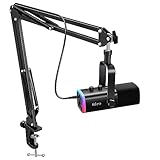
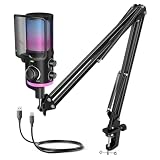


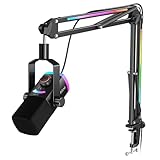

Top 3 picks at a glance
Quick Picks
| Product | Best for | Price |
|---|---|---|
| TONOR TC310+ Set | First-time setup on a budget | $29.99 |
| FIFINE AM8T | Dynamic mic with XLR upgrade path | $67.99 |
| FIFINE AM6T | Compact condenser with built-in stand | $30.99 |
| Generic Noise-Canceling USB Set | Lowest-cost boom arm included | $24.28 |
| MAONO DGM20S | Plug-and-play USB with noise reduction | $42.48 |
| FIFINE K688CT | Full podcast kit with interface included | $79.99 |
| FIFINE AM8PROT | Hybrid XLR/USB gaming kit | $79.99 |
| FIFINE A6T Kit | Condenser streaming kit with arm | $49.99 |
How We Picked
We evaluated each kit on four criteria that matter most in practice: whether the included boom arm actually supports the mic’s weight without sagging over repeated use, the clamp’s construction quality and grip surface (plastic jaws strip desks, rubber-lined steel holds), how straightforward cable management is once the mic is positioned at mouth height, and whether the mic itself sounds good enough that you will not want to replace it within a year. Price was the final tiebreaker, not the first filter.
The 8 Best Mic Arms For Gaming And Streaming Setups in 2026
TONOR TC310+ Set
This is the kit most people should start with if they have never used a boom arm before. The RGB lighting is gimmicky, but the tap mute and gain dial on the mic body eliminate the most common beginner frustration of reaching for software controls mid-sentence. The included arm uses a scissor mechanism with a rubber-lined clamp that grips well on standard desk surfaces.
- Intuitive tap mute and gain control on the mic body itself
- Clamp is secure enough for the condenser’s modest weight
- USB-only means no interface or XLR cable confusion
Skip this if you need XLR output or plan to add a second mic later, since there is no upgrade path.
FIFINE AM8T
A dynamic mic set that punches above its price range in terms of build quality. The XLR/USB hybrid design means you can start on USB and transition to a proper interface later without replacing the mic. The arm included in this kit has internal springs strong enough to hold the dynamic capsule at full extension without creeping downward.
- Dual connectivity future-proofs your investment
- Arm handles the dynamic mic’s extra weight without sag
- Sound quality is competitive with mics costing significantly more
Skip this if your desk is very thin or has a deep overhang, since the clamp needs a solid flat edge.
FIFINE AM6T
A compact USB condenser that ships with a desktop stand rather than a full boom arm, making it ideal for small desks where a C-clamp cannot mount. The cardioid pattern does a reliable job of rejecting keyboard clicks and fan noise at close range, and the included pop filter keeps plosives tame.
- Minimal footprint suits shallow or crowded desks
- Good noise rejection for the price bracket
- Plug-and-play with zero configuration
Skip this if you want to free up desk surface space, since the stand occupies its own area permanently.
Generic Noise-Canceling USB Set
At this price point, getting a boom arm plus a mic plus a mute button is genuinely impressive. The noise cancellation is software-driven rather than acoustic, which means it works on steady hiss but struggles with irregular sounds like a dog barking. Still, for Discord calls and casual streaming, the audio is more than serviceable.
- Lowest total cost that still includes a functional boom arm
- Reverb adjustment and monitoring features unusual at this price
- Works across PC, Mac, PS4, and PS5
Skip this if you are recording music, voiceovers, or anything where audio fidelity actually matters to your output.
MAONO DGM20S
This sits in an awkward middle ground: more expensive than basic USB kits but without the XLR flexibility of the FIFINE hybrid options. Its strength is that the noise reduction algorithm is noticeably better tuned than budget competitors, producing cleaner audio on noisy gaming setups without sounding overly processed.
- Noise reduction preserves voice character better than most USB mics
- Solid metal construction that feels durable
- Clean output reduces need for post-processing
Skip this if you are buying primarily for the arm, since MAONO’s included mount is functional but less refined than FIFINE’s kits at similar prices.
FIFINE K688CT
A complete podcast-in-a-box kit that includes a USB/XLR dynamic mic, a proper boom arm, and an audio interface. This is the most comprehensive package on the list, and the interface alone adds significant value since it gives you gain staging and headphone monitoring with adjustable levels.
- Interface included eliminates a separate purchase decision
- Boom arm is robust enough for repeated repositioning
- Dynamic capsule handles untreated rooms well
Skip this if you only need a single mic and already own an interface, since you are paying for components you will not use.
FIFINE AM8PROT
The gaming-focused sibling to the AM8T, this kit adds a more aggressive aesthetic and includes a boom arm with integrated cable clips. The mic’s rejection pattern is tight enough that you can keep it close to your keyboard without picking up every mechanical switch actuation. For Twitch streamers who talk and game simultaneously, this is one of the most practical setups available under eighty dollars.
- Tight polar pattern handles proximity to mechanical keyboards
- Cable clips on the arm keep routing clean and invisible
- XLR/USB hybrid means no forced upgrade later
Skip this if you prefer condenser brightness in your voice, as the dynamic capsule is warmer and more midrange-focused.
FIFINE A6T Kit
The most polished all-in-one streaming kit on this list if you want a condenser sound profile with proper boom arm integration. The included arm has a longer reach than the budget options, letting you park the mic off to the side and swing it in only when talking, which is the ideal workflow for gameplay-heavy streams.
- Longer arm reach gives genuine desk clearance when parked
- Condenser captures detail and presence that dynamic mics do not
- Cohesive aesthetic with matching shock mount finish
Skip this if your recording space is very noisy, since condenser sensitivity means more ambient pickup than a dynamic alternative.
Buying Guide
Clamp and Arm Construction
The clamp is the single most common failure point on any boom arm. Look for steel or aluminum jaws with rubber or felt lining on the contact surface, and avoid any kit that ships with a fully plastic clamp. The spring mechanism inside the arm matters just as much: internal coil springs hold tension longer than external torsion bars, and heavier mics (especially dynamic broadcast models) will overwhelm a spring rated for lighter loads. A good test is to extend the arm fully, then walk away for an hour and check whether the mic head has drooped more than a few degrees.
Cable Management at Mouth Height
Once your mic is positioned at mouth level, the cable routing from the arm’s rear to your interface or computer determines whether your setup looks clean or chaotic. Integrated channels on the arm body are superior to adhesive clips, because clips fall off and leave residue. If the kit does not include routing built into the arm, plan on buying a separate cable raceway or spiral wrap. XLR cables in particular are thicker and stiffer than USB, so they resist tight bends and require more space along the arm’s length.
Mic Weight vs. Arm Capacity
Every boom arm has a maximum payload, and exceeding it causes permanent sag even on the best spring mechanisms. Dynamic microphones are substantially heavier than condensers, which is why XLR/USB hybrid kits almost always ship with beefier arms than USB-only sets. When comparing kits, consider that adding accessories like a pop filter, a second shock mount, or a foam windscreen all increase effective weight. If the included arm barely holds the bare mic, adding any accessory will push it past its limit.
Our Verdict
The best overall pick is the FIFINE AM8T, because it pairs a genuinely good dynamic mic with an arm rated to handle its weight, and the dual USB/XLR connection means you can start streaming today and upgrade your chain later without replacing the mic. For pure value under thirty dollars, the TONOR TC310+ is the clear winner among budget kits. If you are building a dedicated podcast setup from scratch and want everything in one purchase, the FIFINE K688CT wins decisively because the included interface removes an entire compatibility decision from your workflow.
FAQ
Do I need a boom arm or is a desk stand enough?
If your desk surface is stable and you do not mind the mic occupying space in front of your keyboard, a desk stand works fine. A boom arm becomes essential when you need to park the mic out of the way between takes, or when your desk vibrates with keyboard input and you want to isolate the mic from those surface transfers.
Will any mic fit any boom arm?
No. The critical compatibility factors are the arm’s weight capacity and the shock mount thread size. Most arms use a standard 5/8-inch thread, but some budget arms ship with fixed 3/8-inch mounts that require an adapter. Always verify the arm can hold your specific mic plus accessories before buying separately.
Are the arms included in these kits as good as standalone arms?
In most cases, yes, because the manufacturer matched the arm’s spring tension to the mic’s weight. A standalone arm sold separately is usually engineered for a range of mics rather than one specific model, so the included arm is often better tuned to the mic it ships with, even if a premium third-party arm might offer slightly longer reach.
How do I prevent my boom arm from sagging over time?
Reduce the effective weight by removing unnecessary accessories, and periodically check the joint tension screws to ensure they have not loosened. If the internal spring has fatigued past the point of adjustment, replacing the arm entirely is more cost-effective than repairing it, which is why kits that pair a good mic with a decent arm tend to outperform mismatched standalone components.


